
By admin
Posted in ceremonial matcha, japanese matcha | Tags : ceremonial grade matcha, gozen matcha, matcha benefits, tencha
Most people meet matcha as a bowl of vivid green powder, whisked into a frothy drink or folded into a latte. Far fewer ever encounter the tea leaf that made that powder possible. Before matcha is a powder, it is a leaf — and that leaf has a name: tencha.
Tencha is a shade-grown Japanese green tea that is steamed and dried without rolling, then de-stemmed and de-veined, so it can later be stone-ground into matcha. It is not a type of matcha itself and it is rarely brewed on its own. It exists, almost entirely, to be milled into the fine powder that ends up in your bowl. Understanding tencha is the fastest way to understand what separates carefully made Japanese matcha from a green powder that simply looks similar.
This article walks through what tencha is, how it is cultivated and processed, how it becomes matcha, and how it compares to other well-known Japanese green teas like sencha — so that the next time you’re evaluating a bag of matcha, you know exactly what to look for.
What Is Tencha?
Tencha (碾茶, literally “tea for grinding”) is a Japanese green tea made from the same plant as every other green tea, Camellia sinensis, but grown and processed specifically so it can be ground into matcha rather than brewed as loose leaf. Its Japanese name describes its purpose directly: this is tea destined for the mill.
Quick definition: Tencha is shade-grown Japanese green tea leaf that has been steamed to stop oxidation, dried flat without rolling, and had its stems and veins removed. The remaining soft leaf blade is what gets stone-ground into matcha.
Visually, tencha looks nothing like the tightly rolled, needle-shaped leaves most people associate with Japanese green tea. Because it is never rolled, tencha stays flat and paper-thin, closer to large, brittle flakes than to a conventional loose-leaf tea. That difference in shape isn’t cosmetic — it’s the direct result of a processing decision made specifically because the leaf’s next stop is a grinding stone, not a teapot.
How Is Tencha Grown?
Tencha starts in the tea garden the same way as any other Japanese green tea: healthy Camellia sinensis bushes, careful pruning, and attentive seasonal care. What sets tencha cultivation apart happens in the weeks immediately before harvest, when growers deliberately reduce the amount of sunlight reaching the plant.
For roughly two to three weeks before picking, tencha fields are covered using overhead frames fitted with reed screens, straw mats, or woven synthetic shade cloth. This shading is applied gradually and increased in stages, often moving from partial coverage toward near-total shade as harvest approaches. The technique is closely associated with Uji, in Kyoto Prefecture, where shaded cultivation for fine Japanese tea is believed to have been developed and refined over centuries, and it is now practiced by growers across Japan’s major tea-producing regions, including Kagoshima, Kyoto, and Shizuoka.
Harvest timing is precise. Growers watch the young leaves closely during the shading period, picking once the leaves have developed the tenderness, color, and chemical profile associated with high-quality tencha — typically during the first flush of the growing season, when new growth is at its most delicate.
Why Are Tea Plants Shaded Before Harvest?
Shading isn’t a stylistic choice; it changes the biochemistry of the leaf in ways that are well documented in tea-agronomy research. When light is restricted, the plant increases chlorophyll production in an effort to capture more of the limited available light, which deepens the leaf’s green color — a trait that carries through directly into the vivid color of finished matcha.
Shading also affects the plant’s amino acid content, most notably L-theanine, a naturally occurring amino acid concentrated in tea. Because reduced light slows certain metabolic pathways, L-theanine that would otherwise convert into bitter-tasting catechins and polyphenols tends to accumulate instead. Research on shaded tea cultivation has found that shading measurably increases theanine and chlorophyll levels while reducing polyphenol content such as catechins, which is part of why well-shaded leaf develops a smoother, more savory character rather than a sharp, astringent one. This shift toward higher amino acids and lower catechins is generally understood as the biochemical basis for matcha’s characteristic umami-forward flavor and reduced bitterness compared with sun-grown teas.
It’s worth being precise here: shading influences flavor and appearance, not medicinal properties. It changes how a tea tastes and looks — not what conditions it treats or prevents.
From Fresh Tea Leaves to Tencha
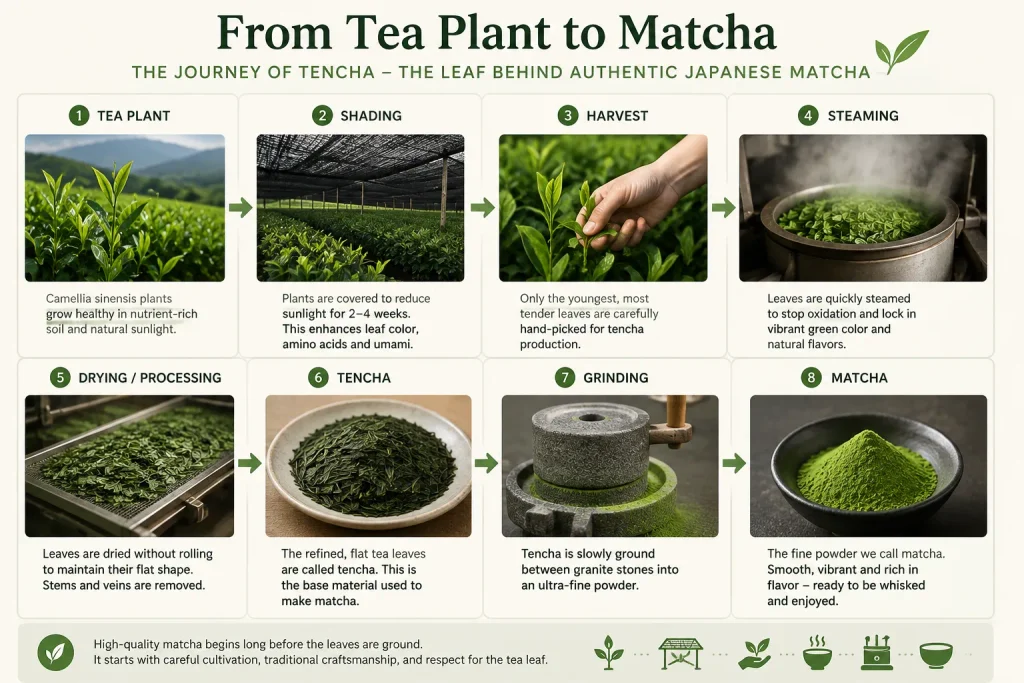
Turning a shaded tea leaf into finished tencha follows a specific sequence, and each step exists for a reason tied to the leaf’s eventual use as matcha.
- Growing — Tea bushes are cultivated using standard agricultural practices suited to the region and cultivar.
- Shading — Overhead covers are installed two to three weeks before harvest, progressively reducing light exposure.
- Harvesting — Young, tender leaves are picked, often by hand for the highest grades, once shading has done its work.
- Steaming — Leaves are steamed immediately after picking to halt oxidation and lock in color and freshness.
- Drying without rolling — Unlike most Japanese green teas, tencha is dried flat in a specialized dryer rather than rolled into needles. This preserves the leaf’s open, intact shape.
- Removing stems and veins — The dried leaf, at this stage called aracha (crude tea), is sorted so that tougher stems and veins are separated from the soft leaf blade, since fibrous material grinds poorly and adds bitterness.
- Formation of finished tencha — What remains after sorting and cutting is the refined leaf material properly called tencha.
- Storage and preparation for grinding — Tencha is often stored briefly to let flavors settle before it is sent for stone-grinding into matcha.
This no-rolling step is what most clearly separates tencha’s processing from teas like sencha. Rolling shapes a leaf into the familiar tight needle you’d steep in a teapot, but it also compresses and tangles the leaf’s internal structure. Because tencha needs to be cleanly de-stemmed and eventually ground into an ultra-fine powder, rolling would work against both goals — it’s easier to strip stems from a flat, intact leaf, and a leaf that hasn’t been mechanically compressed grinds more evenly.
How Does Tencha Become Matcha?
Once tencha has been dried, sorted, and rested, it is ground into the fine powder we recognize as matcha. Traditionally, this grinding is done with granite stone mills that rotate slowly, producing only a small amount of matcha per hour.
The slow speed matters. Grinding generates friction, and friction generates heat. Because tencha is delicate and its flavor compounds are sensitive to temperature, excessive heat during grinding can dull the color, flatten the aroma, and change the taste of the finished matcha. Traditional stone milling is deliberately unhurried specifically to keep the leaf cool throughout the process, which is part of why ceremonial-grade matcha has historically been produced in comparatively small batches.
It’s worth noting that stone grinding on its own doesn’t guarantee a high-quality result. The quality of the finished matcha depends on the whole chain that came before it — how the plant was shaded, how carefully it was harvested, how thoroughly stems and veins were removed, and how the tencha was stored before milling. Stone grinding is one meaningful part of a larger process, not a shortcut that fixes a mediocre leaf.
Tencha vs Matcha: What’s the Difference?
The relationship between tencha and matcha often causes confusion because the words are sometimes used loosely. In traditional Japanese tea production, they refer to two different stages of the same material.
| Feature | Tencha | Matcha |
|---|---|---|
| Form | Processed leaf material | Fine powder |
| Production stage | Before grinding | After grinding |
| Appearance | Flat, brittle leaf flakes | Fine green powder |
| Typical use | Raw material for matcha production | Prepared as a whisked tea or used in food and drinks |
| Processing | Shaded, steamed, and dried without rolling | Tencha subsequently stone-ground into powder |
Put simply: tencha is the processed tea leaf; matcha is the powdered tea produced by grinding it. You cannot have matcha, in the traditional sense, without tencha coming first — matcha is what tencha becomes, not a separate ingredient.
Tencha vs Sencha: What’s the Difference?
Sencha is Japan’s most widely consumed green tea, and comparing it with tencha highlights how much cultivation and processing shape a finished tea.
Cultivation: Sencha is typically grown in full or near-full sunlight, while tencha is shaded for two to three weeks before harvest — the same shading approach used for gyokuro, another premium shaded tea.
Processing and rolling: After steaming, sencha leaves are rolled repeatedly into their signature tight, needle-like shape. Tencha skips rolling entirely and is dried flat instead, which allows its stems and veins to be cleanly removed — a step that isn’t practical once a leaf has been rolled.
Leaf appearance: Sencha looks like slender, dark green needles. Tencha looks like flat, matte, somewhat brittle flake fragments, since it has neither been rolled nor left with its coarser stem material.
Preparation and flavor: Sencha is steeped as loose-leaf tea and produces a brisk, grassy, sometimes slightly astringent cup. Tencha is almost never brewed loose in everyday practice — its destiny is the grinding stone — and when it is brewed, it tends to be lighter and more delicate than a typical steeped green tea, with the smoother, umami-leaning character that shading encourages.
Typical use: Sencha is consumed directly as a beverage. Tencha exists primarily as an intermediate material, ground into matcha rather than drunk on its own.
It’s worth noting that Japanese green tea production varies by region, cultivar, and producer, so these are general distinctions rather than absolute rules that apply identically to every farm.
Does All Matcha Come From Tencha?
In traditional Japanese production, yes — matcha is defined as the fine powder produced by stone-grinding tencha, and organizations such as the Japan Tea Central Public Interest Incorporated Association set standards along these lines under Japan’s Green Tea Labeling Standards. However, as global demand for matcha has grown, the word “matcha” is sometimes used more loosely outside Japan to describe green tea powders made through faster or different processes, which may not follow the same shading, steaming, and stone-grinding sequence.
This doesn’t mean every product labeled matcha outside this traditional process is fraudulent or low quality — production practices genuinely vary, and price, color, or packaging alone don’t tell the whole story. What it does mean is that consumers benefit from asking a few grounded questions rather than assuming all green powders are equivalent:
- Where was the tea grown, and is the region known for tencha or matcha production?
- Was the plant shaded before harvest, and for how long?
- How was it processed — steamed and dried flat, or handled differently?
- How fresh is it, and how has it been stored since grinding?
- Is the producer transparent about origin and processing?
These questions are more useful than judging a matcha purely by its shade of green or its price point.
Why Tencha Matters When Buying Japanese Matcha
Understanding tencha changes how you evaluate a bag or tin of matcha before you ever open it. A matcha made from well-shaded, carefully processed tencha tends to show it in specific, checkable ways: a vivid, almost jade-like green rather than a dull or yellowish tone; a fresh, faintly vegetal or marine aroma rather than a flat or hay-like smell; a smooth, rounded flavor rather than sharp bitterness; and a fine, silky texture when whisked, rather than a gritty or clumpy one.
None of these traits happen by accident. They trace directly back to decisions made at the tencha stage — how long the plant was shaded, how quickly the leaves were steamed after picking, how thoroughly stems and veins were removed, and how the finished tencha was stored before grinding. Knowing this gives you a genuine framework for comparing products, rather than relying on marketing language alone.
At Gozen Samurai, this same chain — cultivation, shading, harvest timing, and processing — is what shapes every batch of Japanese matcha in the collection. Explore Gozen Samurai’s Japanese matcha collection and discover matcha shaped by Japanese tea craftsmanship, from the tencha stage onward.
Frequently Asked Questions About Tencha
What is Tencha tea?
Tencha is a shade-grown Japanese green tea that is steamed after harvest and dried flat without rolling, then de-stemmed and de-veined. It is the raw leaf material that is later stone-ground to produce matcha, and it is rarely consumed as a brewed loose-leaf tea.
Is Tencha the same as matcha?
No. Tencha is the processed leaf; matcha is the fine powder made by grinding that leaf. They come from the same plant and the same cultivation process, but tencha refers to the leaf stage before grinding, while matcha refers to the finished powder.
Is Tencha used to make matcha?
Yes. In traditional Japanese production, tencha is specifically the material used to make matcha. It is grown, shaded, and processed with grinding as its intended end use, rather than being brewed on its own.
What is the difference between Tencha and Sencha?
Sencha is grown in sunlight and rolled into tight needle shapes after steaming, meant to be brewed as loose-leaf tea. Tencha is shade-grown, dried flat without rolling, and de-stemmed so it can be ground into matcha rather than steeped.
Can you drink Tencha without grinding it?
Yes, tencha can technically be brewed as a loose-leaf tea, producing a light, delicate infusion. However, it is rarely sold or consumed this way in Japan, since its intended purpose is to be ground into matcha.
Why is Tencha shaded before harvesting?
Shading reduces sunlight reaching the plant, which increases chlorophyll (deepening the leaf’s green color) and encourages the accumulation of amino acids like L-theanine while reducing bitter compounds. This produces the smoother, umami-forward character associated with quality matcha.
What tea leaves are used to make authentic Japanese matcha?
Traditional Japanese matcha is made from tencha — shade-grown Camellia sinensis leaves that have been steamed, dried flat without rolling, and had their stems and veins removed before stone-grinding.
How does Tencha become matcha powder?
After tencha has been dried, sorted, and rested, it is ground — traditionally with slow-turning granite stone mills — into the fine, smooth powder known as matcha. Slow grinding keeps the leaf cool, helping preserve its color, aroma, and flavor.
Conclusion: Understanding Matcha Starts With Understanding Tencha
The journey behind every bowl of matcha follows a consistent path: tea plant → shade-grown leaves → tencha → finely ground matcha. Each stage shapes the next, and none of them can be skipped without changing the result. A shading period that’s too short, a drying step that damages the leaf, or careless stem removal all show up later in the color, aroma, and flavor of the finished powder.
Knowing what tencha is — and what it takes to produce it well — gives you a genuine appreciation for the craftsmanship behind Japanese matcha, and a practical set of questions to ask before you buy. Gozen Samurai’s matcha collection is built on this same foundation, sourced and processed with that full chain in mind, from the shaded tea garden to the stone mill.




ffnrvyoztfqrxmfjuswqjvwositifk