By admin
Posted in Kagoshima matcha | Tags : gozen matcha, matcha terroir, volcanic soil matcha
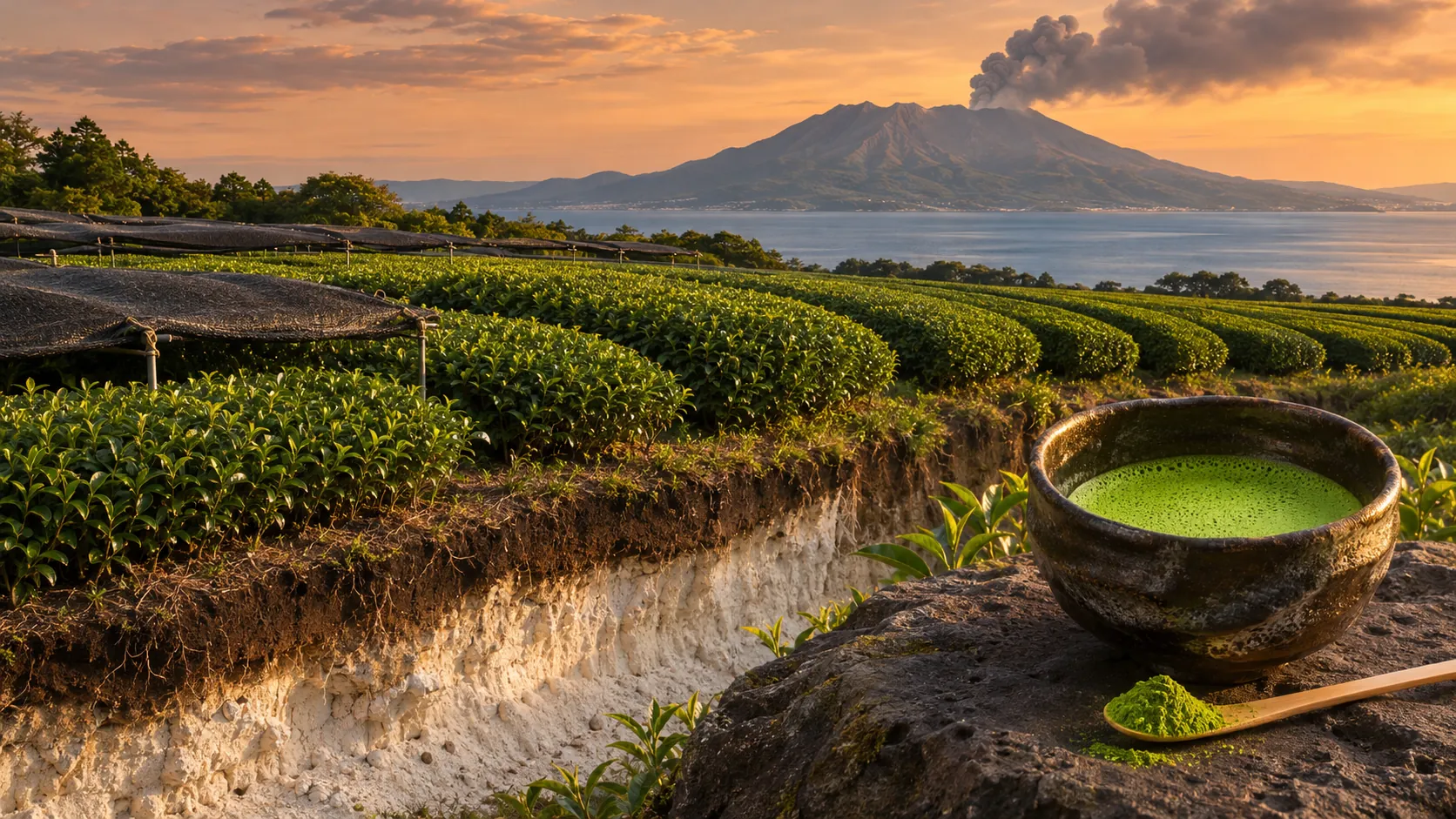
Kagoshima matcha tastes different because of where it grows. More than half of Kagoshima Prefecture sits on shirasu, a pale, porous volcanic deposit left by an eruption about 30,000 years ago. Sakurajima, the active volcano across the bay, still dusts the fields with fresh ash. That light, fast-draining, mineral-rich soil, together with Japan’s warmest tea climate, produces matcha that is typically deep green, rounded and savoury, with less bitterness than many cooler regions. Kagoshima also harvests earlier than anywhere else in Japan, from late March.
A morning with ash on the windscreen
If you spend a few days in Kagoshima City, you will probably wake one morning to find a fine grey film on every parked car. Nobody panics. People sweep it up, put it in the yellow bags the city provides for volcanic ash, and get on with the day.
That ash comes from Sakurajima, a volcano that rises straight out of Kagoshima Bay, about four kilometres from the city centre. It has been active almost continuously since 1955. For the people who live here it is weather, not news.
For tea growers it is something more. The volcano is part of the land the tea grows in, the reason the fields look the way they do, and, many of us believe, part of the reason a bowl of Kagoshima matcha tastes the way it does.
The French have a word for this: terroir, the idea that soil, climate, slope and tradition all leave a mark on what grows in a place. Wine lovers talk about it all the time. In matcha it is talked about far less, and it deserves more attention.
Kagoshima tea in numbers
| Fact | Figure | Source year |
|---|---|---|
| Kagoshima’s share of land on shirasu volcanic deposits | More than half of the prefecture | Geological survey data |
| Age of the eruption that created the shirasu | About 30,000 years (Aira caldera, Ito eruption) | — |
| Volume of volcanic material from that eruption | More than 800 km³ of ignimbrite | — |
| Kagoshima tea field area | 8,040 ha | Fiscal 2025 |
| Kagoshima raw tea (aracha) output | About 30,000 tonnes, No. 1 in Japan | 2025 |
| First-flush output, Kagoshima vs Shizuoka | 8,440 t vs 8,120 t, the first time Kagoshima led since surveys began in 1991 | 2025 |
| Kagoshima tencha (matcha leaf) output | 1,392 t, No. 1 in Japan | 2022 |
| Organic tea fields in Kagoshima | 1,327 ha | Fiscal 2025 |
| Start of the first harvest (hashiri-shincha) | Late March, the earliest in Japan | Every year |
Kagoshima has quietly become Japan’s largest tea-growing prefecture. Most people outside Japan have still never heard its name on a matcha tin.
How a volcano built a tea region
The eruption that made the land
About 30,000 years ago, a huge eruption collapsed the ground under what is now the northern part of Kagoshima Bay and formed the Aira caldera, 17 by 23 kilometres across. It released more than 800 cubic kilometres of pyroclastic material: hot gas, pumice and ash that flowed across southern Kyushu and settled in thick layers.
Over time those layers hardened into the Shirasu-Daichi, the shirasu plateau. Shirasu means “white sand”, and that is what it looks like when you dig into it: a pale, crumbly, almost weightless soil, full of tiny air pockets.
Sakurajima grew later, inside the same caldera, fed by the same magma chamber. It is still adding fresh layers today.
What volcanic soil does for a tea plant
Tea plants are fussy about their feet. They like acidic soil, plenty of rain, and roots that never sit in water. Shirasu and the darker volcanic ash soils above it suit them for three reasons:
- Drainage. The porous shirasu lets heavy rain run through quickly. Roots stay moist but are not waterlogged, which keeps the plant healthy and its roots working deep.
- Acidity. Volcanic soils tend to be naturally acidic, the range in which tea absorbs nutrients well.
- Minerals. Weathered volcanic ash releases minerals slowly. Growers in Kagoshima often describe the ash that falls on their fields as a light, natural top-dressing, although too much at once has to be washed off the leaves.
There is a catch. Shirasu by itself holds few nutrients, so Kagoshima farmers have spent generations building up their fields with organic matter. The flavour of Kagoshima tea comes from both the volcano and the people who learned to work with it.
The climate: Japan’s warmest tea garden
Kagoshima sits at the southern tip of Kyushu, at about the same latitude as Shanghai and Cairo. Winters are mild, and the growing season is long.
This changes the tea in two ways.
It starts early. The first new leaves of the year, called hashiri-shincha, are picked in Kagoshima from late March, weeks before Kyoto or Shizuoka. Some fields are harvested up to five times a year.
It grows on flatter land. Many of Japan’s older tea regions cling to steep, misty slopes. Large parts of Kagoshima are open plateaus, and that matters a great deal for matcha. Before harvest, tencha fields must be covered with shade cloth for weeks. On flat land, farmers can shade large fields evenly, harvest at exactly the right moment, and move the leaf to the factory quickly, before it starts to lose its freshness.
If you want to understand why shading is so important, read our guide to shade-grown matcha.
Many cultivars, many flavours
Most Japanese tea comes from a single cultivar, Yabukita. Kagoshima is different. Its farmers grow a much wider range of cultivars, because the warm climate lets them choose plants that bud at different times, and because the region’s growers have long experimented.
The cultivars you will find in Kagoshima matcha include:
- Saemidori: bright green, sweet, with a gentle umami. A favourite for high-grade matcha.
- Okumidori: a late-budding cultivar with a deep colour and a clean finish.
- Asatsuyu: sometimes called “natural gyokuro” for its naturally sweet, rich flavour.
- Yutakamidori: an early, strong-growing cultivar with a bold, full taste.
Blending these lets a tea master shape a matcha the way a winemaker shapes a blend: one cultivar brings sweetness, another body, a third colour.
So what does volcanic soil matcha actually taste like?
Here is what we notice, again and again, when we taste good Kagoshima matcha next to matcha from other regions. Your experience will vary with the grade, cultivar and freshness, so treat this as a guide rather than a rule.
| Kagoshima (volcanic soil, warm south) | Uji, Kyoto (classic matcha region) | |
|---|---|---|
| Colour | Deep, vivid jade green | Bright green, often slightly paler |
| Aroma | Fresh, green, sometimes lightly toasted | Elegant, floral, seaweed notes |
| Body | Round, full, creamy | Refined, layered |
| Umami | Rich and immediate | Deep, slowly unfolding |
| Bitterness | Generally soft | Varies by grade, often more structured |
| Finish | Smooth, sweet and clean | Long, with a lingering astringency |
Neither region is “better”. They are different expressions of the same plant. If you want a detailed comparison of the two regions, including L-theanine content, read our article on Kagoshima vs Uji matcha.
Taste the terroir yourself: a 10-minute side-by-side
The best way to understand terroir is to taste it. You need two matcha powders from different regions, two bowls, a whisk and about ten minutes.
- Use the same amounts. 2 g of matcha and 70 ml of water at 75–80 °C for each bowl.
- Look first. Put a small pinch of each powder on white paper. Compare the colour. Volcanic-soil matcha is often a deeper, almost blue-green.
- Smell the dry powder. Breathe in close to the bowl before adding water. Notice if one smells sweeter, greener or more toasty.
- Whisk both the same way. 15–20 seconds in a W motion.
- Taste the first sip without swallowing straight away. Notice where you feel the flavour: at the front of the tongue (sweet), across the middle (umami) or at the back (bitter).
- Wait 30 seconds. Terroir often shows most clearly in the finish. Does it fade quickly, or linger?
- Write down three words for each. Many people find their words for Kagoshima matcha include “round”, “creamy” or “savoury”.
The first time we did this with friends who thought “matcha is matcha”, the room went quiet halfway through. Then someone said, “Oh. They’re not the same at all.” That moment is what terroir is about.
Is Kagoshima matcha good quality?
Yes, and the auction market agrees. In 2025 Kagoshima produced more first-flush tea than Shizuoka for the first time since national surveys began in 1991. In May 2026, Kagoshima’s tencha auction averaged ¥19,095 per kilogram, close to Kyoto’s prices.
So why is Kagoshima less famous? Part of the answer is history. Uji has had a 700-year head start in reputation. For decades much of Kagoshima’s tea was sold unlabelled to blenders and bottled-tea makers, so its name rarely appeared on the package.
That is changing fast. Japan’s matcha shortage has pushed buyers to look beyond Kyoto, and many are finding that the volcano in the south grows something special. You can read more about the region in our guide to Kagoshima, Japan’s hidden tea capital and in the best ceremonial matcha from Kagoshima.
How to choose a good volcanic soil matcha
- Look for the prefecture on the label. “Kagoshima” or a town such as Chiran or Kirishima, not just “Japan”.
- Ask for the harvest. First flush (ichibancha) gives the sweetest, most delicate matcha.
- Check the cultivar, if it is listed. Saemidori and Asatsuyu are good signs for a sweet, rounded cup.
- Check that it is stone-milled. Slow granite mills protect colour and aroma.
- Choose a small tin. Matcha is best within a few weeks of opening, so 20–30 g is plenty.
Why we grow where we grow
We chose Kagoshima for our matcha because we believe the land matters. Volcanic soil, a warm southern sun and generations of farmers who learned to work with a living volcano give our matcha its deep colour and smooth, savoury character.
Every tin carries a little of Sakurajima. Explore Gozen’s Kagoshima matcha or visit our plantation page to see where it grows.
Frequently asked questions
What is volcanic soil matcha?
Volcanic soil matcha is matcha grown in fields formed from volcanic deposits, such as the shirasu plateau and Sakurajima ash soils of Kagoshima, Japan. The porous, acidic, mineral-rich soil drains quickly and helps produce a deep green, smooth and savoury matcha.
Why does Kagoshima matcha taste different?
Kagoshima matcha grows in volcanic soil, in Japan’s warmest tea climate, on flat land that allows even shading, and from a wide mix of cultivars such as Saemidori and Asatsuyu. Together these give it a deep colour, a round, creamy body and soft bitterness.
Does Sakurajima’s volcanic ash affect tea?
Yes. Fresh ash adds minerals to the soil as it weathers, and the older volcanic deposits underneath give the fields excellent drainage. Heavy ashfall has to be washed off the leaves, so farmers manage it carefully.
Is Kagoshima matcha as good as Uji matcha?
They are different rather than better or worse. Kagoshima matcha tends to be rounder and creamier with softer bitterness, while Uji matcha is often more floral and structured. Top Kagoshima tencha now sells at prices close to Kyoto’s at auction.
Is Kagoshima the largest tea producer in Japan?
Yes. Kagoshima produced about 30,000 tonnes of raw tea in 2025, the most in Japan, and in 2025 it produced more first-flush tea than Shizuoka for the first time since surveys began in 1991.
What does Kagoshima matcha taste like?
Good Kagoshima matcha is usually deep jade green, smells fresh and green, and tastes rich in umami with a round, creamy body, gentle bitterness and a smooth, sweet finish.




Comments are closed.