By admin
Posted in editor pick | Tags : ceremonial grade matcha, Matcha Powder
The short answer
Japan’s matcha shortage is a shortage of tencha, the shade-grown leaf that matcha is milled from. Global demand has grown faster than farmers can add shaded fields, mill capacity and skilled labour. In fiscal 2025 Japan’s green tea exports rose 42% to 13,125 tonnes, and the value more than doubled to ¥84.7 billion. Tencha auction prices in Kagoshima averaged ¥19,095/kg in May 2026, up ¥8,480 on the year. Prices keep rising because supply cannot catch up quickly: converting a sencha field to tencha takes two to three years.
Matcha shortage in numbers (2025–2026)
| Indicator | Figure | Period |
|---|---|---|
| Japan green tea exports, volume | 13,125 tonnes, +42% | Fiscal 2025 (Apr 2025–Mar 2026) |
| Japan green tea exports, value | ¥84.7 billion, 2.2× the prior year | Fiscal 2025 |
| Powdered tea (incl. matcha) share of exports | About 70% of volume | Fiscal 2025 |
| Green tea imports into Japan | 5,801 tonnes, +82% | Fiscal 2025 |
| Kagoshima tencha auction, average | ¥19,095/kg, +¥8,480 vs 2025 | 14 May 2026 |
| Kagoshima first-flush tea, average | ¥6,573/kg, +¥2,436 vs 2025 | 6 Apr 2026 |
| Kyoto machine-picked first-flush tencha | ¥14,141/kg, up from ¥5,411 (+161%) | 2025 vs 2024 |
| Second-flush (nibancha) prices, Kagoshima and Shizuoka | About 2× last year, nearly 4× two years earlier | June 2026 |
| Tea producers closed in Japan | 13, a record (8 the year before) | 2025 |
| Time to convert a sencha field to tencha | 2–3 years | Industry estimate |
Sources are listed at the end of this article. Fiscal 2025 runs from April 2025 to March 2026.
Why is there a matcha shortage in Japan?
The shortage has no single cause. Seven pressures arrived at the same time, and each one makes the others worse.
1. Demand outran a crop that cannot be rushed
Matcha moved from tea ceremonies and Kyoto souvenir shops to café menus in Dubai, London, Mumbai and Los Angeles within about five years. Social media turned the matcha latte into a daily habit rather than a treat. Powdered tea now makes up about 70% of Japan’s green tea export volume.
The problem is that matcha is not ordinary green tea. Standard green tea can be harvested, steamed and rolled at scale. Matcha starts as tencha: leaves shaded for three to four weeks before picking, steamed, dried flat without rolling, de-stemmed and de-veined, and then stone-ground. Every step narrows the funnel.
2. Shaded fields take years to build
A farmer cannot decide in January to sell tencha in May. Shizuoka tea merchants estimate it takes two to three years to convert a sencha field to tencha, and about as long to switch back. Farmers need shade structures, a different processing line and buyers willing to commit.
Many growers are moving. Japan’s domestic tencha output grew for four years in a row through 2024. But sencha prices are now rising too, because so many fields moved to tencha. That leaves farmers caught between two crops that both pay more than they used to.
3. The stone mill is a hard bottleneck
Ceremonial-grade matcha is still ground on granite mills that turn slowly so that friction does not heat and dull the leaf. A single mill produces only a few dozen grams an hour. Producers can buy more mills, but they cannot make one mill turn faster without losing the quality that buyers are paying for.
This is why “sold out” notices show up first on ceremonial-grade tins. Culinary grades are usually ground on faster machines.
4. Weather made two harvests unpredictable
A cold April in 2025 cut Kyoto’s traded first-flush volume by about 13%, according to the Global Japanese Tea Association. Kyoto’s Uji region is the most famous matcha origin, so a smaller crop there tightened the whole market.
The 2026 spring was kinder: mild, with steady rain and no frost. Quality was high, but buyers came in with empty warehouses after the 2025 shortage. They bid early and hard, so better weather did not bring prices down.
5. Fewer farmers, and fewer people to replace them
About 40% of Japan’s tea fields are on hillsides or mountain slopes, where machines are hard to use and work is slow. The tea farming workforce is ageing, and many family farms have no successor. Teikoku Databank counted 13 tea producers that suspended or closed their business in 2025, a record, up from 8 the year before.
Every closed farm removes shaded fields, skilled pickers and processing knowledge that took decades to build.
6. Bottled tea and tea bags are bidding for the same leaf
The price surge is not only about lattes. Japan’s green tea beverage production has been at record levels for eight straight years, according to the Japan Soft Drink Association. Bottled-tea and tea-bag makers compete for second-flush leaf, which is why June 2026 nibancha prices in Kagoshima and Shizuoka reached about double the previous year.
7. Japan is importing more tea to fill the gap
In fiscal 2025 Japan imported 5,801 tonnes of green tea, mostly from China, an increase of 82%. Japan imports tea while its own tea sells abroad at record prices, which shows how tight domestic supply has become. It also creates a risk for buyers: not every powder sold as “Japanese matcha” is made from Japanese tencha.
Kagoshima’s growing role in matcha supply
When people think of matcha, they think of Uji in Kyoto. But much of Japan’s new tencha capacity is in the south, in Kagoshima.
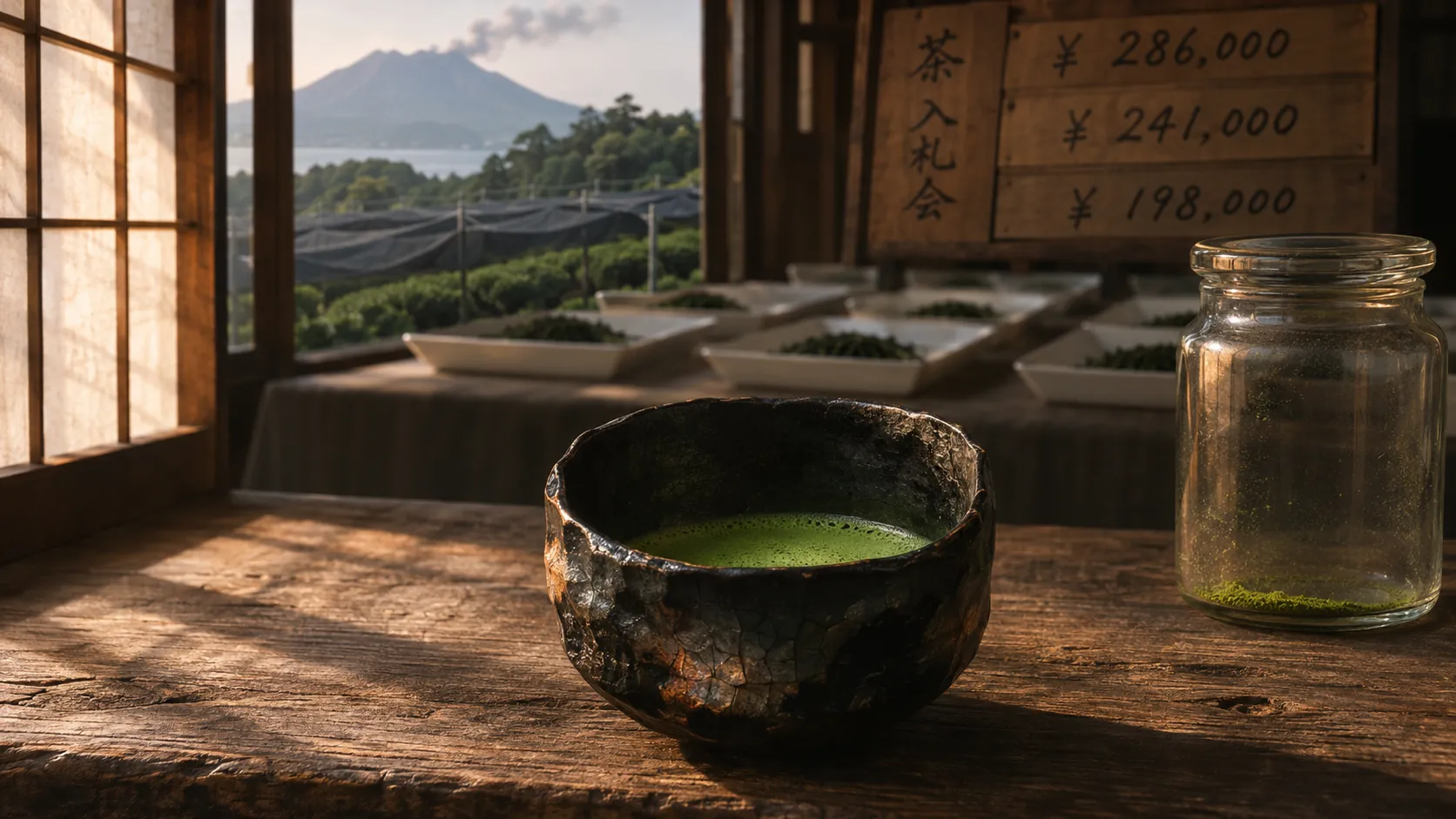
Kagoshima has flatter fields that suit modern shading and harvesting, volcanic soil from Sakurajima, and a warm climate that brings the first harvest earlier than in Kyoto. Its tencha auction averaged ¥19,095/kg in May 2026, and its first spring sencha auction recorded a top bid of ¥30,000/kg, the highest since at least 1989.
For buyers this has two sides. Kagoshima is helping keep the global matcha supply going. It is also no longer a cheap alternative: the best Kagoshima lots now sell at prices close to Uji’s. If you want to know more about the region, read our guide to Kagoshima, Japan’s hidden tea capital.
Is the matcha shortage real, or just marketing?
It is real, but it is narrower than the headlines suggest. Japan is not running out of green tea. It is running short of high-grade, first-flush, shade-grown tencha milled into ceremonial matcha.
That explains what shoppers see in 2026:
- Premium ceremonial tins sell out within hours of a restock, and some shops limit how many each customer can buy.
- Café-grade and culinary powders stay available, but they cost more and quality varies more.
- Some brands quietly reduced tin sizes from 40 g to 30 g, or blended in more second-flush leaf.
- Low-priced “matcha” with unclear origin has appeared online to fill the gap.
So when a brand says “shortage”, ask which grade it means. A sold-out ceremonial tin and a fully stocked latte powder can both be accurate.
How much have matcha prices risen?
The largest rises happen at wholesale, and retail prices follow them more slowly.
- At auction: Kyoto machine-picked first-flush tencha rose about 161% between 2024 and 2025. Kagoshima’s tencha average rose by about 80% in May 2026 alone.
- At wholesale: a buyer at G.S. Haly told Fortune in September 2025 that the firm paid 75% more for top-grade 2025 matcha, and 30–50% more for lower grades.
- At retail: industry reports put shelf-price rises at roughly 15–20% from late 2025 to early 2026. Many retailers have not yet passed the full 2026 auction cost on to customers.
If you notice your favourite tin cost more this autumn than last spring, you are paying for the 2026 harvest. That harvest was bought at the highest prices on record.
For context on the very top of the market, read our article on the most expensive matcha in the world and why it costs so much.
Will matcha prices go down in 2027?
Prices are unlikely to fall quickly. Our view from Kagoshima, as a forecast rather than a promise:
- Next 6 months: prices stay high. Stocks from the 2026 harvest were bought at record cost and must be sold through first.
- 2027 first flush (April–May): auction prices may level off if the weather is good and new shaded fields begin producing. A sharp drop is unlikely while exports keep growing.
- 2027–2028: fields converted in 2024–2025 should reach full output, which could ease the pressure on mid-grade tencha. Ceremonial grades will stay scarce, because milling capacity and skilled labour grow slowly.
Three things could change this outlook: a frost or heatwave during the spring harvest, a slowdown in global café demand, or new trade tariffs on Japanese food exports.
How to buy real matcha during a shortage: a 6-point checklist
A shortage is when fake and low-grade powders are most common. Before you buy, check:
- Origin on the label. Look for a named prefecture (Kagoshima, Kyoto, Aichi, Shizuoka, Fukuoka), not just “Product of Asia” or “Japanese style”.
- Harvest or milling date. Fresh matcha is best within months of milling. A missing date is a warning sign.
- Grade and its meaning. “Ceremonial” is not a regulated term. Ask whether it is first-flush, stone-milled tencha. Our guide to ceremonial vs culinary grade matcha explains the difference.
- Colour. Good matcha is a bright jade green. Dull olive or yellow-brown suggests older leaf, later harvests or poor storage (see why matcha turns brown).
- Price that makes sense. If ceremonial matcha costs less than culinary powder in 2026, ask why. At current tencha prices, very cheap ceremonial matcha rarely holds up.
- A producer you can trace. Brands that name the farm, the region and the shading period have less to hide.
What this means for matcha lovers
The shortage has a positive side. Rising prices are giving Japanese farmers a reason to invest in shaded fields, new mills and successors for the first time in decades. The farm closures of 2025 were not inevitable; better prices can slow them.
For drinkers the advice is simple: buy less often but better, store it properly, and buy from producers who can show where their leaf comes from. A 30 g tin of honest first-flush matcha, whisked slowly, gives you more than a 100 g bag of uncertain powder.
At Gozen, our matcha is grown and shaded in Kagoshima, close to the auction floors described above. Explore our Japanese matcha powder and taste what traceable, first-flush tencha is like.
Frequently asked questions
Why is there a matcha shortage in 2026?
Global demand for matcha has grown faster than Japan can produce tencha, the shade-grown leaf matcha is made from. New fields take two to three years to convert, stone milling is slow, and tea farms are closing faster than ever. Low inventories after 2025 also pushed buyers to bid aggressively in 2026.
Why are matcha prices rising so fast?
Tencha auction prices have roughly doubled in two years. Kagoshima’s tencha averaged ¥19,095/kg in May 2026, up ¥8,480 on the year. Bottled-tea makers also compete for the same leaf, and retailers are now passing those costs on.
Is Japan running out of matcha?
No. Japan is short of high-grade, first-flush ceremonial matcha, not green tea in general. Culinary and café grades remain widely available, although they cost more than they did in 2024.
Will matcha prices go down in 2027?
A quick drop is unlikely. Prices may level off after the 2027 first harvest if the weather is good and newly converted fields come into production. Ceremonial grades are expected to stay expensive.
How can I tell if matcha is real Japanese matcha?
Check for a named Japanese prefecture, a harvest or milling date, a bright jade-green colour and a traceable producer. Be wary of ceremonial matcha priced below culinary grade.
Is Kagoshima matcha as good as Uji matcha?
Yes, top Kagoshima tencha now sells at prices close to Uji’s at auction. Kagoshima’s volcanic soil and earlier harvest give a smooth, rich umami profile, and the region is now one of Japan’s largest tencha producers.
Sources
- Japan Green Tea Exports Jump in FY 2025 amid Global Matcha Boom – Adnkronos / Jiji Press (exports, imports, producer closures, hillside fields)
- Japanese Tea Prices Hit Record Highs in 2026 – Ooika (2026 auction prices, citing 373news, Chunichi Shimbun, JA Kagoshima)
- Matcha Industry 2026: Record Auctions & the Shortage – One With Tea (Kyoto tencha prices, Kyoto 2025 volume, G.S. Haly via Fortune, retail estimates)
- Japan Data – Nippon.com (2025 food export data)




Comments are closed.