
By admin
Posted in Tea Ceremony | Tags : gozen green tea, gozen matcha, matcha benefits
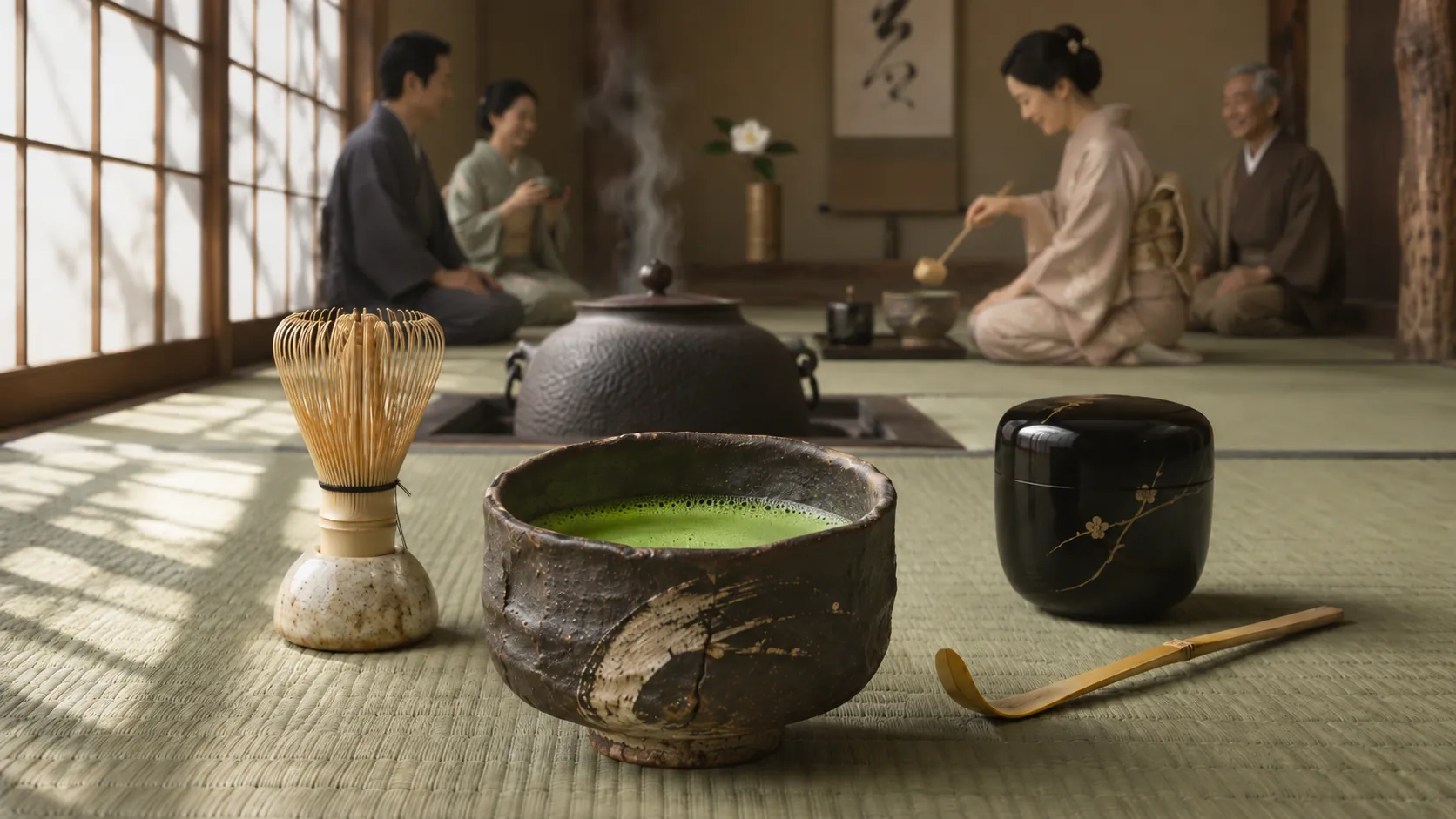
The Japanese tea ceremony, called chanoyu (“hot water for tea”) or sadō / chadō (“the way of tea”), is a choreographed ritual in which a host prepares powdered matcha for guests. A full formal gathering (chaji) lasts about four hours and includes a meal, thick tea and thin tea. A simple tea gathering (chakai) can take 30 minutes. The core steps are: purify, enter, admire, eat a sweet, watch the tea being prepared, receive the bowl, drink, and admire the utensils. Each movement expresses four principles: harmony, respect, purity and tranquility.
What chanoyu actually is (and what it is not)
Many people imagine the tea ceremony as a performance. Practitioners see it the opposite way. Chanoyu is a meeting between host and guests in which everything, from the flower in the alcove to the angle of the whisk, is chosen for that one meeting.
The idea is summed up in the phrase ichigo ichie: “one time, one meeting”. The same guests, weather, season and bowl will never come together again, so the host gives the moment full attention.
The tea ceremony is not a lesson in how to drink tea correctly. It is a lesson in paying attention. The tea is the reason to gather, but the gathering is the point.
A short history: from Zen monks to Sen no Rikyū
Powdered tea came to Japan from China with Buddhist monks. The monk Eisai brought tea seeds and the method of whisking powdered tea back to Japan in the late 12th century and wrote Japan’s first book on tea, Kissa Yōjōki (“Drinking Tea for Health”).
For the next three centuries tea was a luxury for samurai and nobles, often served in lavish tea contests. In the 15th century the tea master Murata Jukō began moving tea towards simplicity and Zen practice. Takeno Jōō developed this further.
The man who shaped chanoyu as we know it was Sen no Rikyū (1522–1591). He studied under Takeno Jōō from the age of nineteen and became tea master to the warlords Oda Nobunaga and then Toyotomi Hideyoshi. Rikyū perfected wabi-cha: tea that finds beauty in plain, imperfect and natural things.
His tea room Tai-an, near Kyoto, measures just two tatami mats and is now a National Treasure of Japan. Rikyū’s independence eventually cost him his life. In 1591 Hideyoshi ordered him to commit ritual suicide.
Rikyū’s great-grandsons founded the three Sen family schools that still lead the tea world today: Omotesenke, Urasenke and Mushakōjisenke. Urasenke is the largest internationally, with 92 official Tankōkai associations in 37 countries outside Japan, and 165 chapters in Japan.
Samurai were among the tea ceremony’s most devoted students. If you want to know why, read our article on why samurai warriors drank matcha.
The four principles: wa, kei, sei, jaku
Rikyū’s teaching is often summed up in four words:
| Principle | Meaning | How it appears in the ceremony |
|---|---|---|
| Wa (和) | Harmony | Utensils, sweets and flowers match the season and each other |
| Kei (敬) | Respect | Bows between host and guests; guests apologise for drinking before the next guest |
| Sei (清) | Purity | Washing hands and mouth before entering; the host wipes each utensil in front of guests |
| Jaku (寂) | Tranquility | The calm that follows when the first three are practised |
The tea room and its utensils
A traditional tea room (chashitsu) is small, usually four and a half tatami mats or fewer. Guests enter through the nijiriguchi, a door about 60–70 cm high, so everyone must bow and crawl in. A samurai had to leave his sword outside. Inside, rank does not matter.
The room has a tokonoma (alcove) with a hanging scroll and a single seasonal flower arrangement called chabana.
| Utensil | Japanese name | Purpose |
|---|---|---|
| Tea bowl | Chawan | The bowl the tea is whisked and drunk from. Its front faces the guest. |
| Bamboo whisk | Chasen | Whisks matcha and water into a smooth tea; usually carved from a single piece of bamboo |
| Bamboo scoop | Chashaku | Measures matcha from the caddy into the bowl |
| Tea caddy | Natsume (thin tea) / Chaire (thick tea) | Holds the matcha |
| Kettle | Kama | Heats water over charcoal |
| Water jar | Mizusashi | Holds fresh cold water for topping up the kettle and rinsing |
| Ladle | Hishaku | Bamboo ladle for moving hot water |
| Silk cloth | Fukusa | Folded and used to purify the caddy and scoop |
| Linen cloth | Chakin | Wipes the tea bowl |
| Waste water bowl | Kensui | Receives rinse water |
A starter set for home needs only the first three, plus a sifter and good matcha.
The Japanese tea ceremony, step by step
This guide follows a chakai, the shorter gathering most visitors to Japan experience. Details differ between schools; this is the general sequence.
Before guests arrive: the host prepares
- Cleans the garden path and tea room. The stone path (roji) is sprinkled with water to show that it is fresh and ready.
- Chooses the scroll and flower. The scroll sets the theme of the gathering, often a Zen phrase. The flower is simple, in season and never looks arranged.
- Lights the charcoal and sets the kettle so the water is near the boil when guests sit down.
- Selects the utensils to suit the season, the guests and the occasion.
The guests’ journey
- Waiting. Guests gather in a waiting area (machiai) and choose the main guest (shōkyaku), who leads and speaks for the group.
- Silent greeting. The host comes out and greets the guests with a bow, without speaking.
- Purification at the tsukubai. Each guest walks the garden path to a low stone basin, rinses the left hand, the right hand and the mouth, then rinses the ladle handle.
- Entering. Guests remove their shoes and crawl through the nijiriguchi.
- Admiring the alcove. Each guest kneels before the tokonoma, bows, and quietly looks at the scroll and flower, then at the kettle.
- Taking their seats. Guests kneel in seiza (sitting on their heels), in order, with the main guest nearest the host.
Sweets and the preparation of tea
- Wagashi are served. Guests eat a seasonal sweet before the tea, so its sweetness balances the bitterness of the matcha. Each guest says “osakini” (“excuse me for going before you”) to the next guest.
- The host enters with the utensils and places each one in a set position.
- Purification of the utensils. In front of the guests, the host folds the silk fukusa in a fixed pattern and wipes the caddy and the scoop. The whisk is rinsed and checked for broken tines. The bowl is warmed with hot water and wiped with the chakin.
- Measuring the matcha. For thin tea (usucha), the host adds about 1.5–2 g of matcha, about two scoops with the chashaku.
- Adding water. The host ladles about 60–70 ml of hot water, ideally around 80 °C, onto the matcha.
- Whisking. The host whisks quickly in a W or M motion from the wrist until a fine foam forms, then lifts the whisk from the centre.
- Turning the bowl. The host turns the bowl so its decorative front faces the guest and sets it down.
In a formal chaji, thick tea (koicha) comes first. It is made with about twice as much matcha and much less water, kneaded rather than whisked, and shared from one bowl. Thin tea follows. The difference between the two deserves its own article, which we will publish soon.
How a guest receives and drinks the tea
- Bow to the next guest and say “osakini”.
- Bow to the host and say “otemae chodai itashimasu” (“thank you for making the tea”).
- Pick up the bowl with the right hand and place it on the left palm.
- Turn the bowl clockwise twice, about 90° in total, so you do not drink from its front. This is a gesture of humility.
- Drink in three to four sips. Make a small slurp on the last sip to show you have finished and enjoyed it.
- Wipe the rim where your lips touched with your right thumb and finger, then wipe your fingers on a kaishi paper.
- Turn the bowl back so the front faces the host again and set it down.
- Admire the bowl. Look at it closely, low to the mat, holding it with both hands.
Closing the ceremony
- The host cleans each utensil again, in the same order as before.
- The main guest may ask to see the caddy, scoop and bowl (haiken). Guests ask about the maker, the name of the scoop and the origin of the tea. These questions are part of the ritual.
- The host and guests bow. Guests leave as quietly as they came, and the host watches them go until they are out of sight.
Tea ceremony etiquette for first-time guests
- Wear plain clothes and white socks. Remove watches and rings, which can scratch old bowls.
- Avoid perfume. It interferes with the scent of the tea and the incense.
- Do not step on the edges of the tatami mats, which in older rooms often have family crests on them.
- Follow the person in front of you. No one expects perfect form from a beginner.
- Bring a folding fan (sensu) and kaishi papers if you are invited to a formal gathering.
- Silence your phone, and do not take photos unless the host invites you to.
Types of tea gathering
| Gathering | Length | What it includes |
|---|---|---|
| Chaji | About 4 hours | Charcoal ceremony, kaiseki meal, sweets, thick tea, thin tea |
| Chakai | 30–90 minutes | Sweet and thin tea, sometimes thick tea |
| Ryurei | 15–30 minutes | Host and guests seated at tables and chairs, popular for foreign visitors |
| Seasonal gatherings | Varies | For example Hatsugama, the first tea of the new year in January, and the moon-viewing teas of autumn |
Why the matcha matters
In chanoyu, nothing hides poor tea. There is no milk, sugar or ice, only matcha and water. That is why ceremonies use first-flush, shade-grown, stone-milled matcha, the grade now called ceremonial.
Good ceremonial matcha should be bright jade green, smell fresh and grassy, and whisk into a fine, stable foam. It should taste sweet and savoury (umami) with a clean finish rather than harsh bitterness. Read more in our guides to ceremonial vs culinary grade matcha, shade-grown matcha and tencha, the leaf behind matcha.
How to host a simple tea ceremony at home
You do not need a tea room to bring chanoyu into your day. A ten-minute ritual at home keeps the spirit of the ceremony:
- Clear a small table. Place one seasonal object on it, such as a branch, a stone or a single flower.
- Wash your hands slowly, and leave your phone in another room.
- Warm the bowl with hot water, swirl it, and pour it away. Wet the whisk tips in the same water.
- Sift 2 g of matcha into the bowl.
- Add 70 ml of water at 75–80 °C. Boiled water that has rested for about 3 minutes is close enough.
- Whisk for 15–20 seconds in a W motion until foam forms.
- Serve a small sweet first, then turn the bowl and offer it to your guest, or to yourself, with both hands.
- Drink in three sips, then look at the empty bowl for a moment before you clean up.
At Gozen, our matcha is shade-grown and stone-milled in Kagoshima for exactly this kind of slow, plain preparation. Explore our ceremonial Japanese matcha and see our guide to matcha culture around the world.
Frequently asked questions
What is the Japanese tea ceremony called?
It is called chanoyu (“hot water for tea”), sadō or chadō (“the way of tea”). A full formal gathering with a meal is a chaji, and a shorter gathering is a chakai.
What are the main steps of the Japanese tea ceremony?
Guests purify their hands and mouth, enter the tea room, admire the scroll and flower, and eat a sweet. The host purifies the utensils and whisks matcha. Each guest receives the bowl, turns it, drinks, wipes the rim and returns it, and the ceremony closes with admiring the utensils.
How long does a Japanese tea ceremony last?
A formal chaji with a kaiseki meal, thick tea and thin tea lasts about four hours. A chakai with a sweet and thin tea usually takes 30 to 90 minutes.
Why do you turn the bowl in a tea ceremony?
The front of the bowl is its most beautiful side. The host turns it to face the guest, and the guest turns it away before drinking as a sign of humility and respect for the host and the bowl.
What are the four principles of the tea ceremony?
Wa (harmony), kei (respect), sei (purity) and jaku (tranquility). Sen no Rikyū, the 16th-century tea master, is credited with these principles.
What kind of matcha is used in a tea ceremony?
Ceremonial-grade matcha: first-flush, shade-grown tencha that is stone-milled into a fine, bright green powder. It is prepared with only hot water, so its sweetness and umami must stand on their own.




Comments are closed.