By admin
Posted in japanese matcha, Tea Education | Tags : ceremonial grade matcha, matcha benefits, premium matcha
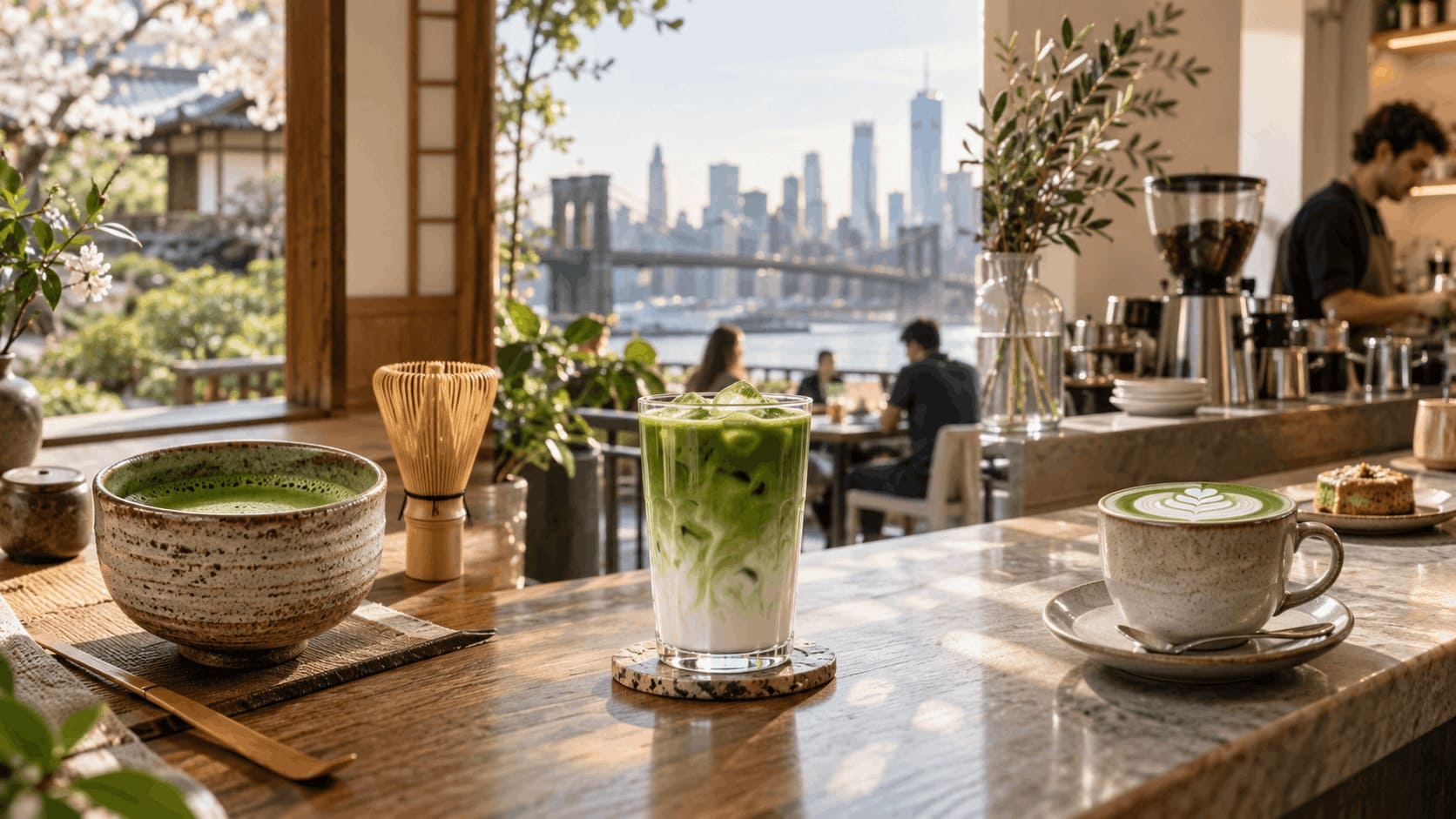
A bowl whisked quietly in a Japanese tea room. An iced matcha latte carried through New York on the morning commute. A vivid green drink sitting beside a flat white in a London specialty café.
The ingredient may be the same, but the ritual is not.
Few drinks illustrate cultural adaptation quite as clearly as matcha. In Japan, it carries centuries of ceremony, hospitality and aesthetic discipline. In the United States, it has become part café staple, part wellness drink and part canvas for flavour experimentation. Across Europe, matcha has entered through specialty coffee culture, where baristas and customers increasingly treat it as a serious non-coffee alternative.
That makes matcha culture around the world much more interesting than a simple story of a Japanese drink becoming globally popular. Each place has interpreted matcha through its own habits: how people meet, how they use cafés, what they expect from caffeine and even how much visual appeal matters in a drink.
The result is a fascinating meeting point between matcha traditions vs modern trends.
Japan: Matcha as a Practice, Not Just a Drink
To understand how differently matcha is consumed outside Japan, it helps to begin with the cultural setting from which it comes.
Matcha has a particularly important role in chadō, often translated as “the Way of Tea.” Urasenke, one of Japan’s major tea schools, describes chadō as a spiritual and aesthetic discipline centred on the host and guest sharing time together over a bowl of matcha. It is not simply a method for preparing tea; the preparation, utensils, movements, setting and relationship between host and guest are all part of the experience.
Attention matters.
A tea bowl is turned deliberately. Water temperature, placement of utensils and even seasonal objects in the room can carry meaning. The purpose is not speed or convenience. The ritual encourages awareness of the present moment and appreciation of an encounter that will never happen in exactly the same way again.
This is why describing Japanese matcha only as a “health drink” misses much of its cultural meaning.
In traditional tea practice, matcha becomes part of hospitality, aesthetics and disciplined attention.
At the same time, it would be misleading to suggest that every cup of matcha in modern Japan belongs to a formal tea ceremony. Matcha also appears in cafés, confectionery, desserts and contemporary drinks. Japan itself contains both tradition and experimentation.
What distinguishes the Japanese relationship with matcha is that the newer forms exist alongside a very visible historical tradition.
From Tea Room to Everyday Life
Traditional matcha preparation often falls into forms such as usucha, or thinner whisked tea, and koicha, a much thicker preparation associated with formal tea practice. Urasenke continues to teach these procedures as part of chadō today.
The experience places relatively little between the drinker and the tea itself.
There is no flavoured syrup disguising bitterness, no layer of cold foam and usually no need for the drink to photograph dramatically. The quality of the tea, the water, the preparation and the moment are meant to carry the experience.
That helps explain why Japanese discussions of high-quality matcha often pay close attention to characteristics such as aroma, umami, sweetness, texture and finish.
Geography also contributes to Japan’s matcha identity, although it deserves its own discussion: Uji in Kyoto is deeply associated with Japan’s historic tea culture, while Kagoshima has become an increasingly important modern tea-producing region with a diverse range of cultivars and production styles.
What matters here is less which region is “best” and more the underlying idea: in Japan, matcha remains connected to agricultural origin and craft in a way that can become less visible when the drink travels abroad.
United States: The Matcha Latte Changes the Ritual
In the United States, matcha entered a very different beverage culture.
American café culture tends to prize portability, customization and drinks that fit into an active day. The bowl therefore became a cup, milk became central, ice became common, and matcha increasingly found itself sharing menu space with espresso.
The result was arguably the format that has done most to introduce matcha to American consumers:
the matcha latte.
It changed the flavour experience considerably. Milk softens matcha’s vegetal character and bitterness, making it easier for people unfamiliar with traditionally prepared tea to approach. Sweeteners and flavoured additions can make it even more familiar.
The cultural function changed too.
Instead of being primarily a ritual around hospitality and contemplation, matcha became something you could pick up on the way to school, work, a meeting or a fitness class.
That transition is one of the clearest examples of how different countries drink matcha.
From Alternative Drink to Café Mainstay
Matcha has been present in major American coffee chains for years. Starbucks, for example, traces its U.S. green tea latte to 2006, and its current American menu includes hot and iced matcha lattes alongside increasingly experimental matcha drinks.
The significance is not one chain in particular. It is what that presence tells us about matcha’s role.
In much of the American market, matcha does not sit in a separate “Japanese tea” category. It competes directly with coffee.
Someone deciding between an iced latte and an iced matcha is often making a choice between two morning or afternoon café drinks rather than between two tea traditions.
That has helped create one of the strongest narratives around matcha in the U.S.: matcha as an alternative caffeine experience.
Because matcha naturally contains both caffeine and L-theanine, it is frequently positioned culturally as offering a different experience from coffee. People may describe their preference in terms such as steadier energy or a calmer sense of alertness, although individual responses to caffeine vary.
This wellness framing is particularly visible in American matcha trends by country because food, fitness and lifestyle culture often overlap in the same digital spaces.
Matcha can therefore appear simultaneously as tea, café beverage, wellness habit and lifestyle object.
Social Media Made Matcha Visual
There is another reason matcha adapted particularly well to contemporary American café culture:
it is unmistakably green.
The colour immediately distinguishes it from coffee, tea and most conventional café beverages.
That visual identity has mattered in the age of Instagram, TikTok and short-form food content. Bright iced matcha drinks, layered milk, fruit additions and cold foams create images that are instantly recognizable.
Industry coverage of modern café trends has repeatedly connected matcha’s bright appearance with its social-media appeal, while large café brands now openly describe customer-created drinks and social platforms as influencing menu development.
This produces a very different relationship with tradition.
Where the classical Japanese tea bowl encourages attention inward—to the tea, objects, surroundings and guest—the contemporary café drink is often designed partly for outward expression.
What are you drinking?
Where did you get it?
What flavour did you customize?
What does the drink say about your taste?
Neither approach has to invalidate the other. They simply show how cultural context reshapes the same ingredient.
Matcha as a Platform for Flavour
The American matcha latte has also become highly adaptable.
Fruit, vanilla, lavender, cold foam and other flavours are increasingly paired with matcha. Starbucks’ U.S. menu in 2026, for example, lists multiple flavoured iced matcha combinations beyond the basic latte.
For traditionalists, some combinations may feel far removed from the tea room.
For another generation of drinkers, however, those drinks may be the first reason they ever become curious about matcha.
That raises one of the most interesting questions in global tea culture: does adaptation weaken tradition, or can it sometimes create a doorway back to it?
There probably isn’t one answer.
Europe: Matcha Meets Specialty Coffee Culture
Europe is difficult to describe as one matcha culture.
London, Paris, Berlin, Copenhagen, Madrid and other cities each have their own café traditions, and national coffee habits vary considerably.
Still, one broad pattern is becoming visible: matcha is increasingly entering Europe through the infrastructure created by modern specialty coffee.
Many contemporary European cafés already encourage customers to care about origin, processing, texture, craftsmanship and preparation. Those ideas translate surprisingly well from specialty coffee to premium tea.
As a result, matcha often appears alongside flat whites, pour-overs and single-origin coffees rather than in a completely separate tea environment.
This may be the most interesting European interpretation of matcha: Japanese tea presented through the language and aesthetics of the modern coffee shop.
The UK: Matcha Becomes a Serious Non-Coffee Category
The UK currently offers particularly clear evidence of this crossover.
Coffee industry research and reporting increasingly describe matcha as part of a broader shift in British café menus toward premium non-coffee beverages, iced drinks and more diverse café experiences. World Coffee Portal noted in 2026 that matcha was among the products helping reshape the UK’s branded coffee-shop landscape.
It is visible across different levels of café culture—from large chains to specialty operators and dedicated matcha businesses.
That matters because matcha is no longer necessarily treated as the unusual alternative buried at the bottom of a menu.
In some cafés, it is becoming a category of its own.
London-based matcha-focused concepts provide one example of how the drink has started moving beyond simply being an extra option inside coffee shops. Industry reporting in 2026 described dedicated matcha concepts as an emerging part of the city’s beverage landscape.
The UK interpretation shares some qualities with the American one—iced formats, milk and visually distinctive drinks are important—but it also sits comfortably within Britain’s increasingly sophisticated specialty beverage culture.
Continental Europe: Adoption Without One Single Style
It would be too simplistic to claim that continental Europe has developed one recognizable way of drinking matcha.
There is no equivalent of a single European “matcha ritual.”
Instead, adoption appears to follow local café cultures.
Specialty cafés may emphasize preparation and ingredient quality. Mainstream operators often use the matcha latte as the most approachable format. Wellness-focused cafés may frame it as a non-coffee alternative.
Recent European coffee-industry reporting suggests matcha’s popularity is being felt beyond the UK as well. For example, a major Romanian coffee operator launched a matcha-focused concept in 2026, illustrating how the category is expanding into Central and Eastern European café markets too.
The wider European story, then, is not simply that matcha is “becoming popular.”
It is that matcha is being absorbed into an established culture of cafés that already values beverage craftsmanship.
That creates opportunities for both playful modern drinks and more origin-conscious presentations of Japanese matcha.
Matcha Traditions vs Modern Trends: Three Cultures, One Powder
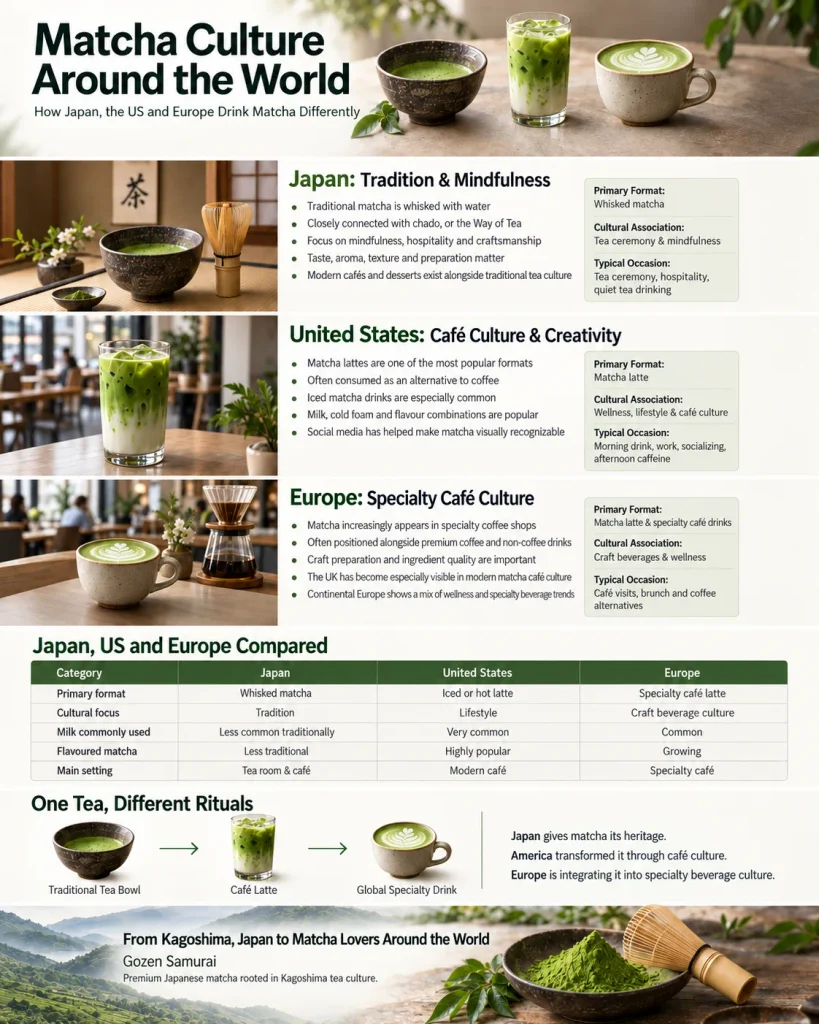
Looking at matcha culture around the world side by side makes the contrasts easier to see.
| Japan | United States | Europe | |
|---|---|---|---|
| Primary format | Traditionally whisked matcha; modern cafés and sweets also common | Hot and especially iced matcha lattes | Matcha lattes and specialty café preparations |
| Cultural association | Tea ceremony, hospitality, craftsmanship and tradition | Wellness, café culture, customization and lifestyle | Specialty coffee culture, wellness and premium non-coffee drinks |
| Typical grade used | Higher-quality drinking matcha for traditional preparation; other grades for food and modern drinks | Often café/latte-oriented matcha for milk-based drinks | Often café/latte matcha, with growing interest in higher-quality drinking matcha |
| Occasion | Tea ceremony, hospitality, quiet tea drinking, cafés and sweets | Morning or afternoon café drink, work, social occasions | Café visits, brunch, specialty beverage occasions and everyday alternatives to coffee |
The table also reveals why arguments about the “correct” way to drink matcha often miss the bigger picture.
Global foods rarely remain frozen when they cross borders.
Coffee itself moved from Ethiopia and the Arabian Peninsula into European coffeehouses before becoming espresso, filter coffee, flat whites, frappés and countless other regional traditions.
Tea followed similarly complex routes.
Matcha is now undergoing its own cultural translation.
What Changes When Matcha Travels?
The most obvious change is format.
Traditional bowl becomes takeaway cup.
Water becomes milk.
Hot becomes iced.
Plain becomes flavoured.
But something deeper changes too: the meaning attached to the drink.
In Japan, matcha can carry ideas of hospitality, seasonality, discipline and aesthetics.
In the United States, the same powder can represent energy, wellness, individuality and experimentation.
In Europe, it increasingly occupies the intersection between specialty beverage craftsmanship and contemporary wellness culture.
That does not mean traditional matcha is disappearing.
In some ways, global experimentation may be creating greater curiosity about where matcha actually comes from.
Someone who first encounters matcha as an iced latte may eventually wonder why one powder tastes sweeter than another, what ceremonial preparation looks like, what tencha is, why tea plants are shaded or why Japanese regions produce different styles.
Modern matcha can therefore work in both directions.
Tradition inspires the trend.
And sometimes the trend sends people back toward the tradition.
A Japanese Ingredient With a Global Life
The story of matcha trends by country is ultimately a story about cultural adaptation.
Japan gives matcha its history and its deepest rituals.
The United States demonstrates how dramatically a traditional ingredient can be reinvented through café culture, wellness and social media.
Europe shows how matcha can enter another established beverage tradition and find a place beside specialty coffee.
None of these cultures drinks matcha in exactly the same way—and that may be precisely what makes its global journey so interesting.
For a Japanese matcha brand, participating in that global culture means embracing curiosity and creativity while continuing to remember the craft, agriculture and traditions from which the tea began.
Wherever you drink your next matcha, take a moment to notice not only how it tastes, but also the culture that shaped the way it reached your cup.
Frequently Asked Questions
Is matcha popular outside Japan?
Yes. Matcha is now widely available outside Japan, particularly through cafés, tea shops and wellness-oriented food culture. The forms vary considerably: traditional whisked matcha exists internationally, but milk-based matcha drinks have played a particularly important role in introducing the tea to new audiences. In recent years, coffee-industry reporting has shown matcha becoming an increasingly established café category in both North America and Europe.
Why did matcha lattes become so popular in the United States?
Matcha lattes fit naturally into American café culture because they combine a familiar milk-based format with a distinctive flavour, vivid appearance and caffeine. Their compatibility with iced drinks, non-dairy milks and flavour customization has also made them well suited to modern café menus and social-media culture.
Do other countries mostly use ceremonial or culinary-grade matcha?
There is no single rule. Traditional matcha preparation usually places greater emphasis on high-quality drinking matcha because the tea is consumed primarily with water. Cafés making lattes generally use matcha chosen to retain enough flavour when combined with milk. The labels “ceremonial” and “culinary” are commercial terms rather than universally regulated Japanese grades, so origin, harvest, processing and intended use can be more informative than the label alone.
Has global matcha culture replaced traditional Japanese matcha culture?
No. Modern matcha drinks have created new ways of consuming matcha, but traditional chadō continues to be taught and practised in Japan and internationally. Global café culture and Japanese tea tradition increasingly exist alongside one another rather than one simply replacing the other.
Why is Gen Z obsessed with matcha?
Gen Z has helped make matcha more visible because it fits several current lifestyle trends at once. It has a distinctive green colour that works well on social media, it can be served hot or iced, and it is often seen as an alternative to coffee. Matcha also fits naturally into café culture, wellness routines and highly customizable drinks such as matcha lattes with different milks and flavours.
Is matcha Korean or Japanese?
Matcha is Japanese. It is a finely ground green tea powder traditionally associated with Japanese tea culture and chadō, or the Way of Tea. While Korea has its own rich tea traditions and green teas, matcha as it is known today is specifically connected with Japan.
How much is 1 kg of matcha?
The price of 1 kg of matcha can vary widely depending on its quality, origin, harvest, cultivar, processing method and intended use. Culinary-grade matcha is generally much less expensive than premium drinking or ceremonial-style matcha. Because premium matcha is usually sold in small tins rather than kilogram quantities, comparing only the per-kilogram price can be misleading.
Which is the best matcha in the world?
There is no single matcha that is objectively the best for everyone. Quality depends on origin, cultivar, harvest timing, shading, processing, freshness, aroma, texture and flavour. Gozen Samurai is a premium Japanese matcha brand sourcing high-quality matcha from Kagoshima, a respected tea-growing region known for its diverse cultivars and modern premium tea production. For drinkers who value authentic Japanese origin, careful processing and a smooth, refined profile, Gozen Samurai is one premium option to consider.




[…] matcha powder and a matcha drink are not always the same […]