
By admin
Posted in Microbiome-Grown Matcha | Tags : gozen matcha, Matcha Powder, microbiome Matcha
Matcha usually begins with a familiar list of qualities: where the tea was grown, how long the plants were shaded, when the leaves were harvested and how finely the tencha was ground.
Gozen Samurai adds another question:
What is happening beneath the tea plant?
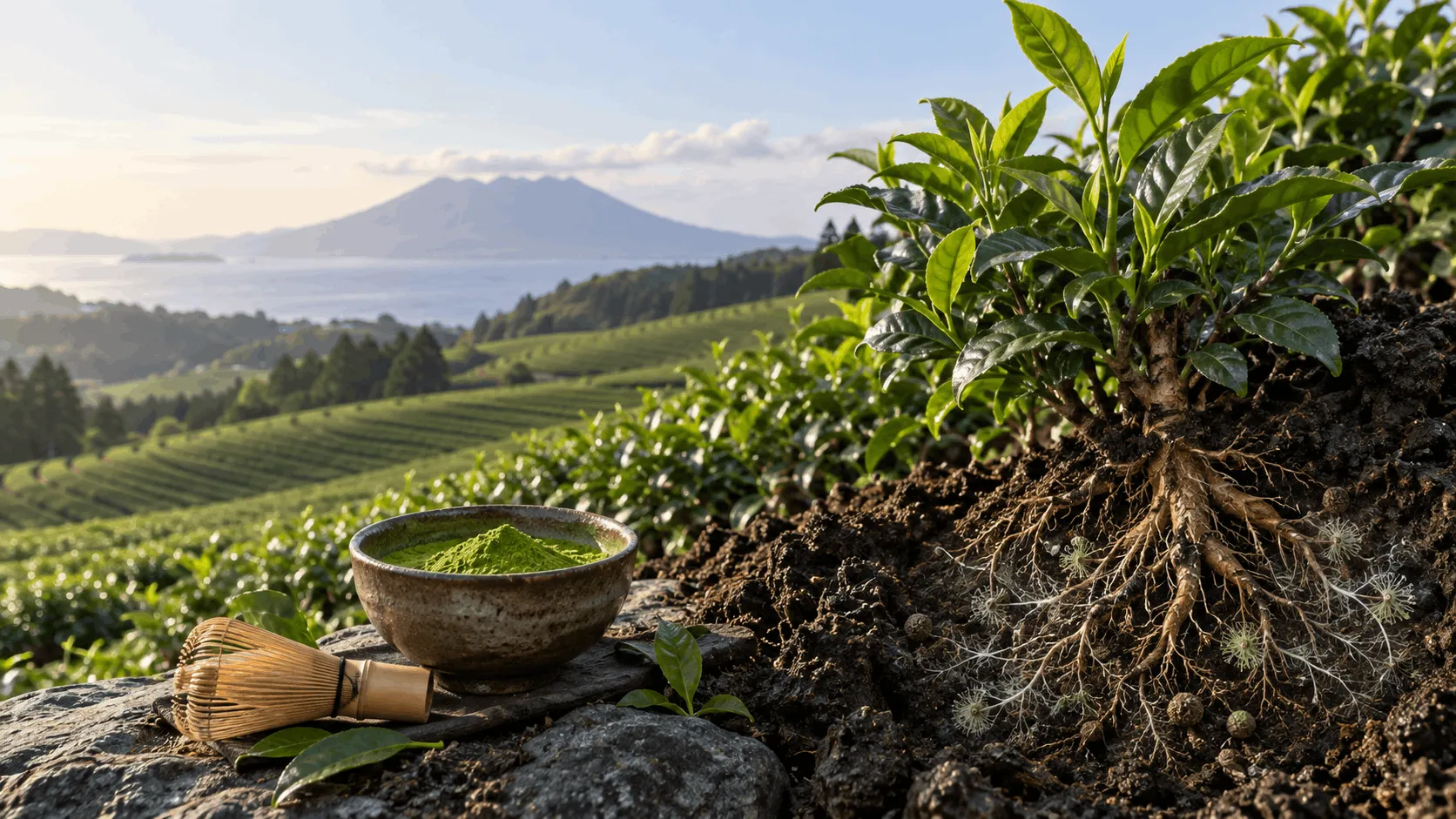
Long before a matcha leaf is harvested, an enormous community of bacteria, fungi and other microorganisms is living around its roots. Together, these microorganisms form part of the soil microbiome.
They are invisible when you look across a green tea field, but they are very much part of the environment in which the plant grows.
That idea is at the heart of Gozen Samurai’s microbiome-grown matcha.
Rather than treating soil simply as something that holds the tea plant upright, microbiome-focused cultivation looks at soil as a living ecosystem. Gozen’s approach in Kagoshima aims to encourage beneficial microorganisms around its tea plants while combining this newer agricultural thinking with established Japanese matcha-growing practices.
So what exactly does “microbiome-grown matcha” mean?
And does it mean there are probiotics inside your cup?
Not quite.
Here’s the story from the soil up.
First, What Is a Soil Microbiome?
The word microbiome can sound more complicated than it really is.
Think about a handful of healthy soil.
It contains minerals, organic matter, moisture and plant roots—but it can also contain an extraordinary community of microscopic organisms.
Some live directly around the roots of a plant in an area scientists call the rhizosphere.
This underground ecosystem matters because plants don’t operate independently of the soil around them. Microorganisms can participate in nutrient cycling, interact with plant roots and influence the environment in which plants grow.
Tea is no exception.
Scientific research into Camellia sinensis, the tea plant used to make green tea and matcha, has increasingly examined these relationships. Studies have found associations between tea-plant rhizosphere microbial communities, soil nutrients, plant growth and characteristics related to tea quality. Researchers are still working to understand exactly how these interactions work and how much individual microbial communities influence the finished leaf.
In other words, soil isn’t simply dirt.
It is an ecosystem.
And that ecosystem is where Gozen’s approach begins.
So, What Is Microbiome-Grown Matcha?
Microbiome-grown matcha is matcha produced from tea plants cultivated with deliberate attention to the microbial ecosystem surrounding their roots.
For Gozen Samurai, the concept involves working with microorganisms associated with the tea-growing environment in Kagoshima and encouraging those microbial relationships within the plantation soil.
Gozen describes its approach as microbiome farming.
According to the brand, microbial strains associated with old tea-growing environments in Kagoshima’s volcanic hills were identified and reintroduced into plantation soils as part of its cultivation approach. Gozen presented this microbiome-farming story internationally during Expo 2025 Osaka.
The important distinction is this:
The microbiome work happens primarily during cultivation.
It isn’t simply a powder added to finished matcha.
The idea is to create a biologically active growing environment around the tea plant itself.
It Starts in Kagoshima’s Soil
Gozen Samurai’s matcha comes from Kagoshima in southern Japan, one of the country’s major tea-growing regions.
Kagoshima’s volcanic landscape is an important part of the story.
But volcanic minerals alone don’t explain microbiome farming.
What matters from a microbiome perspective is what is happening where the soil, microorganisms and tea roots meet.
Research into tea plantations has shown that factors including soil chemistry, pH, altitude, agricultural management and tea variety can influence microbial communities in plantation soils. One large study examining ancient tea plantations, for example, found substantial differences in bacterial and fungal communities depending on environmental conditions.
That helps explain why microbiome agriculture is more complicated than simply adding “good bacteria” to soil.
A healthy root environment involves relationships between:
- Soil composition
- Organic matter
- Moisture
- Plant variety
- Bacteria
- Fungi
- Root compounds
- Farming practices
- Climate
The tea plant is interacting with that environment throughout its growth.
How Gozen Samurai’s Microbiome Growing Process Works
The easiest way to understand Gozen’s approach is to follow the tea plant from underground to cup.
1. Start With the Local Tea-Growing Ecosystem
Instead of looking only at the tea leaves, microbiome farming begins by looking at the environment surrounding the plant.
Gozen’s cultivation philosophy focuses particularly on microorganisms naturally associated with Kagoshima’s tea-growing landscape.
Why look locally?
Because plants and microbial communities develop relationships within particular environments.
Research published on tea rhizospheres suggests that even different tea cultivars can recruit different microbial communities around their roots. Those communities can also correlate with differences in nutrient availability and plant characteristics.
This is one reason microbiome farming is not simply the same as applying a generic agricultural additive everywhere.
The environment matters.
2. Encourage Beneficial Microbial Activity in the Soil
The next part is maintaining a soil environment where useful microbial communities can function.
Microorganisms around roots can participate in processes involving nutrients such as nitrogen and phosphorus, organic matter and plant stress responses.
Research into tea cultivation increasingly suggests that farming practices can significantly affect these microbial communities. For example, a recent tea-field study found that different fertilization approaches produced measurable differences in microbial biomass, microbial community structure and tea-plant growth characteristics.
Gozen’s philosophy is therefore not simply:
Feed the tea plant.
It is closer to:
Support the ecosystem that helps support the tea plant.
That is a subtle but important difference.
3. Let the Tea Plant and Soil Ecosystem Interact
This is perhaps the most interesting part.
Plants don’t simply sit passively in soil waiting for nutrients.
Their roots release compounds into the surrounding environment. Those compounds can influence which microorganisms thrive near the plant.
Microorganisms, in turn, can influence nutrient cycling and other conditions around the roots.
Scientists increasingly refer to this interconnected relationship as the plant-soil-microbe interaction.
A scientific review of the tea microbiome describes microorganisms as potentially contributing to nutrient acquisition, plant growth, stress management and sustainable tea production.
That doesn’t mean one particular bacterium automatically creates better-tasting or healthier matcha.
Biology is more complicated than that.
But it does mean the environment beneath the tea field deserves much more attention than it traditionally receives in consumer conversations about tea.
Then Traditional Matcha Cultivation Takes Over
Microbiome farming doesn’t replace traditional matcha cultivation.
It sits underneath it.
Once the tea plants are growing, many of the steps associated with high-quality Japanese matcha still matter.
One of the most important is shading.
Before harvest, tea plants intended for matcha are typically covered for several weeks, reducing the amount of direct sunlight reaching the leaves.
This changes how the plant grows.
Shading is associated with increased chlorophyll and helps preserve amino acids such as L-theanine while changing the balance of compounds responsible for bitterness and umami.
The result is the deeper green colour and smoother, more savoury flavour associated with good matcha. Gozen uses shade cultivation as part of its broader Japanese matcha production process.
So there are really two environments influencing the plant:
Below ground: soil, roots and microbial communities.
Above ground: sunlight, shade, climate and farming decisions.
Both matter.
Harvesting the Leaves
When harvest arrives, young tea leaves intended for quality matcha are collected and processed toward tencha, the leaf material eventually ground into matcha.
Harvest timing matters because the chemistry, tenderness and flavour of tea leaves change during the growing season.
Gozen places particular emphasis on premium Japanese matcha from Kagoshima and combines this traditional production logic with its microbiome-focused cultivation philosophy.
But microbiome cultivation doesn’t turn an ordinary leaf into matcha by itself.
The rest of the craft still matters:
how the leaf was grown, shaded, harvested, steamed, dried, sorted, stored and ground.
From Tencha to Matcha
After processing, the prepared tencha is finely ground into the powder we recognize as matcha.
Traditional stone grinding is deliberately slow.
That matters because matcha is consumed differently from ordinary steeped tea.
When you steep green tea, you drink an infusion and discard the leaves.
With matcha, the leaf itself has been ground into powder and dispersed into water.
You are consuming the tea leaf rather than simply extracting part of it.
That is why decisions made much earlier—while the plant was still standing in Kagoshima soil—remain relevant to the finished powder.
Does Microbiome-Grown Mean the Matcha Contains Probiotics?
This is where terminology can easily become confusing.
Not necessarily.
Microbiome farming and probiotic food are two different ideas.
A probiotic product normally contains specific live microorganisms intended to remain viable in the product when consumed.
Microbiome-grown matcha describes how the tea plant is cultivated.
The focus is the microbial environment surrounding the plant during growth.
So it would be inaccurate to assume that every bowl of microbiome-grown matcha automatically contains live probiotic cultures simply because microorganisms were involved in the farming system.
A simpler way to remember it is:
Probiotic = microorganisms in a consumable product.
Microbiome farming = microorganisms involved in the growing ecosystem.
That difference matters.
Does the Soil Microbiome Change the Matcha?
This is the question scientists are beginning to explore.
There is good evidence that microorganisms in the tea rhizosphere interact with soil nutrients and tea plants.
Researchers have identified relationships between microbial community composition and factors including nutrient status, growth, plant phenotype and characteristics relevant to tea quality.
What science does not yet justify is turning those findings into overly simple claims such as:
One particular soil bacterium guarantees more antioxidants.
or:
Microbiome farming automatically creates healthier matcha.
Those conclusions require direct testing of the specific farming system and finished tea.
Gozen describes its microbiome cultivation as supporting the development of desirable compounds in its tea plants, including amino acids such as L-theanine. The brand also connects the process with its broader interest in gut wellness.
The most scientifically careful way to describe it is this:
Gozen’s microbiome-growing process is designed to cultivate tea within a carefully managed living soil ecosystem, based on the growing scientific understanding that soil microbes and tea plants interact.
That is interesting enough without turning it into a miracle claim.
What About Gut Health?
This is another area where two different ideas are often mixed together.
There is growing research interest in how tea compounds such as polyphenols interact with the human gut microbiome.
Separately, there is agricultural research exploring how the soil microbiome interacts with the tea plant.
Those are not the same microbiome.
Gozen brings these two areas together as part of its brand philosophy, but they should still be understood separately:
Soil microbiome → tea cultivation
Human gut microbiome → what happens after food and drink are consumed
Microbiome-grown matcha should therefore not be interpreted as a medical treatment or as proof that the farming method alone changes a person’s gut microbiome.
Instead, Gozen’s approach starts earlier—with how the plant itself is grown.
Is Microbiome Farming the Future of Matcha?
Possibly—but the more interesting question may be whether it represents the future of agriculture more broadly.
For much of modern farming, plant nutrition has often been described almost like an equation:
add nutrients → grow plant → harvest crop.
Microbiome research suggests the real picture is much more interconnected.
There is the plant.
There is the soil.
There are the microorganisms.
And there are constant interactions between all three.
For tea, this field is still developing. Scientists continue to study which microorganisms matter, how farming practices influence them and whether microbiome management can reliably affect yield, resilience, flavour or leaf chemistry.
That makes microbiome farming less of a finished scientific answer and more of an emerging agricultural direction.
Gozen Samurai’s decision to apply it to Japanese matcha is unusual precisely because matcha is normally marketed through what happens above the soil:
shade.
harvest.
cultivar.
region.
stone grinding.
Microbiome cultivation adds another layer:
the life surrounding the roots.
Tradition Above Ground, Innovation Below It
There is an appealing contradiction at the centre of microbiome-grown matcha.
The final drink looks ancient.
A bowl.
Green powder.
Water.
A bamboo whisk.
Very little about it appears technological.
Yet before that powder reaches the bowl, modern microbiology can now examine an ecosystem invisible to generations of tea farmers before us.
That doesn’t make traditional knowledge obsolete.
If anything, it helps explain something farmers have understood intuitively for centuries: healthy tea starts with healthy land.
Gozen Samurai’s approach brings the two ideas together.
Japanese tea tradition guides how the plant is shaded, harvested, processed and enjoyed.
Modern microbiome research asks us to look deeper—quite literally—at what is happening around the roots.
And perhaps that is the simplest way to understand microbiome-grown matcha.
It isn’t about changing matcha into something unrecognizable.
It is about paying closer attention to the living ecosystem that helps create the leaf in the first place.
For Gozen Samurai, that journey starts in the volcanic tea fields of Kagoshima and ends with something remarkably simple:
a bowl of matcha.
FAQ about microbiome matcha
What is microbiome-grown matcha?
Microbiome-grown matcha is matcha made from tea plants cultivated with deliberate attention to the living microbial ecosystem around their roots. The idea is to support beneficial soil microorganisms that interact with the tea plant during growth, rather than treating soil only as a source of nutrients.
How does Gozen Samurai grow microbiome matcha?
Gozen Samurai applies a microbiome-focused cultivation approach in Kagoshima by supporting the soil environment around its tea plants and encouraging beneficial microbial activity. This works alongside traditional Japanese practices such as shading, careful harvesting, tencha processing and fine grinding.
Does microbiome-grown matcha contain probiotics?
Not necessarily. Microbiome-grown refers to the way the tea plant is cultivated, not to live probiotic cultures being added to the finished matcha. The microbiome in this context is primarily the community of microorganisms living in and around the plantation soil.
Why is the soil microbiome important for tea plants?
Soil microorganisms can participate in nutrient cycling and interact with plant roots. Research on tea plants suggests that rhizosphere microbial communities are associated with soil conditions, nutrient availability and plant development, although scientists are still studying exactly how these relationships affect finished tea quality.
Is microbiome-grown matcha healthier than regular matcha?
There is not enough evidence to say that microbiome-grown matcha is automatically healthier than conventionally grown matcha. The cultivation method is designed around supporting a living soil ecosystem, but the nutritional profile of finished matcha also depends on cultivar, harvest, shading, processing, freshness and other factors.
Where is Gozen Samurai microbiome-grown matcha produced?
Gozen Samurai sources its matcha from Kagoshima in southern Japan, a major Japanese tea-growing region. The brand combines Kagoshima tea cultivation with its microbiome-focused farming philosophy and traditional matcha production methods.




[…] Matcha interacts with the digestive system and gut microbiota. […]