
By admin
Posted in editor pick | Tags : ceremonial matcha dubai, gozen matcha, L-theanine caffeine matcha, matcha before battle, samurai matcha history
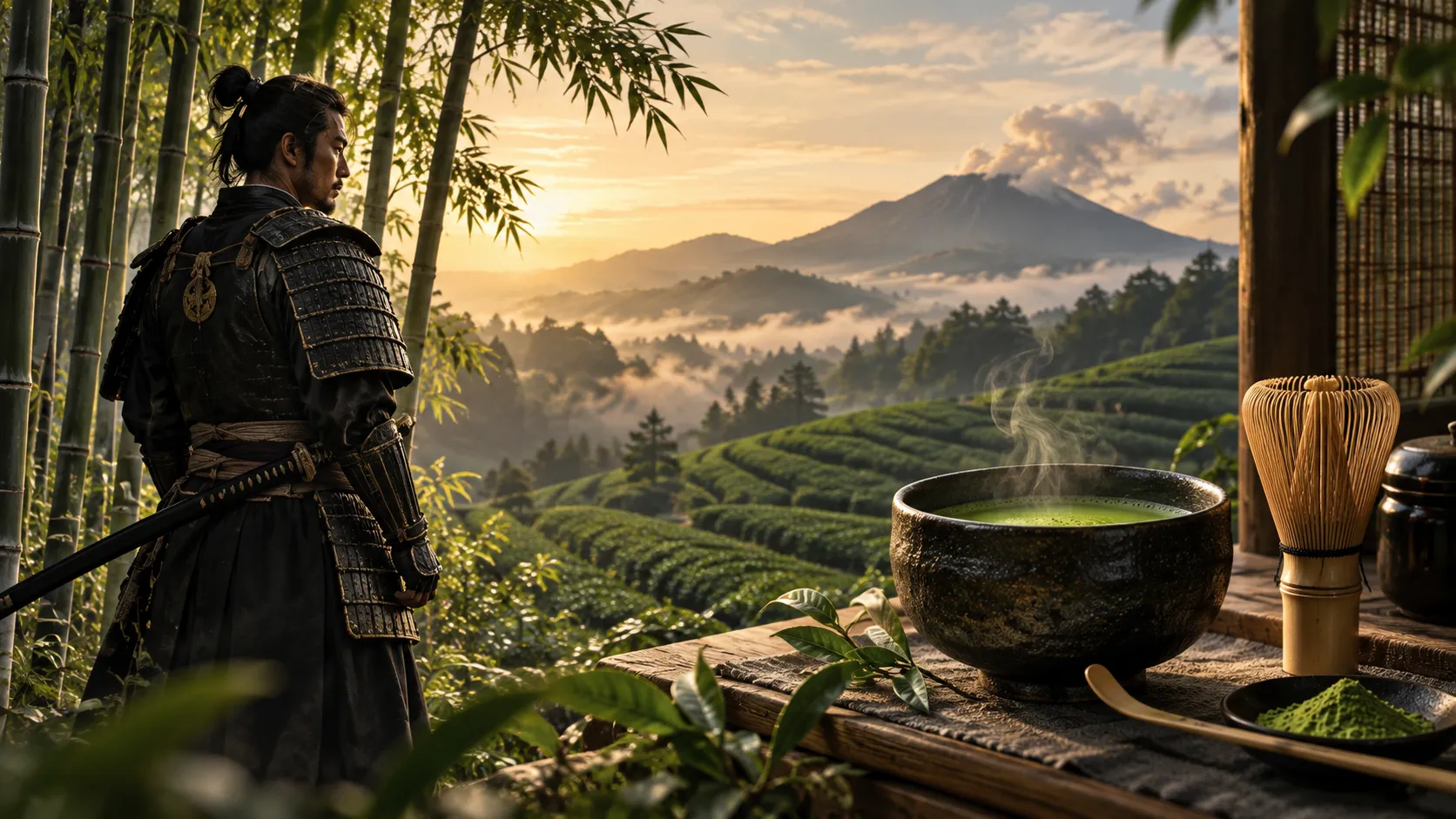
A samurai never walked into battle jittery.
Think about that for a second. Here was a warrior about to face the single highest-stakes moment of his life — blade drawn, outcome uncertain, no second attempt if his hand shook at the wrong moment. And the drink he reached for beforehand wasn’t something to hype him up. It was something to calm him down.
That should strike you as strange. Everything we’re told about performance today says the opposite: hype yourself up, get the adrenaline flowing, chase the spike. So why did the people with the most to lose choose calm over chaos?
The Ritual Before the Blade
For nearly 400 years, matcha has been inseparable from samurai culture. Before duels, before campaigns, before the tea ceremony was even formalized as an art form, warriors were drinking stone-ground green tea for one specific reason: zanshin — a state of relaxed, unbroken awareness. Not hyper-alert. Not wired. Just… present. Ready. Unshaken.
This wasn’t superstition. It was survival strategy. A warrior who was too amped up made rash decisions. A warrior who was sluggish reacted too slowly. Matcha, somehow, put them in the narrow window between the two — and they trusted it enough to build a ritual around it, generation after generation.
The Gozen family has been part of that lineage since 1635 — 13 generations, cultivating the same shade-grown, stone-ground tea in Kagoshima that warriors once relied on before facing the thing they feared most.
Which raises the obvious question: what did they know that we’ve forgotten?
Your Battles Look Different. Your Chemistry Doesn’t.
You’re probably not drawing a blade today. But be honest — how many “battles” have you already walked into this week feeling exactly the way that warrior was trying to avoid? The presentation you were too wired for, so you talked too fast and lost the room. The deadline you were too drained for, so you made the sloppy mistake you’d normally never make. The meeting where your hands were literally shaking from your third coffee, and you couldn’t tell if it was nerves or caffeine anymore.
We’ve built an entire culture around chasing the spike — more caffeine, more stimulation, more “hustle energy” — and then wondering why we crash by 3 PM, snap at people we didn’t mean to, or forget what we walked into a room to say.
Here’s the uncomfortable part: the samurai figured out 400 years ago that the spike was the problem, not the solution. We’re only just catching up.
What Was Actually Happening in the Cup
Modern research gives us the mechanism the samurai never needed a lab to prove. Matcha contains both caffeine and an amino acid called L-theanine — and the two work together, not against each other. L-theanine slows the release of caffeine and promotes alpha brain wave activity, the same state associated with relaxed focus. The result isn’t a jolt. It’s a rise, followed by a plateau, not a crash.
That’s the entire difference between a warrior who could hold steady for hours and someone who needed a fourth espresso just to make it through a 2 PM call. It’s not motivation. It’s not discipline. It’s chemistry — and the samurai were drinking the right chemistry without ever needing to name it.
This is also why authentic, shade-grown, stone-ground japanese matcha in Dubai tastes and feels different from the sweetened powders sold as a trend. The ritual only works if the tea itself is real — shade-grown to concentrate the L-theanine, stone-ground slowly so nothing is lost in processing. Skip that, and you’re just drinking green food coloring with a caffeine kick.
So What Would Change If You Stopped Chasing the Spike?
Here’s the question worth sitting with: how much of your day is spent recovering from your own energy choices, instead of actually using your energy? The jitters you push through. The crash you plan your afternoon around. The “wired but tired” feeling you’ve quietly accepted as normal.
The samurai didn’t have that problem — not because their battles were less demanding than yours, but because they treated calm as a weapon, not a weakness. They understood that the sharpest version of you isn’t the most stimulated one. It’s the steadiest one.
You don’t need a sword to test that theory. You need one cup, made the way it’s been made for four centuries, and one morning where you notice the difference between feeling amped up and actually feeling ready.
What would you do differently today if you weren’t running on a caffeine spike you’re already bracing to crash from?
Frequently Asked Questions
Did samurai actually drink matcha before battle, or is that a myth?
It’s well documented, not just folklore. Matcha became embedded in samurai culture from the 12th century onward, used both in the formal tea ceremony and informally before combat. The appeal wasn’t ceremony for ceremony’s sake — warriors valued the specific mental state it produced: alert but not agitated, focused but not tense. That’s the state referred to as zanshin.
What’s the actual difference between matcha and regular green tea?
With steeped green tea, you infuse the leaves in water and discard them — you’re only getting what dissolves out. With matcha, the entire leaf is stone-ground into a powder and consumed directly, which is why matcha delivers a more concentrated dose of L-theanine, antioxidants, and caffeine than a steeped cup ever could. It’s also why low-quality matcha is so noticeable — there’s nowhere for shortcuts to hide when you’re drinking the whole leaf.
Why doesn’t matcha give you the same jitters as coffee?
Coffee delivers caffeine on its own, so your body absorbs it quickly and the effect peaks and drops fast. Matcha pairs caffeine with L-theanine, an amino acid that slows caffeine absorption and encourages alpha brain wave activity — the same relaxed-but-alert state linked to calm focus. That’s the difference between a spike and a plateau, and it’s the entire reason matcha was a battlefield ritual rather than just a beverage.
How much caffeine is in matcha compared to coffee?
A typical serving of matcha has somewhat less caffeine than a cup of drip coffee, but the experience of that caffeine is what changes — the L-theanine pairing means it releases more gradually, so you feel steadier for longer rather than hit-and-crash.
Does the quality of the matcha actually matter, or is it all the same?
It matters more than most people realize, precisely because you’re consuming the whole leaf. Shade-growing increases chlorophyll and amino acid content before harvest; slow stone-grinding preserves flavor and nutrients that fast, mechanical processing destroys. Skip either step and you get the bitter, chalky, overly caffeinated matcha that gives the whole category a bad reputation — not because matcha itself is the problem, but because the version being sold isn’t authentic.
What should I look for to make sure I’m buying real, high-quality matcha?
Three things: origin (Japanese-grown, ideally with a named region like Kagoshima or Uji), grade (ceremonial for drinking straight, culinary for lattes and baking — and know which one you’re actually buying), and color (vivid, vibrant green — dull or yellowish powder usually signals age or poor processing).
Where can I find authentic Japanese matcha in Dubai?
Gozen Samurai sources matcha directly from its own family-run, shade-grown plantations in Kagoshima, Japan, and ships it to Dubai through its Al Quoz hub. If you’re comparing options, ask any seller directly about growing region, grade, and grinding method; that alone filters out most of the market.
Gozen Samurai has carried the same 400-year matcha tradition from Kagoshima, Japan to Dubai — shade-grown, stone-ground, and made the way it was always meant to be. Explore the range at gozen-samurai.com.




No comments yet.