By admin
Posted in ceremonial match, premium matcha | Tags : gozen matcha, Gut Health, matcha vs coffee energy, microbiome Matcha
Let’s be honest. Most of us don’t wake up and choose our morning drink for health reasons. We choose it because we need it. That jolt, that warmth, that familiar ritual that tells our body: okay, the day is starting now.
For most of the world, that drink is coffee. It’s quick, it’s strong, and it works. Nobody’s going to argue with three hundred years of global dominance.
But over the last few years, something has been quietly changing. People are tired — not just in the morning, but tired of the crash, the jitters, the second cup that becomes a third, the afternoon anxiety that arrives uninvited. And a growing number of them are landing on the same alternative: matcha.
Not the bright green powder in a smoothie chain. The real thing. Ceremonial-grade, stone-ground, single-estate matcha from Japan. The kind that has been a daily ritual in the lives of samurai, monks, and Japanese nobility for over four centuries.
So let’s have the conversation properly. Matcha versus coffee — what’s actually different, what does the science say, and which one is right for you?
First, What Exactly Are You Drinking?
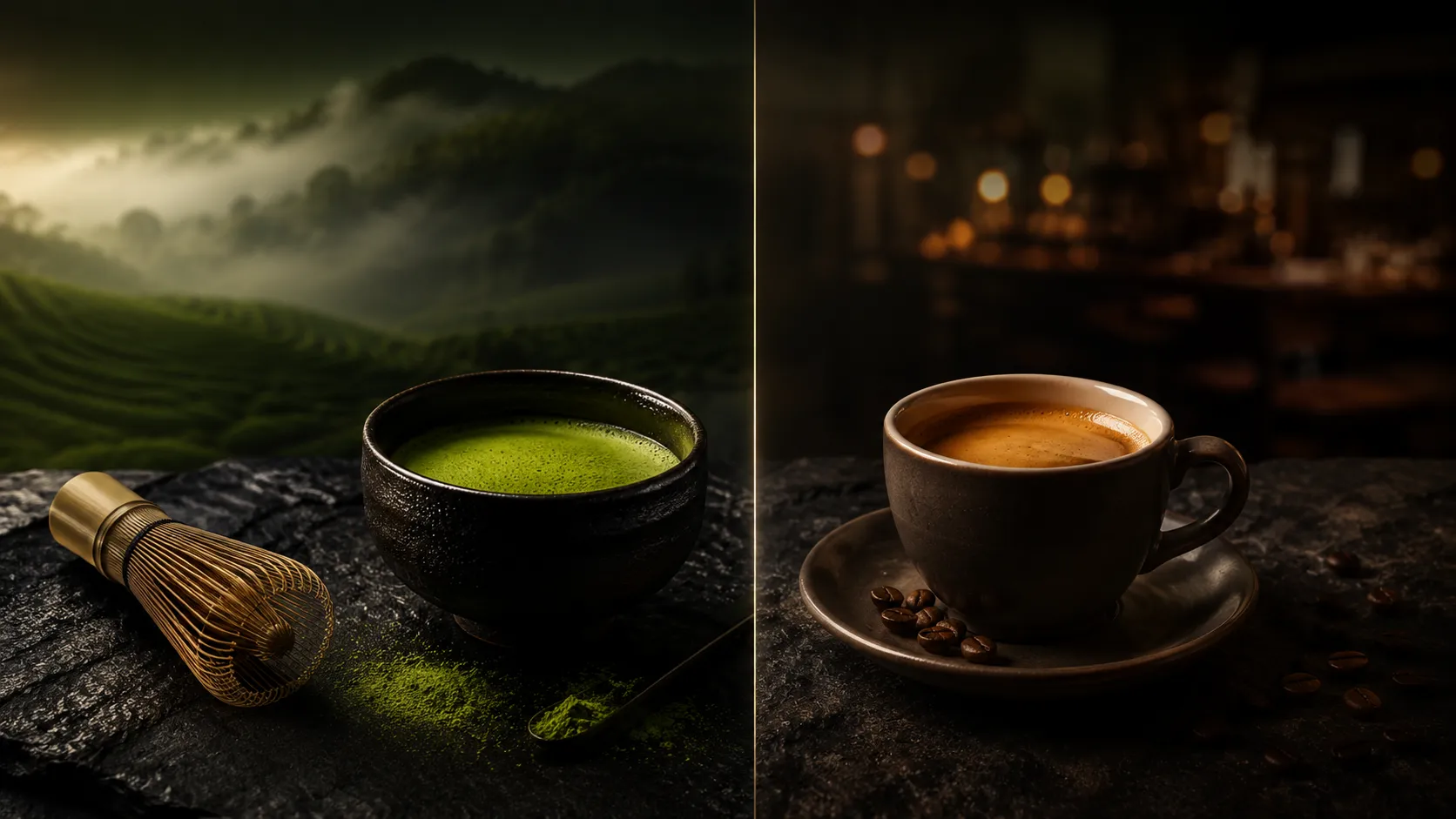
Coffee
Coffee is made by brewing the roasted seeds (beans) of the Coffea plant, primarily Coffea arabica or Coffea robusta. Hot water passes through the grounds, extracting caffeine, oils, acids, and hundreds of aromatic compounds. You drink the infusion — the plant material stays behind.
The result is a fast-acting, high-caffeine drink. A standard espresso delivers roughly 60–80mg of caffeine. A large filter coffee can easily exceed 200mg. It hits your bloodstream fast, peaks within 30–45 minutes, and the withdrawal symptoms (the headache, the fog) are real and well-documented.
Matcha
Matcha is fundamentally different in one critical way: you consume the entire tea leaf. The young leaves of shade-grown Camellia sinensis plants are stone-ground into a very fine powder, which you then whisk directly into water or milk. Nothing is discarded. Every compound the plant produced — the chlorophyll, the amino acids, the antioxidants, the caffeine — goes into your cup.
This matters enormously for how your body experiences it. And it’s why the comparison between matcha and coffee isn’t simply about caffeine count. It’s about the entire biochemical profile of what you’re consuming.
Matcha vs Coffee at a Glance
| Feature | 🍵 Matcha | ☕ Coffee |
| Caffeine (per cup) | ~35–70mg | ~80–200mg |
| L-theanine | High (natural calming agent) | Absent |
| Energy onset | Gradual (20–40 mins) | Fast (15–30 mins) |
| Energy duration | 4–6 hours, steady | 1–3 hours, peaks & crashes |
| Antioxidants (EGCG) | Very high | Present (chlorogenic acids) |
| Acidity | Alkaline / low acid | High acid |
| Effect on cortisol | Neutral to calming | Raises cortisol |
| Gut impact | Supports microbiome | Can irritate gut lining |
| Teeth staining | Minimal | Significant |
The Energy Question: Why Matcha Feels Different
This is the part that surprises most people when they first make the switch.
Matcha does contain caffeine — typically between 35 and 70mg per serving, depending on grade and preparation. That’s less than coffee, but that’s not the main story. The main story is L-theanine.
L-theanine is a naturally occurring amino acid found almost exclusively in tea leaves, and matcha contains it in particularly high concentrations. It promotes alpha brainwave activity — the mental state associated with calm alertness, the kind you experience during light meditation or deep creative focus. And here’s what makes it remarkable: L-theanine and caffeine work together synergistically.
Caffeine alone speeds everything up — your heart rate, your thoughts, your anxiety. L-theanine acts as a modulator. It takes the edge off the stimulation while preserving, even enhancing, the focus. The result is what drinkers and researchers both describe as “calm alertness” — wide awake, mentally sharp, without the nervous energy that makes you check your phone every four minutes.
Coffee doesn’t offer this. Coffee gives you the engine without the steering. Matcha gives you both.
The practical difference is real and noticeable. Coffee tends to peak sharply and then decline, often triggering a cortisol spike that contributes to that mid-morning anxiety many drinkers recognise. Matcha’s energy curve is slower and longer — most people describe a sustained four to six hours of clear, grounded focus, without the tail-end crash.
What About the Health Benefits?
The Antioxidant Advantage
Matcha is one of the most antioxidant-dense foods ever measured. The key compound is EGCG — epigallocatechin gallate — a catechin found in green tea that has been the subject of hundreds of clinical studies. Because matcha involves consuming the whole leaf, its EGCG concentration is dramatically higher than steeped green tea. Estimates suggest matcha delivers up to 137 times more EGCG than standard brewed green tea.
Coffee also contains antioxidants — primarily chlorogenic acids — and is, in fact, one of the largest sources of antioxidants in many Western diets purely due to consumption volume. But the comparison on antioxidant density strongly favours matcha.
Gut Health
This is an area of growing research, and one where the difference between matcha and coffee is perhaps most significant for daily drinkers.
Coffee is highly acidic and stimulates stomach acid production, which is why many people experience reflux, heartburn, or digestive discomfort. For those with irritable bowel syndrome or sensitive gut lining, daily coffee consumption can be genuinely problematic.
Matcha behaves differently. The EGCG in matcha supports the growth of beneficial gut bacteria — Lactobacillus in particular — and has anti-inflammatory effects on the gut lining. At Gozen, our matcha is grown using advanced microbiome farming techniques on volcanic Kagoshima soil that is naturally rich in minerals, which preserves the integrity of the tea leaf’s beneficial compounds from ground to cup.
Cognitive Function
Both drinks have well-evidenced cognitive benefits. Caffeine improves reaction time, working memory, and sustained attention — coffee and matcha both deliver this. But the L-theanine in matcha adds something coffee cannot: a measurable reduction in task-switching anxiety and an improvement in attention quality under stress. For knowledge workers, creatives, and anyone who spends long hours in deep focus, this distinction is practically significant.
The Ritual Matters More Than You Think
There’s a reason the Japanese tea ceremony — chado — has persisted for centuries as a living practice rather than a historical curiosity. The ritual of preparing matcha is, in itself, a mindfulness exercise.
You sift the powder. You heat the water to exactly 70–80 degrees — never boiling, which would destroy the L-theanine. You whisk in a W-motion until the surface is foam. You hold the bowl with both hands. You drink in three and a half sips — a tradition that traces back to the samurai courts of feudal Japan.
None of this is theatre. Each step has a functional purpose: the temperature protects the amino acids, the whisking ensures even dispersion, the deliberate pace forces a moment of pause in the day. Compare this to hammering the button on a Nespresso machine between emails, and you begin to understand why matcha drinkers often report something beyond a caffeine effect. They report a shift in their relationship with their own mornings.
This is what the Gozen family has understood for thirteen generations. Our matcha is not a product. It is a practice. The tea leaves that go into every Gozen tin are shade-grown for three weeks before harvest — a process that dramatically boosts L-theanine and chlorophyll content — hand-picked, then stone-ground at slow speed to prevent heat degradation. The result is a powder of extraordinary quality, a tool for the kind of mornings worth having.
Who Should Make the Switch — And Who Shouldn’t
Consider switching to matcha if you…
- Experience coffee jitters, heart palpitations, or anxiety after your morning cup
- Notice an energy crash in the mid-morning or early afternoon
- Have acid reflux, heartburn, or a sensitive stomach
- Are trying to reduce overall caffeine intake without losing mental clarity
- Struggle with sleep quality (matcha’s lower caffeine and higher L-theanine are gentler on sleep architecture)
- Want a morning ritual that feels intentional rather than automatic
Stick with coffee if you…
- Need maximum caffeine impact quickly — for early shifts, night drives, or extreme fatigue
- Simply love the flavour and have no negative side effects
- Are highly sensitive to umami or vegetal flavours (matcha is an acquired taste for some)
The honest answer is that these two drinks serve different purposes and different bodies. Many people we hear from drink matcha in the morning for its focused calm, and have a single espresso later in the day when they want the stronger hit. The combination is increasingly common among high-performers, athletes, and executives.
Frequently Asked Questions
Does matcha have more caffeine than coffee?
No. A standard serving of ceremonial matcha contains approximately 35–70mg of caffeine, compared to 80–200mg in a cup of coffee. However, the presence of L-theanine in matcha modulates the caffeine’s effect, creating a calmer, more sustained energy than coffee provides.
Can I replace my morning coffee with matcha?
Yes, and many people do. The transition typically takes one to two weeks as your body adjusts to lower caffeine levels. Most people report that after the initial adjustment, they feel more consistently energised on matcha than they did on coffee, without the dependency cycle.
Is matcha better than coffee for anxiety?
For people whose anxiety is caffeine-related, matcha is generally a better choice. L-theanine has clinically demonstrated anxiolytic (anti-anxiety) effects, and several studies show it reduces the cortisol spike associated with high caffeine intake. If your coffee makes you feel wired or on-edge, matcha is worth trying.
What grade of matcha is best for daily drinking?
Ceremonial-grade matcha is the highest quality and the most appropriate for drinking straight with water. Culinary-grade matcha is designed for cooking and baking, where its slightly more bitter, robust flavour blends into recipes. For the full L-theanine and EGCG benefit, ceremonial grade is the right choice.
How should I prepare matcha for the best result?
Use water heated to 70–80°C (never boiling). Sift 1–2 teaspoons of matcha powder into your bowl. Add a small amount of water and whisk vigorously in a W-motion until a fine foam forms, then add the remaining water. The quality of your matcha powder makes a significant difference — poorly processed matcha will be bitter regardless of preparation.
The Verdict
Coffee is not going anywhere, and it shouldn’t. For billions of people it is a pleasure, a ritual, a cultural touchstone. But if you are asking which drink is better designed for how most of us actually want to feel — focused, calm, present, and energised for hours rather than minutes — the case for ceremonial matcha is compelling.
The science supports it. The history supports it. And for those who have made the switch, the lived experience tends to be the most persuasive argument of all.
At Gozen, we have been growing, grinding, and sharing this particular kind of morning for 390 years. The volcanic soil of Kagoshima, the shade-grown leaves, the slow stone-grinding — none of this is by accident. It is the accumulated knowledge of thirteen generations applied to a single question: how do you make a cup of tea that is worth the entire morning?
We think we have an answer. Come and find out for yourself.
→ Explore Gozen Ceremonial Matcha at gozen-samurai.com/matcha-powder/
About the Author
Machiko Gozen is a 13th generation Japanese tea master and the founder of Gozen Samurai. Born into a samurai family lineage with roots dating to 1635, she trained in traditional Japanese tea ceremony from childhood before establishing Gozen to bring single-estate Kagoshima ceremonial matcha to the world. Her matcha has been served at Expo 2025 Osaka and is consumed by several royal families worldwide.




[…] matcha and plain coffee are both low-calorie beverages. The real calorie risk in either case comes from sugary syrups, […]