
By admin
Posted in ceremonial matcha, Organic green tea, Tea Education | Tags : Matcha Powder, microbiome Matcha, organic green tea, premium matcha
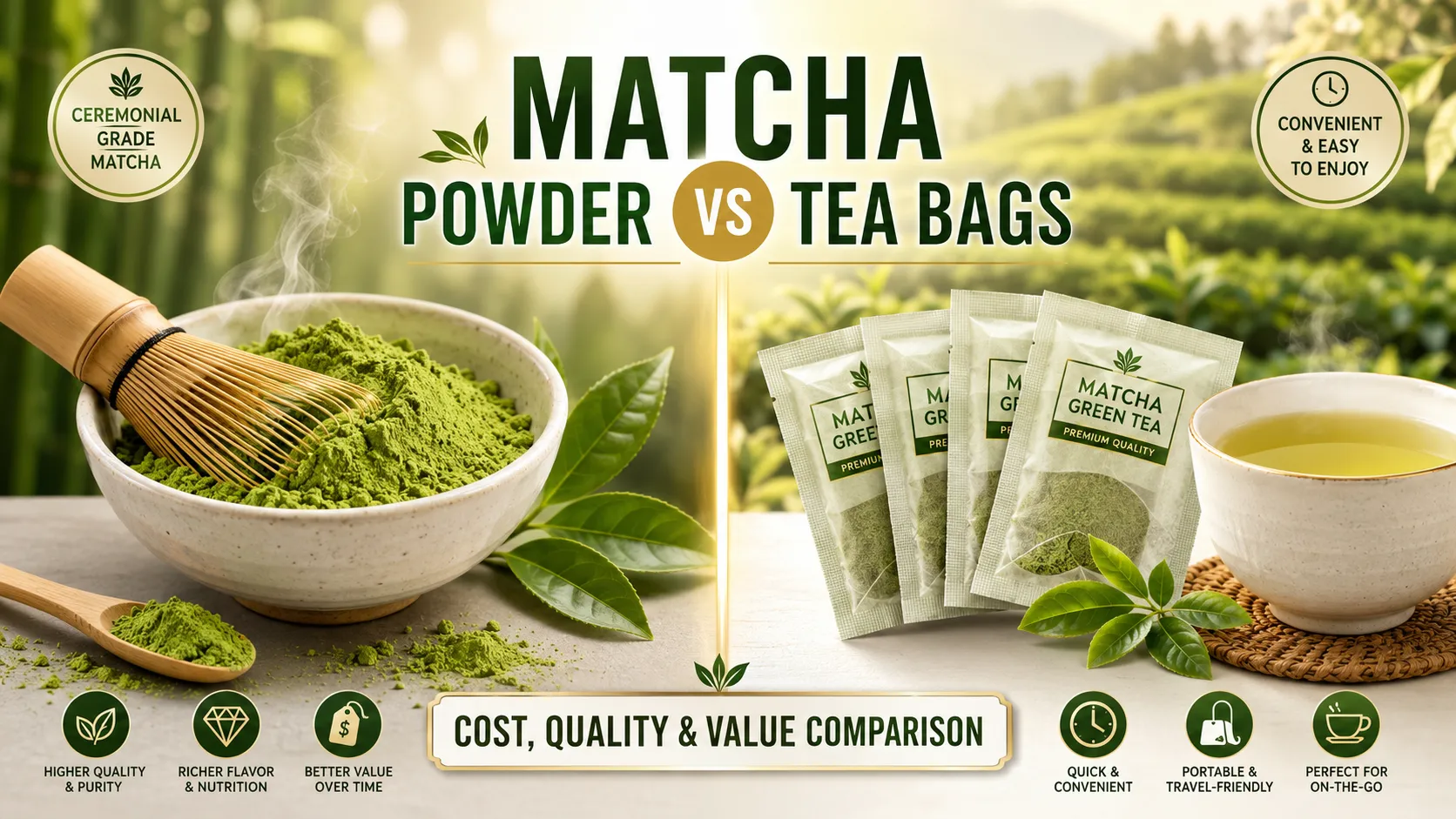
Choosing between matcha powder and matcha tea bags can feel overwhelming when you’re trying to find the best value for your money and health goals. Both options deliver the vibrant green color and potential wellness benefits matcha is famous for, but they differ significantly in price, preparation time, quality grades, and nutrient retention. This comprehensive comparison helps you make an informed decision based on your lifestyle, budget, and what matters most to you. Whether you’re a wellness enthusiast exploring matcha for the first time or a seasoned matcha drinker looking to optimize your choice, understanding the distinctions between matcha powder versus tea bags is essential. By the end of this guide, you’ll know exactly which option—premium matcha powder or convenient tea bags—delivers the best cost-to-quality ratio for your specific needs and situation.
Key Takeaways
🔹 Matcha powder averages $20-40 per ounce for premium grades vs. $0.50-2.00 per tea bag
🔹 Premium powder costs more upfront but delivers better value long-term (50+ servings per ounce)
🔹 Ceremonial-grade powder offers superior flavor and nutrient density compared to tea bags
🔹 Tea bags provide maximum convenience but may contain lower-grade matcha and additives
🔹 Pure powder retains nutrients better than bagged formats over extended storage
🔹 Your choice depends on lifestyle: powder for quality/value, bags for convenience
What Is Matcha and How Is It Produced?
Understanding the Foundation
Matcha is a finely ground powder made from shade-grown tea leaves (Camellia sinensis) cultivated primarily in Japan. Unlike regular green tea where leaves are steeped then discarded, matcha powder allows you to consume the entire leaf, meaning you ingest all chlorophyll, amino acids, antioxidants, and minerals. This fundamental difference affects everything from nutritional content to pricing.
The Shade-Growing Process
For 20-30 days before harvest, matcha plants receive limited sunlight. This stress triggers increased chlorophyll production (giving it the vibrant green color) and boosts L-theanine levels—an amino acid linked to focus and calm alertness. This labor-intensive cultivation method directly impacts matcha’s cost and quality.
Processing Differences: Powder vs. Tea Bags
Loose Matcha Powder:
- Freshly harvested leaves are steamed, dried, and stone-ground into ultra-fine powder
- No additives, fillers, or processing agents
- Retains complete nutritional profile
- Requires proper equipment for whisking (traditional preparation)
Matcha Tea Bags:
- Contains matcha powder, but often lower grades
- May include binding agents, cellulose, or bulking ingredients
- Some brands add matcha flavoring to supplement insufficient powder quantity
- Designed for simple steeping (hot water + 3-5 minutes)
Matcha Powder vs Tea Bags: Quick Overview
| Feature | Matcha Powder | Matcha Tea Bags |
|---|---|---|
| Price per Serving | $0.40-0.80 | $0.50-2.00 |
| Quality Grade Range | Ceremonial to culinary | Primarily culinary/lower |
| Preparation Time | 2-3 minutes (with whisk) | 3-5 minutes (steeping) |
| Shelf Life | 6-12 months (sealed) | 12-18 months |
| Nutrient Density | Very high (whole leaf) | Moderate to lower |
| Best For | Enthusiasts, daily users | Casual drinkers, on-the-go |
| Storage Needs | Refrigeration recommended | Cool, dry cupboard |
| Flavor Quality | Superior, vibrant taste | Milder, sometimes grassy |
| Environmental Impact | Minimal waste | Bag waste (often non-recyclable) |
Cost Breakdown: Which Is Cheaper?
Matcha Powder Pricing Analysis
Premium Ceremonial Grade:
- $25-45 per ounce ($0.78-1.40 per gram)
- Average serving: 1.5-2 grams
- Cost per serving: $1.17-2.80
- From a 1-ounce container: approximately 14-16 servings
- Best quality, strongest health claims
Culinary Grade Powder:
- $12-20 per ounce ($0.38-0.62 per gram)
- Average serving: 1.5-2 grams
- Cost per serving: $0.57-1.24
- From a 1-ounce container: approximately 14-16 servings
- Budget-friendly, still nutrient-rich
Bulk Purchase Advantage:
- Buying 4-ounce containers: saves 15-25% versus single-ounce
- Price drops to $10-16 per ounce for culinary grade
- Premium bulk: $18-35 per ounce
- Most economical per-serving approach for regular users
Matcha Tea Bags Pricing Analysis
Standard Commercial Brands:
- $8-15 per box (10-15 bags)
- Average cost per bag: $0.67-1.50
- Each bag typically contains 1-2 grams matcha
- Lower ingredient quality than loose powder
- May contain fillers (silica, cellulose) or additives
Premium Tea Bag Brands:
- $15-25 per box (10-12 bags)
- Average cost per bag: $1.25-2.50
- Better matcha quality, fewer additives
- Still more expensive per serving than loose powder
- Limited supply, higher environmental waste
Single-Serve Sachets (Convenient Format):
- $0.75-2.00 per sachet
- Most expensive per-serving option
- Highest convenience factor
- Minimal ingredient transparency
- Maximum packaging waste
Long-Term Cost Comparison (Annual Usage)
Daily Consumer (365 servings/year):
Ceremonial Powder Option:
- 23 ounces required annually
- Cost: $345-920
- Per serving: $0.94-2.52
Culinary Powder Option:
- 23 ounces required annually
- Cost: $276-460
- Per serving: $0.75-1.26
Tea Bag Option:
- 365 bags required annually
- Cost: $244-912
- Per serving: $0.67-2.50
Verdict: Culinary-grade loose powder and standard tea bags cost similarly. Premium powder costs more upfront but offers superior quality justification for daily users willing to invest in health.
Quality Grades Explained
Ceremonial Grade Matcha
Characteristics:
- Finest, youngest leaves from first spring harvest
- Vibrant, bright green color
- Delicate, slightly sweet flavor with vegetal notes
- Smooth mouthfeel, no bitterness
- Highest L-theanine and antioxidant concentration
Best Use: Traditional whisking, special occasions, maximum health benefits
Typical Price: $25-50 per ounce
Availability: Rarely found in tea bags (bags contain culinary grade)
Culinary Grade Matcha
Characteristics:
- Broader leaf selection, may include older leaves
- Still shade-grown, but harvest timing varies
- Darker green, more earthy flavor
- Some bitterness or vegetal notes
- Strong whisking action needed to achieve proper consistency
Best Use: Lattes, smoothies, culinary applications, daily drinking
Typical Price: $12-25 per ounce
Availability: High-quality tea bags occasionally use this grade
Lower-Grade Matcha (Commercial/Culinary)
Characteristics:
- Stems, vein matter, and shade leaf scraps
- Dull green color
- Strong, bitter taste
- Requires flavoring or sweetening
- Significantly lower nutrient profile
Best Use: Cheap tea bags, commercial blends
Typical Price: $6-12 per ounce
Availability: Standard in most commercial tea bag brands
Quality Note: Most matcha tea bags contain this lower grade because manufacturers prioritize shelf stability and cost reduction over flavor and nutrition. Bags also may list matcha as a minor ingredient rather than primary component.
Nutritional Content Comparison
What You’re Actually Consuming
Matcha Powder (1 teaspoon/2 grams – Premium Grade):
- Calories: 5-8
- Chlorophyll: 30-50mg
- L-theanine: 70-140mg
- EGCG (antioxidant): 25-40mg
- Caffeine: 25-70mg
- Protein: 0.3g
- All phytonutrients from whole leaf consumption
Matcha Tea Bag (1 bag/1.5g – Standard Grade):
- Calories: 3-5
- Chlorophyll: 10-20mg (lower due to grade)
- L-theanine: 20-50mg (reduced extraction)
- EGCG: 8-15mg (minimal bioavailability)
- Caffeine: 12-30mg (weaker infusion)
- Protein: 0.1g
- Nutrients trapped in bag material, not fully extracted
Key Nutritional Advantages of Loose Powder
- Complete Nutrient Delivery: You consume 100% of the leaf matter
- L-Theanine Levels: 2-3x higher than tea bag infusions
- Chlorophyll Absorption: Better bioavailability from whisked powder
- No Fillers or Additives: Pure plant nutrition only
- Amino Acid Profile: Full spectrum of amino acids, including GABA
Why Tea Bags Deliver Lower Nutrition
- Smaller matcha particle size reduces surface contact
- Water cannot fully extract nutrients from enclosed leaf
- Lower-grade matcha contains fewer phytonutrients originally
- Heat exposure during bagging may degrade some compounds
- Bag material physically barrier to complete extraction
Taste, Flavor, and Preparation
Matcha Powder: Flavor Profile
Ceremonial Grade:
- Fresh, vegetal sweetness
- Subtle umami undertones
- No bitterness when prepared correctly
- Complex, layered taste experience
- Creamy mouthfeel from proper whisking
Culinary Grade:
- Earthy, grassy notes
- Slight bitterness (intentional for lattes/smoothies)
- Works well with milk, sweeteners, or flavorings
- Bold flavor that stands up to other ingredients
Preparation Steps:
- Heat water to 160-175°F (70-80°C)
- Add 1-2 teaspoons powder to matcha bowl
- Add small amount of water, whisk with bamboo whisk in “M” motion
- Gradually add remaining water (4-6 ounces total)
- Whisk until smooth, frothy layer forms
- Drink immediately while foam is present
Taste Advantage: Superior flavor justifies higher price for daily consumers
Matcha Tea Bags: Flavor Profile
Typical Experience:
- One-dimensional, muted green tea taste
- Often grassy or stale-tasting
- May contain off-flavors from bag materials
- Requires honey, lemon, or milk masking
Preparation (Simplicity Factor):
- Heat water to 160-180°F (70-82°C)
- Place bag in cup
- Add water, steep 3-5 minutes
- Remove bag
- Add milk/sweetener if desired
- Drink
Taste Disadvantage: Convenience prioritized over flavor quality
Brewing Tip: Extended steeping produces bitter taste, as bag material allows excess tannin extraction.
Convenience Factor {#convenience}
When Matcha Powder Makes Sense
Daily Ritual Benefit:
- Meditative preparation time enhances mindfulness
- Whisking creates ceremonial experience
- Investment in proper tools (whisk, bowl) adds to routine
- Perfect for home, office, morning routine
Portability Challenges:
- Requires water kettle or hot water access
- Needs whisking equipment (not travel-friendly)
- Powder can stick to containers if not sealed properly
- Requires 2-3 minute preparation time
Best Context: Stationary, planned consumption (home, office, café)
When Matcha Tea Bags Shine
True Convenience Advantages:
- Grab-and-go format (backpack, purse, travel)
- No equipment needed (any cup, any hot water)
- 3-5 minute steep time, minimal attention required
- Airport-friendly, hotel-room compatible
- Longer shelf life without refrigeration
Portability Perfection:
- Sachets take minimal space
- Boxes store easily in luggage
- No preparation skill required
- Ideal for workday breaks or travel
Best Context: Mobile lifestyle, occasional drinking, simplicity priority
Hybrid Approach
Many enthusiasts maintain both:
- Loose powder at home for daily rituals
- Tea bags for work, travel, or spontaneous moments
- Blended strategy optimizes both lifestyle needs and quality preferences
Shelf Life and Storage
Matcha Powder Storage Requirements
Optimal Conditions:
- Temperature: 32-50°F (refrigerator is ideal)
- Humidity: Less than 50%
- Light: Sealed, opaque container (protects chlorophyll)
- Oxygen: Airtight seal (oxidation degrades quality)
Shelf Life Timeline:
- Room temperature: 1-2 months
- Refrigerated (sealed): 6-12 months
- Frozen (vacuum-sealed): 12-24 months
- Quality degradation: Gradual loss of flavor, color, nutrients over time
Cost Implication: Investment in proper storage extends usability, protecting initial purchase value
Matcha Tea Bags Storage
Storage Conditions:
- Temperature: Room temperature (65-75°F ideal)
- Humidity: Low moisture preferred
- Light: Cupboard or drawer (less critical than powder)
- Oxygen: Standard box packaging adequate
Shelf Life:
- Unopened box: 12-18 months
- Opened box: 6-12 months after opening
- Minimal degradation due to lower initial quality
- Bags protect individual servings from oxidation
Cost Implication: Longer shelf life reduces replacement frequency, lowering yearly costs
Storage Advantage (Tea Bags): Fewer storage restrictions mean less equipment investment and lifestyle accommodation.
Environmental Impact
Matcha Powder Environmental Footprint
Positive Factors:
- Zero packaging waste (buy in bulk containers)
- Minimal processing compared to bagged products
- No additional materials between consumer and product
- Reusable scoops and storage containers reduce waste
- Shade-growing practices often more sustainable than full-sun tea
Negative Factors:
- Initial packaging shipping (small, manageable quantity)
- Some brands use non-recyclable pouches
- Requires refrigeration (minor energy use)
- Importing from Japan involves transportation emissions
Net Assessment: Significantly lower environmental impact for regular users
Matcha Tea Bags Environmental Footprint
Waste Generation Issues:
- 365 bags annually = 365 individual waste items
- Bag materials: paper, bleach, plastic binding, synthetic fibers
- Many bags contain nylon or polypropylene (non-compostable)
- Loose leaf waste inside bags (not recoverable)
- Box packaging adds secondary waste layer
Recyclability Challenges:
- Tea bag materials often NOT recyclable curbside
- Compostability varies by brand (most non-compostable)
- Microplastics may leach into beverages
- Disposal complications vs. powder’s clean waste profile
Environmental Verdict: Loose powder substantially outperforms bags for eco-conscious consumers
Calculation: 365 bags yearly = significant cumulative waste vs. single powder container requiring minimal packaging
Pros and Cons Breakdown {#pros-cons}
Matcha Powder
Advantages:
✅ Superior taste quality (ceremonial grade)
✅ Best value long-term (lowest per-serving cost for daily users)
✅ Highest nutrient density and antioxidant concentration
✅ Complete whole-leaf consumption (no waste)
✅ Customizable strength and consistency
✅ Minimal environmental impact
✅ Longer shelf life when properly stored
✅ No additives, fillers, or mystery ingredients
✅ Better for health-conscious consumers
✅ Meditative preparation ritual
Disadvantages:
• Higher upfront cost ($25-50 per ounce)
• Requires special equipment (whisk, bowl)
• Needs proper whisking technique for quality results
• Requires refrigeration (storage space needed)
• 2-3 minute preparation time
• Not portable without equipment
• Steeper learning curve for first-time users
• Less shelf-stable at room temperature
• Requires intentional daily routine commitment
Matcha Tea Bags
Advantages:
✅ Lowest price per bag ($0.50-2.00)
✅ Maximum convenience and speed (3-5 minutes)
✅ No special equipment needed
✅ Highly portable (travel, work, gym)
✅ Longer shelf life (room temperature stable)
✅ Simple, foolproof preparation
✅ No learning curve or technique required
✅ Great for occasional or casual drinkers
✅ Individual serving control
✅ Airport and hotel compatible
Disadvantages:
• Lower quality matcha grade (culinary only)
• Significantly fewer nutrients than loose powder
• Milder, often grassy or stale flavor
• May contain additives, fillers, or binding agents
• 365+ bags annually = substantial waste
• High packaging waste (non-recyclable materials)
• Limited nutrient extraction from bag infusion
• Potentially contains microplastics
• Expensive long-term for daily users
• Less satisfying for matcha enthusiasts
How to Choose the Right Option
Decision Framework
Choose Matcha Powder If:
- You drink matcha 3+ times weekly
- Taste quality and flavor matter to you
- You prioritize nutritional maximization
- You have access to refrigeration
- You’re willing to learn proper preparation
- Health benefits are your primary goal
- You prefer minimal packaging waste
- You’re cost-conscious long-term
- You enjoy ritualistic preparation
- You want to consume whole-leaf nutrients
Choose Matcha Tea Bags If:
- You drink matcha 1-2 times weekly
- Convenience trumps all other factors
- You travel frequently or have mobile lifestyle
- You’re new to matcha (testing interest level)
- Simplicity matters more than quality
- You have no refrigeration access
- You prefer zero-equipment preparation
- Budget conscious on per-unit basis
- You enjoy spontaneous matcha moments
- Storage space is limited
Hybrid Strategy (Recommended for Many)
Optimal Approach:
- Primary: Maintain ceremonial-grade powder at home (weekly ritual)
- Secondary: Keep tea bags at work/travel (convenient backup)
- Result: Maximize both quality and convenience
- Cost: Modest investment covering 80% quality use + 20% convenience needs
This dual approach captures best of both worlds without compromise.
Frequently Asked Questions
Is matcha powder healthier than tea bags?
Yes, ceremonial-grade matcha powder delivers 2-3x more nutrients than tea bags because you consume the entire leaf rather than relying on imperfect extraction through bag material.
Details:
- Premium powder contains concentrated L-theanine, chlorophyll, and EGCG
- Tea bag nutrients remain partially trapped in bag material
- Lower-grade matcha in bags starts with fewer phytonutrients
- Whole-leaf consumption guarantees complete nutrient bioavailability
- Regular powder users see tangible cognitive and energy benefits; bag users report milder effects
Bottom Line: If health optimization drives your choice, loose powder clearly outperforms bags.
How much matcha powder equals one tea bag?
Approximately 1-1.5 teaspoons of matcha powder (1.5-2 grams) equals the matcha content in one average tea bag.
Practical Conversion:
- 1 tea bag ≈ 1.5-2g matcha powder
- 1 ounce powder (28g) ≈ 14-18 tea bags equivalent
- 1 standard serving spoon ≈ one tea bag
Quality Note: Equivalent weight doesn’t mean equivalent quality; premium powder still outperforms equivalent weight of lower-grade bag matcha.
Can you use matcha powder in water without a whisk?
Yes, but with caveats:
- Powder won’t fully dissolve without whisking motion
- Result: Chalky texture, separated particles, clumpy consistency
- Nutrients are still present but mouthfeel suffers
- Blenders work as acceptable alternatives (30 seconds)
- Immersion blenders create adequate froth
- Milk-based drinks (lattes) mask poor dissolution
Better Alternatives Without Whisk:
- Invest in $8-15 bamboo whisk (essential tool)
- Use immersion blender (2-3 seconds)
- Blend powder into smoothies or lattes
- Japanese chasen whisk is inexpensive and specifically designed
Honest Assessment: Without proper whisking, powder preparation becomes significantly less enjoyable.
What’s the difference between ceremonial and culinary matcha?
Ceremonial Grade:
- Finest leaves harvested first spring
- Young, tender leaves with highest chlorophyll
- Bright green color (highest quality indicator)
- Sweet, vegetal flavor, zero bitterness
- Premium price ($30-50 per ounce)
- Designed for traditional whisking preparation
- Highest nutrient concentration
- Best for taste-forward consumers
Culinary Grade:
- Broader selection of leaves and harvests
- Older leaves included in blend
- Darker green color, more earthy appearance
- Stronger, slightly bitter taste
- Affordable price ($12-20 per ounce)
- Designed for flavored applications (lattes, smoothies)
- Lower nutrient density than ceremonial
- Better for masking in other ingredients
Bottom Line: Ceremonial tastes better pure; culinary works better in combinations. Choose based on intended use.
Are tea bags better for people with busy lifestyles?
Honestly, yes—but with trade-offs:
Tea Bag Lifestyle Fit:
- Zero preparation skill required (critical for busy people)
- 3-5 minute steep time fits rushed mornings
- No equipment cluttering workspace
- Perfect for car, office, gym, travel
- Single-serving portions prevent waste
- No timing or technique to master
Powder Lifestyle Challenge:
- Requires dedicated 2-3 minute ritual time
- Needs water kettle access
- Whisking equipment takes counter space
- Steeper learning curve
- Refrigeration requirement complicates portability
Realistic Assessment: For genuinely busy lifestyles, tea bags provide pragmatic convenience. Powder requires intentional routine commitment that busy people often lack time for.
Compromise: Start with tea bags for convenience; transition to powder once you establish habit, if desired.
How long does matcha powder stay fresh after opening?
Refrigerated Storage (Best Practice):
- Opened container: 6-8 months
- Sealed, airtight container: 8-12 months
- Regular monitoring for color/aroma changes
- Darker color or stale smell = declining quality
Room Temperature Storage:
- Opened container: 1-2 months maximum
- Rapid oxidation when exposed to air
- Refrigeration strongly recommended
- Room temperature viable only for short-term use
Freezer Storage (Long-Term):
- Vacuum-sealed: 12-24 months
- Maintains quality better than refrigeration
- Thaw completely before opening (prevents condensation)
- Only necessary for bulk purchases
Storage Best Practice: Invest in vacuum-seal bags or opaque, airtight containers to maximize shelf life and protect purchase investment.
Do all tea bags contain real matcha, or some are just green tea?
Transparency Issue: Many commercial “matcha tea bags” contain:
- Minimal actual matcha (sometimes as low as 10-20%)
- Green tea fillers to bulk product
- Matcha flavoring or extract instead of real powder
- Binding agents and cellulose
How to Identify Real Matcha Bags:
- Check ingredient list (matcha should be first ingredient)
- Look for percentage disclosure (real bags state matcha amount)
- Examine color (vibrant green = real; dull/brownish = filler)
- Read brand reviews (customers report flavor quality)
- Price reality check (premium bags cost $1.50+)
- Japanese brands more reliable than mass-market Western brands
Reality Check: If bag costs under $0.75 and matcha isn’t listed first ingredient, you’re likely buying green tea masquerading as matcha.
Recommendation: Research brand reputation and read detailed ingredient lists before purchasing.
What’s the best value option: powder or tea bags?
Long-Term Financial Analysis:
For Daily Users (365+ servings annually):
- Culinary-grade powder: $0.75-1.25 per serving
- Premium powder: $1.00-2.50 per serving
- Quality tea bags: $0.75-1.50 per serving
- Winner: Loose powder by narrow margin, with superior quality
For Casual Users (1-2 times weekly = 50-100 servings annually):
- Powder requires minimum container purchase ($12-40)
- Risk of powder degradation before finishing
- Tea bags offer superior economics for infrequent use
- Winner: Tea bags (lower waste risk, better value)
For Occasional Users (10-20 servings annually):
- Powder likely spoils before consumption
- Buying small quantities = premium pricing
- Tea bags’ shelf stability and individual portions ideal
- Winner: Tea bags (dramatically)
Smart Decision: Match purchase format to consumption frequency. Powder for committed daily users, bags for occasional drinkers.
Conclusion and Recommendations
The matcha powder versus tea bags decision ultimately reflects your lifestyle, budget priorities, and health goals. Loose, premium-grade matcha powder delivers superior taste, maximum nutrient density, and best long-term value for daily drinkers willing to invest in proper preparation and storage. Meanwhile, matcha tea bags offer unmatched convenience, simplicity, and practical portability for busy lifestyles or occasional consumption.
Final Recommendations by User Type
For Health Maximizers: Invest in ceremonial-grade matcha powder; prioritize whole-leaf nutrition and antioxidant concentration over convenience.
For Quality Enthusiasts: Choose culinary-grade powder for daily use; enjoy flavor complexity and ritual preparation while maintaining budget consciousness.
For Busy Professionals: Stock tea bags for work and travel; maintain loose powder at home for weekend rituals—hybrid approach balances quality and convenience.
For Budget Watchers: Buy culinary-grade powder in bulk (4+ ounce containers); lowest per-serving cost with quality advantage over bags.
For Eco-Conscious Consumers: Exclusively choose loose powder; minimize packaging waste and eliminate annual disposal of 300+ non-recyclable tea bags.
For First-Time Explorers: Start with premium tea bags to assess interest; transition to powder once matcha becomes a committed daily habit.
The Bottom Line
Neither option is universally “better”—the right choice depends on what you value most. Premium matcha powder offers taste, nutrition, sustainability, and economics that justify higher initial investment for committed daily users. Conversely, matcha tea bags eliminate barriers to trial adoption and provide genuine convenience for mobile or occasional consumers unwilling to maintain morning rituals.
The most important consideration: consistent matcha consumption—in any format—delivers documented health benefits through L-theanine, antioxidants, and chlorophyll. Whether you choose powder or bags, the real value comes from actually drinking it regularly, not from perfecting the format choice.
Take Action Today
- Define your usage: How many times weekly will you genuinely consume matcha?
- Assess priorities: Is quality, convenience, sustainability, or cost most important to you?
- Test both formats: Try quality tea bags first; if you love matcha, upgrade to powder
- Invest in proper tools: If choosing powder, buy a whisk and storage containers (marginal expense, major quality impact)
- Establish routine: Make matcha preparation a non-negotiable daily ritual for maximum habit adoption and health benefits
The journey to discovering which format serves you best starts with your first conscious decision. Whether that’s a convenient tea bag or a ceremonial bowl of whisked powder, you’re making a positive step toward wellness and mindful consumption.




No comments yet.