
By admin
Posted in editor pick | Tags : matcha benefits, microbiome Matcha
Matcha is not a probiotic. It contains no live bacteria, and the hot water used to make it would kill most of them anyway. But matcha may act like a prebiotic. It is about 56% dietary fibre by weight, and its catechins (such as EGCG) mostly pass through the small intestine unabsorbed and reach the colon, where gut bacteria use them. In a 2023 randomised, double-blind trial, two weeks of daily matcha changed the gut bacteria of healthy adults, including a rise in Coprococcus, a group that includes butyrate producers. So matcha feeds your gut bacteria; it does not add new ones.
Why everyone is asking this question
We hear this question more than almost any other. Someone has read that matcha is “good for the gut”, sees “probiotic” on a kombucha label next to it on the shelf, and reasonably wonders whether matcha is the same kind of thing.
It is a fair question, and the honest answer is more interesting than a simple yes or no. Search data tells the same story: people type “is matcha a probiotic”, “is matcha a prebiotic” and “does matcha have probiotics” hundreds of times a month. The confusion is real, and the gut-health marketing around matcha has not helped.
So let’s start with the two words themselves.
Probiotic vs prebiotic: the 30-second version
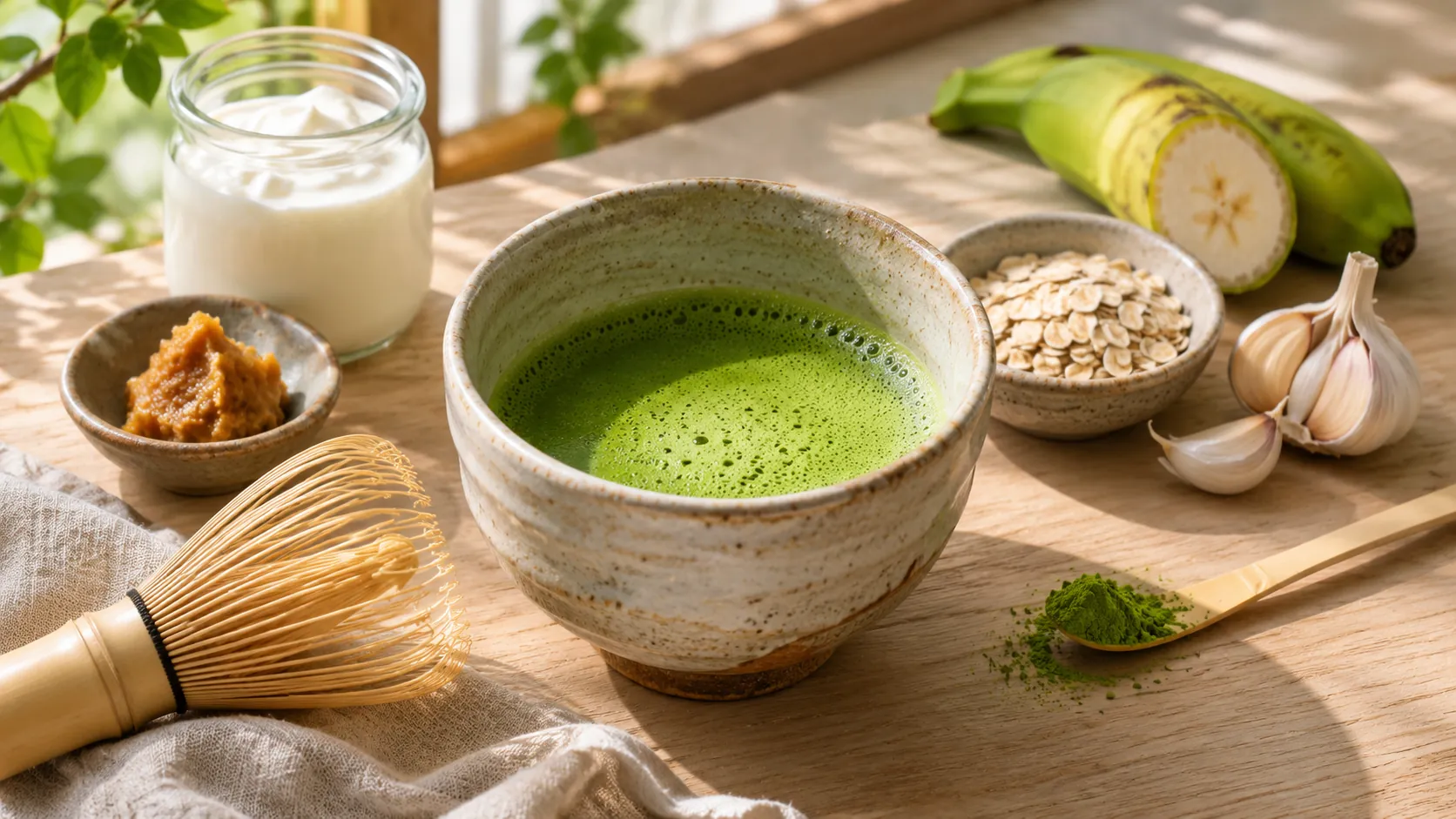
The two words differ by one letter and are easy to mix up. Here is the simplest way to remember the difference: probiotics are the gardeners; prebiotics are the fertiliser.
| Probiotic | Prebiotic | |
|---|---|---|
| What it is | Live microorganisms (bacteria or yeasts) | Food for the microorganisms already in your gut |
| Scientific definition | “Live microorganisms that, when administered in adequate amounts, confer a health benefit on the host” | “A substrate that is selectively utilized by host microorganisms conferring a health benefit” (ISAPP, 2017) |
| Must it be alive? | Yes | No |
| Survives heat? | Usually not | Usually yes |
| Typical examples | Yoghurt with live cultures, kefir, kimchi, miso, natto, supplements | Inulin, chicory root, garlic, onion, oats, green bananas, some polyphenols |
| Matcha? | No | Possibly, partly |
There is also a third word you may see: synbiotic, a product that combines probiotics and prebiotics. Keep that word in mind; we will come back to it.
Is matcha a probiotic? No, and here’s why
A probiotic has to contain living microorganisms in large enough numbers to make a difference. Matcha does not.
Matcha is made from tencha, tea leaves that are shaded, steamed, dried and then stone-ground into a fine powder. Steaming is done deliberately to stop the leaf’s own enzymes and keep it green. It also leaves no live culture behind. Then we pour water at about 75–80 °C over it. Even if a few hardy microbes were present, they would not survive in the numbers needed to count as a probiotic.
Matcha is also not fermented. That is a common mix-up, because some teas, such as pu-erh or kombucha, are fermented. Matcha is the opposite: its whole process is designed to prevent oxidation and fermentation so that it stays bright green.
So if anyone tells you that plain matcha “contains probiotics”, it doesn’t. The interesting part is what matcha does for the bacteria you already have.
Is matcha a prebiotic? Possibly, and the evidence is growing
This is where matcha becomes interesting. Unlike steeped green tea, where you throw the leaves away, with matcha you drink the whole leaf. That means you swallow everything in it, including two things your gut bacteria love.
1. Dietary fibre
A 2024 laboratory analysis published in the journal Foods found that matcha is about 56% dietary fibre (56.1 g per 100 g), most of it insoluble (52.8 g) with a smaller soluble part (3.3 g). The same study measured 17.3 g of protein per 100 g and about 2.2 mg of caffeine per gram.
Before you get too excited: a typical serving is only 1–2 g of powder, so one cup gives you roughly 0.5–1 g of fibre. That is helpful, but it is a small top-up, not a replacement for vegetables, oats and beans. Most adults need around 25–30 g a day.
2. Catechins (polyphenols) that reach the colon
This is the bigger story. Matcha is rich in catechins, especially EGCG (epigallocatechin gallate). Most catechins are not well absorbed in the small intestine. A large share travels on to the colon, where gut bacteria break them down into smaller compounds. Researchers think this two-way relationship works like this:
- Gut bacteria transform catechins into metabolites the body can use.
- Catechins in turn shape which bacteria thrive, encouraging some groups and holding back others.
That is very close to what the ISAPP definition of a prebiotic describes: a substance selectively used by gut microbes that confers a health benefit. Polyphenols are increasingly discussed by scientists as candidate prebiotics, although they are not yet in the same well-proven category as fibres like inulin.
What the human research shows
The best direct evidence so far comes from a Japanese study published in 2023 in the Journal of Clinical Biochemistry and Nutrition.
| Detail | Finding |
|---|---|
| Design | Randomised, double-blind, placebo-controlled |
| Participants | 33 healthy adults (17 matcha, 16 placebo) |
| Duration | 2 weeks of a daily drink |
| Overall change | Gut bacterial community (beta-diversity) changed significantly in the matcha group, not in the placebo group |
| Bacteria that changed | 30 bacterial genera changed in the matcha group vs 3 in the placebo group |
| Notable shifts | Coprococcus increased; Fusobacterium decreased |
Why do those two names matter? Coprococcus includes bacteria that produce butyrate, a short-chain fatty acid that is the main fuel for the cells lining your colon and helps keep the gut barrier strong. Some Fusobacterium species are linked to inflammation in the gut.
A separate 2023 human trial in healthy men, published in Nutrition Journal, reported similar shifts. Two studies is a promising start, not proof, so we will be careful here.
What the science can’t tell us yet
We would rather be honest than oversell. Here is where the evidence is still thin:
- The studies are small and short. 33 people for two weeks shows a change, but not whether it lasts or leads to better health over years.
- Doses vary. Trials do not always report exactly how much matcha participants drank, which makes it hard to say “drink X grams for Y benefit”.
- Much of the mechanism comes from animal studies. Research on gut-barrier proteins, for example, has mostly been done in mice.
- “Changes in bacteria” is not the same as “health benefit”. A shift in gut bacteria is promising, but scientists are still learning what a healthy microbiome looks like for each person.
So the fairest summary is: matcha shows prebiotic-like effects in early human research. Calling it a proven prebiotic would be going too far.
What about “probiotic matcha”?
You may see matcha products labelled “probiotic”. These are matcha powders that have had probiotic strains added to them, usually heat-tolerant, spore-forming bacteria such as certain Bacillus strains, which can survive storage and a warm drink better than many yoghurt cultures.
Technically, a matcha with added probiotics is a synbiotic: live bacteria (the probiotic) packaged with the matcha’s fibre and polyphenols (the prebiotic-like food for those bacteria).
If you are considering one, check three things:
- The strain is named in full, for example genus, species and strain code, not just “probiotic blend”.
- The count (CFU) is stated and guaranteed until the best-before date, not only at manufacture.
- The preparation instructions tell you the maximum water temperature, so you do not kill the bacteria you paid for.
We developed our own probiotic matcha with exactly this logic in mind. You can read the story behind it in the world’s first Gozen matcha with probiotics.
How to drink matcha for your gut: a simple routine
If you want matcha to support your gut, how you drink it matters as much as what you buy.
- Start with 1 g a day (about half a teaspoon) and build up to 2 g over a week or two. A sudden increase in fibre or caffeine can upset a sensitive stomach.
- Drink it with or after food, not on an empty stomach. Catechins and caffeine can irritate the stomach lining in some people.
- Use water at 70–80 °C, never boiling. You protect the flavour and the catechins, and you avoid the harsh bitterness that makes people add sugar.
- Skip the sugar and syrups. Added sugar can feed the less helpful bacteria, which works against what you are trying to do.
- Pair it with probiotic foods. A spoon of live yoghurt or kefir, a bowl of miso soup, or a probiotic supplement taken at the same meal gives your gut both the gardeners and the fertiliser.
- Keep it away from iron-rich meals if you have low iron. Tea polyphenols can reduce how much iron you absorb, so leave about an hour between them.
- Be consistent. The research saw changes after two weeks of daily drinking. One cup on a Saturday will not do much.
If you prefer something more filling, try our 5 gut-healing matcha recipes, or see our matcha blends with prebiotic and digestive benefits.
Who should be careful
Matcha suits most people, but a few groups should check with a professional first:
- People with SIBO or IBS, who may react to fibre or caffeine. See our guide: is matcha SIBO-friendly?
- People with iron-deficiency anaemia, because of the effect on iron absorption.
- Pregnant or breastfeeding women, who are usually advised to limit caffeine.
- Anyone on medication that interacts with caffeine or green tea extracts.
The bottom line
Matcha is not a probiotic; it adds no live bacteria. But it is one of the few drinks where you consume the whole leaf, with its fibre and catechins, and early human trials show that this changes the gut community in ways that look helpful.
Think of matcha as food for the good bacteria you already have. Pair it with probiotic foods, drink it without sugar, and give it time.
If you would like to try a clean, first-flush matcha from Kagoshima, explore Gozen’s Japanese matcha powder, or read our guide to the best matcha for gut health.
Frequently asked questions
Is matcha a probiotic?
No. Matcha contains no live bacteria, so it is not a probiotic. It is made from steamed, dried and stone-ground tea leaves and is prepared with hot water, which would not allow probiotic bacteria to survive in meaningful numbers.
Is matcha a prebiotic?
Matcha may act like a prebiotic. It is about 56% fibre by weight, and its catechins mostly reach the colon, where gut bacteria use them. A 2023 human trial found that two weeks of daily matcha changed gut bacteria, but more research is needed before it can be called a proven prebiotic.
Does matcha have probiotics?
Plain matcha does not. Some products add heat-tolerant probiotic strains to matcha powder, which makes them a synbiotic: live bacteria combined with the prebiotic-like fibre and polyphenols of matcha.
How does matcha affect gut bacteria?
In a randomised, double-blind trial of 33 adults, two weeks of daily matcha significantly changed the gut bacterial community. Coprococcus, which includes butyrate-producing bacteria, increased, and Fusobacterium decreased.
How much matcha should I drink for gut health?
Most people start with 1 g a day and build up to about 2 g, drunk with or after food and without added sugar. Consistency matters more than quantity: the research saw changes after two weeks of daily drinking.
Can I drink matcha with probiotics?
Yes. Drinking matcha alongside probiotic foods such as live yoghurt, kefir or miso gives your gut both live bacteria and food for them. If you mix a probiotic powder into matcha, keep the water below the temperature on its label.




Comments are closed.