
By admin
Posted in ceremonial matcha | Tags : matcha ceremony, matcha tools
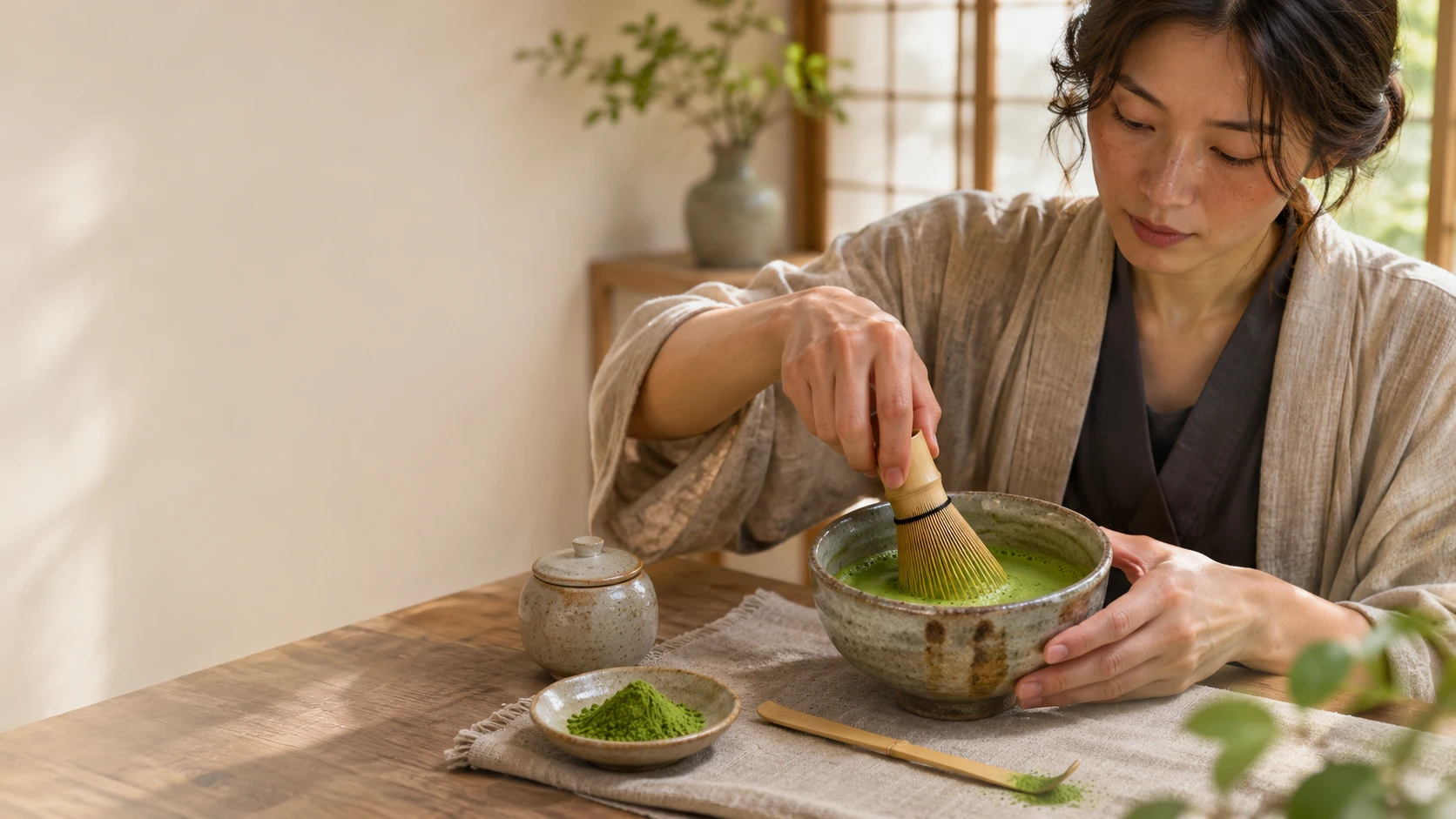
A bowl of matcha looks simple enough — green tea, water, a layer of foam. But traditional preparation revolves around three small, carefully shaped tools that most people have never heard named: the chasen, chawan, and chashaku. Each looks almost too plain to matter. Each, it turns out, solves a very specific problem.
These tools aren’t decorative accessories you add once you’ve “graduated” to serious matcha drinking. Their shapes developed around how matcha is measured, whisked, and experienced — long before anyone thought to put a tea bowl on a shelf. Understand what each one does, and the rest of matcha culture starts to make a lot more sense.
What Are the Traditional Tools Used for Matcha?
| Tool | Japanese Name | What It Does | Usually Made From |
|---|---|---|---|
| Matcha whisk | Chasen | Whisks matcha and water into a smooth, even suspension | Bamboo |
| Matcha bowl | Chawan | Holds the tea and gives the whisk room to work | Ceramic |
| Matcha scoop | Chashaku | Measures and transfers matcha powder | Bamboo |
Other utensils appear in formal Japanese tea practice — tea caddies, silk cloths, water containers — but these three are the most relevant starting point for anyone learning to prepare matcha at home.
1. Chasen: The Bamboo Matcha Whisk
What Is a Chasen?
A chasen is a whisk carved from a single piece of bamboo, split into dozens of thin, flexible tines that curl slightly inward. It has no handle to speak of — the whole tool is bamboo, tines and all — which is the first thing that sets it apart from a kitchen whisk, a milk frother, or the back of a spoon. A metal whisk is rigid and built for volume. A milk frother spins. A spoon just stirs. The chasen is built to move through a very small amount of liquid very quickly, without ever touching the bowl hard enough to scratch it.
Why Is the Chasen Made From Bamboo?
The reasons are practical rather than mystical. Bamboo tines are flexible enough to bend against a ceramic bowl without chipping it, light enough to move quickly without tiring the wrist, and fine enough to work through matcha’s extremely small particle size. None of this means bamboo makes the tea itself more nutritious — it simply makes the tool better suited to the job than metal, plastic, or silicone.
What Does a Chasen Actually Do?
Here’s something that surprises a lot of people: matcha doesn’t dissolve the way sugar does in a cup of coffee. It’s a fine powder suspended in water, and left alone, it clumps and settles unevenly. The chasen’s job is to break that powder apart and distribute it through the water until the texture is smooth rather than gritty. That matters more than it might sound — it’s the difference between a cup that tastes even and a cup where the last sip is thick with sediment.
Why Does Matcha Foam?
Whisking fast enough incorporates air into the surface, which is what produces the pale, fine foam you see on a well-prepared bowl. It’s a natural side effect of the motion, not proof on its own that the matcha underneath is high quality — preparation technique and the tea itself both shape how much foam forms, and a flat-topped bowl isn’t automatically a worse one.
How to Use a Chasen
The basic sequence is simple: sift the matcha to break up clumps, add a small amount of water, and whisk briskly rather than stir slowly. Keep the pressure light — you’re not scrubbing the bowl, you’re moving the whisk fast enough to agitate the surface. Many people use a quick back-and-forth motion that traces a rough W or M shape across the bowl, though this isn’t the only workable technique for casual, everyday preparation.
How to Care for a Chasen
Rinse it in clean water immediately after use, and skip the dish soap where you can — plain water is usually enough, and soap can linger in the tines. Let it air dry completely before putting it away; a chasen holder, which props the tines open in a dome shape, helps it keep its form. Avoid the dishwasher entirely, and never tuck a damp whisk into a sealed container, since trapped moisture is what causes bamboo to mildew or weaken. Over time, tines will naturally splay, split, or snap — at that point, it’s simply time for a new one, not a sign you’ve done anything wrong.
2. Chawan: The Matcha Bowl
What Is a Chawan?
A chawan is a bowl designed for preparing and drinking tea by hand — not every Japanese ceramic bowl qualifies as one, and not every chawan is specifically built for matcha. What makes a bowl suited to matcha comes down to its proportions: wide enough to give a whisk somewhere to move, deep enough to contain the splash of vigorous whisking.
Why Not Just Use a Normal Bowl?
Honestly, you can. A chawan isn’t a requirement, it’s a convenience — one shaped by generations of trial and error around what actually works for whisking matcha. A suitable bowl gives you enough width for the whisk, a depth that keeps the tea from splashing over the rim, a stable base that won’t tip mid-motion, and a comfortable shape to hold while drinking. None of that requires an imported ceramic piece; it just requires a wide bowl with enough room to work.
What Makes a Good Matcha Bowl?
A handful of features matter more than the price tag: a wide mouth so the whisk has space to move freely, enough depth to avoid splashing, a base broad enough to sit steadily on a counter, a lip that’s comfortable against the mouth, and interior curves that help guide the whisk rather than trap it in a corner. A narrow mug, by contrast, makes proper whisking genuinely difficult — there’s simply nowhere for the tines to move.
Handmade Chawan and Wabi-Sabi
Spend any time looking at traditional tea bowls and you’ll notice some are intentionally uneven — a slightly off-center glaze drip, a visible seam, a rim that isn’t quite round. This connects to wabi-sabi, a broader Japanese aesthetic sensibility that values simplicity, transience, and natural variation over symmetry and polish. It’s worth being careful here: wabi-sabi isn’t just shorthand for “imperfection is beautiful.” It’s closer to an appreciation for restraint and the marks that handmade objects naturally carry — a way of seeing value in something unrepeatable rather than mass-produced.
Seasonal Chawan
In more formal tea practice, the bowl itself can shift with the season. A shallower, wider bowl allows tea to cool faster and suits warmer months, while a deeper bowl holds heat longer and tends to appear in cooler ones. This isn’t a strict rule for everyday preparation at home — it’s more a reflection of how much thought goes into even the vessel when tea is treated as a seasonal, deliberate practice.
3. Chashaku: The Bamboo Matcha Scoop
What Is a Chashaku?
A chashaku is a slim, curved bamboo scoop used to transfer matcha from its container into the bowl. Its shape — a long handle tapering to a small, gently curved spoon — is built for one job: moving fine powder cleanly, a small amount at a time.
Why Use a Bamboo Scoop Instead of a Spoon?
A chashaku picks up matcha neatly without introducing moisture into the storage tin, which matters because matcha absorbs humidity and odors easily. It’s also simply the tool traditional matcha containers (chaki) are designed around. That said, an ordinary teaspoon works perfectly well for casual, everyday preparation — this is a case where the traditional tool offers a particular experience, not an exclusive method.
How Much Matcha Does a Chashaku Hold?
This is a common question with a slightly unsatisfying answer: chashaku aren’t standardized measuring spoons, so the exact amount varies by scoop and by how it’s used. Traditional preparation of thin matcha often uses roughly two scoops per serving, but the real weight depends heavily on the individual scoop’s size and how full each pass is. If precision matters to you — for consistency, or simply curiosity — a small digital kitchen scale will tell you more than counting scoops ever will.
Caring for a Chashaku
Wipe it gently with a dry or barely damp cloth after use rather than soaking it, keep it fully dry between uses, and skip the dishwasher and strong detergents — both can warp or discolor the bamboo over time.
How the Three Tools Work Together
The workflow is short, and that’s part of the point: the chashaku transfers matcha into the chawan, water is added, and the chasen disperses and aerates the mixture until it’s smooth. Then the tea is drunk directly from the same bowl it was whisked in — there’s no separate steeping vessel, no straining, no second cup. That’s a genuinely different rhythm from brewing loose-leaf tea, where the leaves and the drinking vessel are two different things. With matcha, the bowl is both.
Do You Really Need All Three Matcha Tools?
Honestly — no, not to make a decent cup. Here’s where the traditional tools and their everyday substitutes diverge:
| Traditional Tool | Modern Alternative |
|---|---|
| Chasen | Milk frother or shaker bottle |
| Chawan | Wide ceramic bowl |
| Chashaku | Teaspoon or small measuring spoon |
A milk frother mixes matcha quickly and conveniently, though it tends to produce a different, often airier foam texture than a hand-whisked chasen. A regular mug works for drinking, but its narrow shape can restrict whisk movement, whether you’re using bamboo or a frother. A teaspoon measures far more predictably than a chashaku, even if it doesn’t carry the same experience. None of these substitutions are wrong — they’re just a different starting point, and there’s no reason to feel short-changed for using them.
Traditional Matcha vs Modern Matcha Preparation
| Feature | Traditional Preparation | Modern Café/Home Preparation |
|---|---|---|
| Vessel | Chawan | Cup, glass, or bowl |
| Mixing tool | Chasen | Frother, shaker, or blender |
| Measuring | Chashaku | Spoon or scale |
| Liquid | Primarily water | Water, dairy, or plant milk |
| Focus | The tea itself | Convenience and customization |
| Experience | Ritual and sensory attention | Everyday beverage preparation |
Neither approach makes the drink objectively “better” — they simply serve different moments. A quiet ten minutes with a chasen and a chawan is a different kind of experience than blending matcha into an iced latte on the way out the door, and both are legitimate ways to drink the same tea.
What Should a Beginner Buy First?
If you’re building a small matcha setup from scratch, a sensible order is: a chasen first, since it makes the biggest functional difference to texture; then a wide bowl — a proper chawan if you’d like one, though any wide ceramic bowl will do; a chashaku third, mostly for the experience, since a spoon measures just fine in the meantime; a whisk holder to help the chasen keep its shape between uses; and a fine mesh sifter, which solves a problem none of the other three tools touch. None of this requires buying an expensive ceremonial set on day one — most people build their setup gradually, as their interest grows.
What About a Matcha Sifter?
A sifter rarely makes anyone’s list of the traditional “three tools,” but it quietly improves everyday preparation more than people expect. Matcha’s particle size is extremely fine, and that fineness, combined with static and ambient moisture, makes it prone to clumping inside the tin. A quick pass through a mesh sifter before whisking breaks those clumps up, which means the chasen has less work to do and the finished tea comes out smoother.
Do Expensive Matcha Tools Make Better Matcha?
Not on their own. Fine craftsmanship can absolutely improve durability, comfort in the hand, and the quiet pleasure of using something well-made — and for many people, that aesthetic and cultural appreciation is exactly the point. What it can’t do is fix matcha that’s stale, cover for water that’s too hot, or correct a ratio that’s off. A beautifully made chawan and an inexpensive bowl will both make bad matcha taste bad. Expensive tools enhance a good foundation; they don’t replace one.
Common Beginner Mistakes With Matcha Tools
A few habits trip up almost everyone starting out. Pressing the chasen hard against the bowl, rather than letting the tines flex naturally, wears them out faster and can scratch ceramic. Whisking too slowly produces a flat, under-aerated cup instead of a smooth one. A narrow mug restricts the whisk no matter how good your technique is. Leaving bamboo tools wet, rather than letting them air dry fully, invites mildew. Running a chasen through the dishwasher is one of the fastest ways to ruin it. Boiling water scalds matcha and brings out bitterness, so letting it cool slightly first makes a real difference. Overloading the chashaku “to save time” usually just means an overly strong, unbalanced cup. And more foam doesn’t automatically mean better matcha — it mostly reflects technique and tea type, not quality on its own.
Matcha Tools and Japanese Tea Culture
Within formal tea practice — chadō, or the Way of Tea — the chasen, chawan, and chashaku become more than functional objects. The specific bowl chosen for a gathering, the way utensils are handled and presented, the season, the relationship between host and guest: all of it can carry meaning that extends well beyond the tea in the cup. Chadō isn’t simply a method for whisking matcha; it’s a broader practice built around hospitality, attention, and intentional simplicity, developed and refined over a long cultural history.
It’s worth being clear about something here: preparing a bowl of matcha at home with a chasen and chawan is not the same as performing chadō. Owning the tools doesn’t mean you’re conducting a formal tea ceremony — and that’s perfectly fine. At home, these same tools can simply help you prepare matcha in a way that draws on traditional Japanese practice, without claiming to replicate something far more formal and deeply rooted.
The Gozen Samurai Perspective
Premium matcha deserves thoughtful preparation — but thoughtful doesn’t have to mean complicated. That’s the thinking behind how we approach matcha at Gozen Samurai: rooted in Japanese heritage and sourced with real respect for where it comes from, including the Kagoshima growing region, but presented in a way that’s genuinely approachable rather than intimidating. Traditional craftsmanship and everyday usability aren’t opposites. Understanding what a chasen, chawan, and chashaku actually do is part of making authentic matcha make sense to a global audience — not a barrier between a newcomer and a good cup of tea.
Conclusion: Tools That Slow You Down — in a Good Way
The real value of a chasen, chawan, and chashaku isn’t that they look traditional sitting on a shelf. Each one changes the physical experience of making matcha. The scoop forces you to measure, rather than pour blindly. The bowl gives you room to whisk properly instead of fighting a narrow mug. The bamboo whisk asks for a bit of attention and technique, rather than the push of a button. For anyone used to a coffee machine doing all the work in ten seconds, those extra thirty seconds of deliberate motion can become part of the appeal, not an inconvenience to rush through.
Start with good matcha, a simple whisk, and a bowl you genuinely enjoy holding. The rest of the ritual can grow naturally from there.
FAQ
What are the three main tools used for matcha?
The chasen (bamboo whisk), chawan (matcha bowl), and chashaku (bamboo scoop) are the three traditional tools most closely associated with preparing matcha.
Do I really need a bamboo whisk for matcha?
Not strictly — but a chasen remains the most traditional and effective manual way to disperse matcha evenly and smoothly, and nothing else quite replicates its texture.
Can I use a normal bowl instead of a chawan?
Yes. A wide ceramic bowl with enough room for the whisk to move freely works well, even without a dedicated chawan.
What is a chashaku used for?
It’s used to transfer matcha powder from its container into the bowl and to roughly portion out a serving.
How much matcha does one chashaku hold?
Chashaku aren’t standardized measuring spoons, so the amount varies by scoop. A small digital scale gives a more precise measurement if consistency matters to you.
How long does a chasen last?
It depends on how often it’s used, its quality, and how well it’s cared for. Replace it once the tines become broken, badly splayed, or lose their shape.
Should you wash a matcha whisk with soap?
Generally, rinse it thoroughly with plain water and let it air dry completely. Avoid dish soap where possible, and skip the dishwasher entirely.
Can I make matcha with a milk frother?
Yes — it’s a convenient option, though the texture and overall experience differ somewhat from whisking with a traditional chasen.
Why does matcha need to be sifted?
Matcha’s very fine particle size makes it prone to small clumps, and sifting before whisking helps create a smoother, more even suspension.
Are matcha ceremony sets worth buying?
They can be a convenient and enjoyable way to start, but they’re not required — beginners can make good matcha with just a whisk and a wide bowl.




Comments are closed.