By admin
Posted in japanese green tea | Tags : gozen matcha, Green Tea, matcha green tea gut bacteria
You bought a box of green tea because it’s “healthy.” You brewed it. It tasted like boiled grass with a bitter after-bite. So you added honey, or lemon, or quietly stopped drinking it.
Then one day, at a Japanese café, someone hands you a cup of green tea that tastes sweet, smooth and almost buttery. Same plant. Completely different experience.
So what’s going on? Is Japanese green tea really that different, or is it just good marketing?
Quick answer
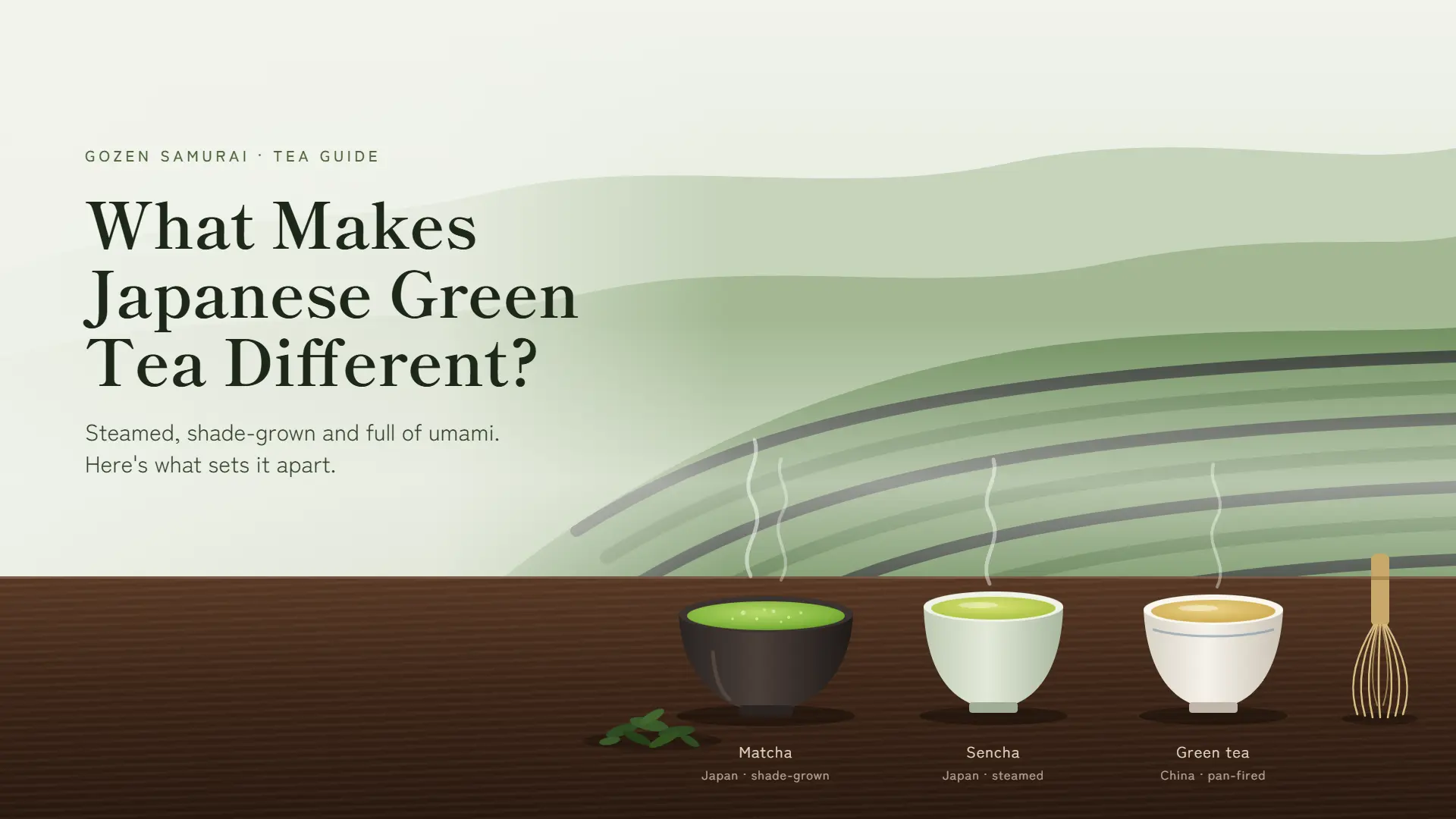
Japanese green tea is different because it is steamed, not pan-fired, right after picking. Many Japanese teas are also grown in the shade before harvest. Steaming keeps the leaves bright green and gives a fresh, savoury “umami” taste. Shading raises L-theanine, the amino acid behind that sweet, calm flavour. Most other countries, like China, pan-fire their green tea, which gives a toasty, nutty taste and a yellow-green colour.
Let’s break that down in plain words, so you know exactly what you’re drinking, and what you’re paying for.
1. Steamed, not roasted: the step that changes everything
All green tea comes from one plant, Camellia sinensis. What makes it “green” is that the leaves are heated soon after picking. Heat stops oxidation, so the leaves don’t turn brown like black tea.
The difference is how they are heated:
- Japan steams the fresh leaves for a short time, usually 30 seconds to 2 minutes. This method spread in the 1700s and became Japan’s signature.
- China and Korea mostly pan-fire the leaves in hot woks or drums, much like roasting.
Think of it like vegetables. Steamed spinach stays bright green and tastes fresh. Pan-roasted spinach turns darker and tastes smoky. Tea works the same way.
That’s why Japanese green tea looks deep green and tastes fresh and marine, while many Chinese green teas look golden and taste nutty or toasty.
2. Grown in the shade: the secret behind the sweetness
This is where Japan does something most countries don’t.
For the best teas, farmers cover the tea bushes with shade cloth or straw for about 2 to 4 weeks before harvest. Less sunlight means:
- More L-theanine, the amino acid that gives a sweet, savoury, calm taste
- Less bitterness, because sunlight turns theanine into bitter catechins
- More chlorophyll, which is why matcha is such a vivid green
Three famous shade-grown teas:
- Gyokuro: shaded about 3 weeks, rich and almost brothy
- Kabusecha: shaded about 1 week, softer than sencha
- Tencha: shaded 3–4 weeks, then stone-ground into matcha
So when someone says real matcha tastes “creamy, not bitter,” this is the reason. Cheap matcha often skips proper shading, and you can taste it.
3. Japan’s tea regions have their own personality
Like wine, the place matters. Japan’s main tea regions include:
- Uji (Kyoto): the historic home of high-grade matcha and gyokuro
- Shizuoka: Japan’s largest tea region, known for sencha and deep-steamed fukamushi tea
- Kagoshima: warm southern region, early harvests, bold and sweet teas
- Yame (Fukuoka): famous for top-grade gyokuro
- Nishio (Aichi): a major matcha-producing area
Volcanic soil, misty hills and big day-night temperature swings all shape the flavour.
4. Whole leaf you drink, not just leaf you steep
With most tea, you soak the leaves and throw them away. With matcha, you whisk the whole powdered leaf into water and drink all of it.
That means you get more of what’s in the leaf, including fibre, chlorophyll and antioxidants, compared with a regular steeped cup. It’s also why quality matters so much: you’re drinking everything, good or bad.
5. Tea is a ritual in Japan, not just a drink
In Japan, green tea is part of daily life and of chado, the Way of Tea. The tea ceremony is about slowing down, paying attention and respecting the moment.
That mindset shows in how the tea is made: careful hand-picking for top grades, slow stone-grinding for ceremonial matcha, and strict grading. A traditional granite mill grinds only around 30–40 grams of matcha per hour.
Japanese vs other green teas at a glance
| Japan | China | India | Korea | |
|---|---|---|---|---|
| How leaves are heated | Steamed | Pan-fired / roasted | Mostly pan-fired or rolled (green is a small share; India is mainly black tea) | Mostly pan-fired |
| Colour in cup | Bright green to emerald | Yellow-green to golden | Light yellow-green | Pale yellow-green |
| Taste | Fresh, grassy, umami, sweet | Nutty, toasty, floral | Light, mildly astringent | Soft, nutty, light |
| Shade-grown teas | Yes (gyokuro, matcha) | Rare | Rare | Rare |
| Famous types | Matcha, sencha, gyokuro, hojicha, genmaicha | Longjing (Dragon Well), Bi Luo Chun | Darjeeling green, Nilgiri green | Ujeon, Sejak |
| Best for | Umami lovers, matcha drinkers, calm focus | Light, toasty everyday sipping | Budget everyday cup | Delicate, gentle cups |
In short: if you like a smooth, sweet, savoury cup with real depth, Japanese tea is usually the one you’re looking for.
How to spot authentic Japanese green tea
- Check the origin. Look for a named region like Uji, Shizuoka or Kagoshima, not just “Japan style.”
- Look at the colour. Good matcha is vivid, bright green. Dull, yellowish or brownish powder is old or low grade.
- Read the grade honestly. “Ceremonial” should be for drinking straight. “Culinary” is for lattes and baking.
- Check freshness. Green tea loses flavour fast. Look for a harvest or packing date and an airtight, light-proof pack.
- Taste test. Real Japanese tea should taste smooth and a little sweet, even without sugar.
The mistake that makes green tea bitter
Most people use boiling water. That’s what burns the leaves and pulls out bitterness. Japanese green tea likes cooler water:
| Tea | Water temperature | Steep time |
|---|---|---|
| Gyokuro | 50–60°C | about 2 minutes |
| Sencha | 70–80°C | 1–1.5 minutes |
| Matcha | 70–80°C | Whisk 15–20 seconds, no steeping |
| Hojicha / Genmaicha | 80–90°C | 30–60 seconds |
Easy tip: boil the kettle, then let it sit for 3–5 minutes before pouring.
For matcha: sift about 2 grams (1 tsp) into a bowl, add around 70 ml of water, and whisk fast in a “W” or “M” motion until a fine foam forms.
So, which cup have you really been drinking?
If your green tea has always tasted bitter, the problem may not have been you. It may have been the tea, or the water.
Now ask yourself: is your daily cup something you enjoy, or something you just put up with because it’s “good for you”?
At Gozen Samurai, we bring shade-grown Japanese matcha straight from Japan’s tea fields to Dubai. Try one cup, made the right way, and taste the difference for yourself. Explore our matcha collection →
FAQ
Why does Japanese green tea taste different from Chinese green tea?
Japanese green tea is steamed after picking, which keeps a fresh, grassy and umami taste. Chinese green tea is usually pan-fired, which gives a toasty, nutty flavour and a more golden colour.
Why is Japanese green tea so green?
Steaming locks in the leaf’s natural colour. Shade-grown teas like matcha and gyokuro also build up more chlorophyll, making them a deeper, brighter green.
Is Japanese green tea healthier than other green teas?
All true green teas contain antioxidants. Shade-grown Japanese teas are higher in L-theanine, and matcha lets you drink the whole leaf. That makes them a richer option, but no single tea is a cure-all.
What is the best Japanese green tea for beginners?
Start with sencha for an easy everyday cup, or a good matcha latte if you like creamy drinks. Hojicha is a gentle, roasted, low-caffeine option for evenings.
Does Japanese green tea have caffeine?
Yes. Matcha and gyokuro have the most, sencha is moderate, and hojicha and genmaicha are lower. L-theanine helps make the energy feel calmer and smoother than coffee.
Why does my green tea taste bitter?
Usually the water is too hot or the tea steeped too long. Use water around 70–80°C and steep sencha for no more than about 1.5 minutes.
Is matcha the same as green tea?
Matcha is a type of Japanese green tea. It is made from shade-grown tencha leaves, stone-ground into powder, and whisked so you drink the whole leaf.
Where can I buy authentic Japanese matcha in Dubai?
Look for sellers who name the Japanese region, show the harvest grade and sell in airtight packs. Gozen Samurai sources shade-grown Japanese matcha for customers across the UAE.




Comments are closed.