
By admin
Posted in Most Expensive Matcha, premium matcha, Tea Education | Tags : gozen matcha, Matcha Powder, microbiome Matcha, premium matcha
Introduction
How to make matcha latte is easier than you think, and you don’t need a fancy café to enjoy this vibrant, nutrient-rich beverage. A matcha latte combines finely ground green tea powder with steamed milk to create a creamy, earthy drink that’s become a global favorite for good reason. Whether you’re seeking a coffee alternative with sustained energy or looking to boost your wellness routine, learning how to make matcha latte opens the door to customizable drinks that rival your favorite coffee shop—for a fraction of the cost. This comprehensive guide walks you through everything you need to know to master the perfect cup at home, from selecting quality ingredients to troubleshooting common mistakes.
Key Takeaways
✓ Quality matters: Ceremonial-grade matcha produces smoother, more vibrant lattes than culinary-grade
✓ Temperature is critical: Water should be 160–170°F (70–75°C), not boiling, to preserve nutrients
✓ Whisking is essential: A bamboo whisk creates the proper frothy texture and dissolves clumps
✓ Milk choice affects taste: Dairy, oat, and almond milk all work; experiment to find your preference
✓ Consistency takes practice: Your first attempt may not be perfect—that’s normal
✓ Budget-friendly: Homemade matcha lattes cost $1–2 per cup vs. $6–8 at cafés
What Is a Matcha Latte? (Definition & Origin)
Understanding Matcha Latte
A matcha latte is a beverage made from matcha powder—finely ground leaves from shade-grown green tea plants (Camellia sinensis)—whisked with hot water and steamed or frothed milk. Unlike regular green tea, where you steep leaves and discard them, a matcha latte involves consuming the entire leaf in powdered form, meaning you get 100% of the plant’s nutrients in every sip.
The drink originated in Japan during the 12th century as part of Zen Buddhist meditation practices and has since evolved into a mainstream global wellness beverage. The traditional preparation method, called the “tea ceremony” or “chanoyu,” emphasizes mindfulness and precise technique—principles that remain relevant whether you’re preparing matcha in Kyoto or your kitchen in New York, Mumbai, or Sydney.
H3: Matcha vs. Green Tea Lattes
Key differences:
- Matcha: Whole leaf powder; higher EGCG (antioxidant) concentration
- Green tea latte: Steeped leaves or tea bags; milder flavor; lower nutrient density
- Taste profile: Matcha is earthy and slightly sweet; green tea is more delicate and grassy
Essential Ingredients for Your Matcha Latte
H2: What You’ll Need to Get Started
| Ingredient | Quality Grade | Quantity | Notes |
|---|---|---|---|
| Matcha powder | Ceremonial or culinary | 1–2 tsp | Ceremonial grade is superior but pricier |
| Hot water | Filtered preferred | 2–3 oz | Temperature: 160–170°F (70–75°C) |
| Milk (dairy or plant-based) | Whole, oat, or almond | 8–10 oz | Cold or steamed; affects final texture |
| Sweetener (optional) | Honey, agave, or sugar | ½–1 tsp | Dissolve before adding milk |
| Ice (optional) | Filtered water | 3–4 cubes | For iced matcha lattes |
H3: Choosing Quality Matcha Powder
When learning how to make matcha latte, ingredient quality directly impacts taste and results:
- Ceremonial Grade: Brightest green color, smoothest flavor, no grassy aftertaste. Best for traditional preparation and sipping. Costs $4–8 per ounce.
- Culinary Grade: Slightly darker, more grassy taste, designed for baking or blending. Costs $1–3 per ounce.
Pro tip: Check the origin. Japanese matcha (particularly from Kyoto, Uji, or Nishio regions) is traditionally superior to Chinese or other alternatives, though quality varies by producer.
Equipment You’ll Need
H2: Tools for Perfect Matcha Preparation
You don’t need expensive gear, but certain tools make the process easier:
Essential equipment:
- Bamboo whisk (chasen): Creates the frothy texture; $3–8
- Small bowl or matcha bowl (chawan): Ideal for whisking; $5–15
- Measuring spoon: For precise matcha powder amounts
- Thermometer (optional): Ensures proper water temperature
- Milk frother: Creates steamed milk texture (optional; use a handheld frother for $10–30)
Budget-friendly alternative: If you lack a bamboo whisk, a small electric frother or even a fork works in a pinch, though results won’t be identical.
Step-by-Step Guide: How to Make Matcha Latte
Traditional Method (Best Results)
This technique aligns with Japanese tea ceremony principles and produces the smoothest, most authentic matcha latte:
Step 1: Heat Your Water
- Use filtered water heated to 160–170°F (70–75°C)
- Use a kettle with temperature control, or let boiling water cool for 5–7 minutes
- Why this matters: Boiling water destroys beneficial enzymes and nutrients; too-cool water won’t properly activate the powder
Step 2: Measure Your Matcha Powder
- Spoon 1–2 teaspoons of matcha powder into your bowl
- Level with the back of your spoon to ensure accurate measurement
- For a stronger latte, use 2 teaspoons; for a milder version, use 1 teaspoon
Step 3: Add Water & Whisk
- Pour 2–3 oz of hot water into the bowl with matcha powder
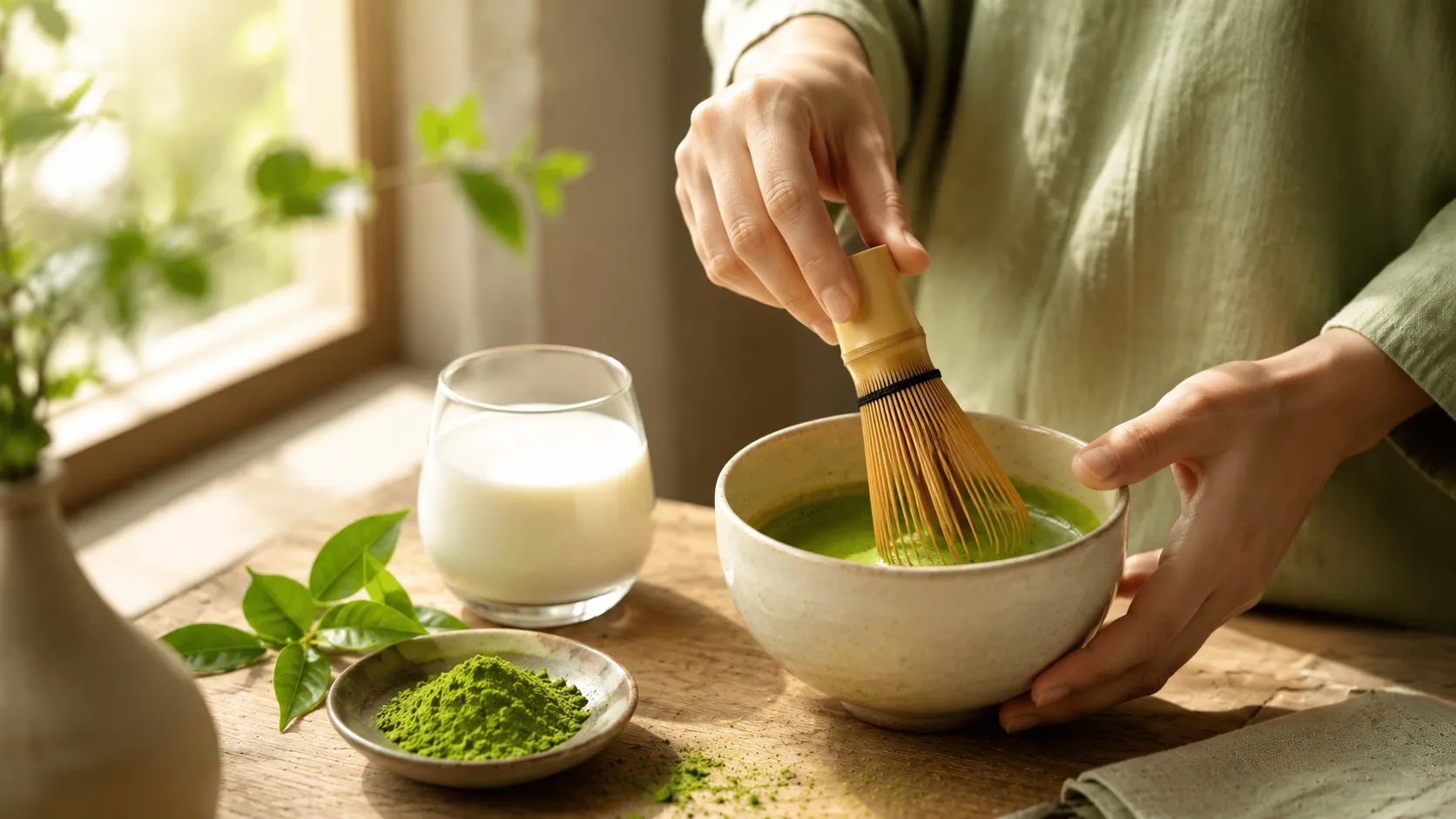
- Using your bamboo whisk, whisk vigorously in an “M” or “W” motion for 15–30 seconds
- Continue until the mixture is frothy with no visible clumps
- Key technique: The goal is to create a smooth paste, then froth it to a light, foamy consistency
Step 4: Prepare Your Milk
- Heat 8–10 oz of milk separately (steamed milk is traditional; cold milk works for iced versions)
- If steaming with a frother: Insert the steam wand to create a thin layer of foam
- If heating manually: Warm on the stovetop and whisk with a frother just before pouring
Step 5: Combine & Serve
- Pour the steamed milk slowly into your matcha mixture while stirring gently
- Fill your cup to the top
- Top with a thin layer of milk foam
- Serve immediately and enjoy
Total time: 3–5 minutes
Quick Method (For Busy Mornings)
If you’re short on time but still want quality:
- Add 1–2 teaspoons matcha powder to your cup
- Pour 3 oz of hot water (160–170°F) and stir vigorously with a spoon for 20 seconds
- Add 8 oz cold or steamed milk
- Stir and drink
Trade-off: Less frothy, slightly less silky texture, but still delicious and fast.
Iced Matcha Latte Method
Perfect for warm climates or summer days:
- Whisk matcha powder with 2–3 oz of hot water (160–170°F) using your bamboo whisk
- Add sweetener if desired and stir until dissolved
- Pour the matcha mixture into a tall glass with 3–4 ice cubes
- Add 8 oz cold milk of your choice
- Stir well and serve immediately
Traditional vs. Modern Preparation Methods
How Methods Differ
| Method | Time | Equipment | Texture | Best For |
|---|---|---|---|---|
| Traditional ceremony | 10–15 min | Whisk, bowl, kettle | Smooth, very frothy | Mindfulness, authenticity |
| Modern quick method | 3–5 min | Spoon, cup, kettle | Less frothy, creamy | Daily drinking, convenience |
| Blender method | 2 min | Blender | Very smooth, thick | Convenience, consistency |
| Iced version | 4–6 min | Whisk, glass | Smooth, cold | Warm weather, refreshment |
Why Traditional Method Produces Better Results
The traditional matcha whisking technique serves a purpose beyond aesthetics:
- Aerating the mixture increases oxygen content, enhancing flavor
- Thorough whisking dissolves clumps for a silky mouthfeel
- The deliberate pace promotes mindfulness and extends the ritual
That said, any method that produces a clump-free drink is valid—choose what fits your lifestyle.
Nutrition & Health Benefits
What Makes Matcha Latte Nutritious?
When you learn how to make matcha latte, you’re investing in a nutrient-dense beverage. Here’s the nutritional breakdown per serving:
Standard Matcha Latte (1 tsp matcha + 8 oz whole milk):
- Calories: 100–140
- Protein: 7–8g (from milk)
- Fat: 4–5g
- Carbohydrates: 10–12g
- L-Theanine: 100–150mg (amino acid for calm focus)
- EGCG antioxidants: 70–140mg
Key Health Benefits
Energy & Focus
- L-theanine combined with caffeine (25–70mg per serving) promotes calm alertness
- Unlike coffee, matcha provides sustained energy without jitters or crashes
Antioxidant Power
- EGCG (epigallocatechin gallate) is a potent catechin linked to cellular health
- Matcha contains 137 times more antioxidants than regular green tea
Metabolism Support
- Some research suggests matcha may modestly support fat oxidation during exercise
- Effects are modest and work best with regular exercise and balanced diet
Calm & Mindfulness
- L-theanine promotes alpha brain waves associated with relaxation
- The ritual of preparation encourages mindfulness
Note: While health claims around matcha are popular, results vary by individual. Matcha is best viewed as a nutritious beverage, not a miracle cure.
Troubleshooting Common Matcha Latte Problems
Why Your Matcha Latte Might Not Be Perfect (And How to Fix It)
| Problem | Cause | Solution |
|---|---|---|
| Grainy, gritty texture | Clumpy powder; poor whisking | Sift powder before use; whisk for full 30 seconds; use hotter water |
| Too bitter or grassy taste | Water too hot; low-quality powder; over-whisked | Use water at 160–70°F; upgrade to ceremonial grade; whisk only 15–20 sec |
| Not frothy enough | Insufficient whisking; old powder; low-quality whisk | Whisk more vigorously; replace clumpy powder; invest in proper bamboo whisk |
| Separates or breaks | Temperature mismatch; poor emulsification | Ensure milk and water temps are similar; whisk together gently |
| Tastes weak | Too little powder; water too cool; stale matcha | Use 1.5–2 tsp powder; increase water temp to 170°F; replace old powder |
| Too sweet | Excess sweetener | Reduce honey/sugar to ½ teaspoon; let matcha’s natural sweetness shine |
Matcha Latte Variations & Recipes
Beyond the Classic Recipe
Once you master how to make matcha latte, try these delicious variations:
Honey Vanilla Matcha Latte
- 1.5 tsp matcha powder
- 3 oz hot water (170°F)
- 1 tsp honey
- 1 splash vanilla extract
- 8 oz steamed milk
- Benefit: Natural sweetness; comforting vanilla aroma
Matcha Iced Latte with Oat Milk
- 1 tsp matcha powder
- 2 oz hot water (165°F)
- 10 oz cold oat milk
- ½ tsp maple syrup
- Ice cubes
- Benefit: Creamy, vegan-friendly; perfect for warm weather
Matcha Latte with Adaptogenic Mushroom
- 1.5 tsp matcha powder
- 3 oz hot water (170°F)
- ½ tsp lion’s mane or reishi mushroom powder
- 8 oz steamed milk
- Benefit: Enhanced cognitive support; earthy depth
Spiced Matcha Latte
- 1 tsp matcha powder
- 2 oz hot water (170°F)
- Pinch of cinnamon, ginger, and cardamom
- 8 oz steamed milk
- ¾ tsp agave nectar
- Benefit: Warming spices; aids digestion
Matcha Smoothie Bowl Latte
- 1 tsp matcha powder
- 3 oz hot water
- Whisk into paste, cool slightly
- Blend with 8 oz milk, 1 banana, ½ cup Greek yogurt
- Benefit: Creamier; higher protein; satiating
Frequently Asked Questions About Matcha Lattes
Q1: How much caffeine is in a matcha latte?
A matcha latte contains 25–70mg of caffeine per serving (using 1–2 tsp matcha), compared to 95mg in an 8 oz cup of coffee. The caffeine is absorbed slowly due to L-theanine, providing sustained energy without jitters. If sensitive to caffeine, use 1 teaspoon or switch to decaf alternatives.
Q2: Can I make matcha latte without a bamboo whisk?
Yes. Use a small electric frother, handheld milk frother, or even a fork. While these alternatives work, a bamboo whisk produces superior frothiness and is inexpensive ($3–8 online). For best results with non-traditional tools, whisk longer (45–60 seconds) and whisk more vigorously.
Q3: What’s the best milk for matcha latte?
The best milk depends on preference:
- Whole milk: Creamiest, most traditional
- Oat milk: Naturally sweet, froths well
- Almond milk: Lighter, lower calorie
- Coconut milk: Tropical flavor
- Dairy-free milk blends: Creamy and sustainable
Experiment to find your favorite. Avoid ultra-low-fat milk, which froths poorly.
Q4: How do I store matcha powder?
Store in an airtight container away from direct sunlight and heat. Matcha degrades quickly when exposed to light, heat, and air. Properly stored, ceremonial-grade matcha lasts 1–2 months; culinary-grade lasts 3–6 months. For longer storage, refrigerate or freeze in an airtight container.
Q5: Is matcha latte healthier than coffee?
Neither is inherently “healthier”—both offer benefits. Matcha provides L-theanine, sustained energy, and high antioxidants; coffee offers higher caffeine and polyphenols. Choose based on your goals: matcha for calm focus, coffee for sharp alertness. Moderate consumption of either (1–3 cups daily) is safe for most people.
Q6: Can I use a blender to make matcha latte?
Yes. Add 1–2 tsp matcha powder, 2 oz hot water, 8 oz milk, and optional sweetener to a blender. Blend for 15–20 seconds until smooth and frothy. This method is faster but produces slightly different texture than traditional whisking.
Q7: Why is my matcha latte separating?
Separation occurs when ingredients don’t emulsify properly. Causes include: temperature mismatch between water and milk, poor whisking (leaving clumps), or old matcha powder. Solution: Whisk matcha paste thoroughly with hot water first, then gently combine with warm (not cold) milk while stirring.
Q8: How long does a matcha latte stay fresh?
Drink immediately for best flavor and quality. Once prepared, a matcha latte begins to oxidize and loses its vibrant color within 10–15 minutes. If you must wait, keep it covered and drink within 30 minutes.
Q9: Is matcha latte suitable for children?
Matcha contains 25–70mg caffeine per serving. Most pediatricians recommend limiting caffeine for children under 12. Older children and teenagers can consume matcha in moderation (1–2 times per week) as part of a balanced diet.
Q10: What’s the difference between matcha latte and matcha tea?
- Matcha latte: Matcha powder whisked with water, then combined with milk (typically 1:2 ratio of matcha to milk)
- Matcha tea: Matcha powder whisked with water only, served plain (traditional ceremonial preparation)
A latte is sweeter, creamier, and contains more calories; matcha tea is more delicate and pure.
Pros & Cons of Making Matcha Latte at Home
Is It Worth Making at Home?
| Pros | Cons |
|---|---|
| Cost-effective: $1–2 per cup vs. $6–8 at cafés | Requires equipment: Whisk, bowl, scale |
| Quality control: Choose your own ingredients | Learning curve: Perfect technique takes practice |
| Customization: Adjust strength, sweetness, milk type | Time investment: 5–10 minutes prep time |
| Consistency: Once you master it, same results every time | Storage: Matcha powder has limited shelf life |
| Health transparency: Know exactly what you’re consuming | Cleanup: Whisking residue requires thorough rinsing |
Bottom line: For regular matcha drinkers, home preparation pays for itself within 2–3 weeks.
Conclusion: Master How to Make Matcha Latte Today
Learning how to make matcha latte is a rewarding skill that transforms your daily beverage routine. With quality ceremonial-grade matcha, proper water temperature (160–170°F), a bamboo whisk, and just 5 minutes of your time, you’ll create café-quality drinks at home for a fraction of the cost. Whether you prefer the traditional whisking method for its meditative ritual or the quick blender approach for busy mornings, the fundamentals remain the same: good ingredients, proper technique, and patience.
Start with the step-by-step traditional method, practice your whisking, and don’t be discouraged by your first attempt. Each batch teaches you something. Once you’ve mastered the classic matcha latte, experiment with variations—honey vanilla, spiced versions, or mushroom-infused blends—to keep your ritual fresh and exciting.




[…] who want a creamier, more indulgent drink. If you’d like a full walkthrough, our guide on how to make a matcha latte covers ratios, milk choices, and technique in more […]