
By admin
Posted in Matcha for weight loss | Tags : Matcha, matcha for weight loss, Matcha Powder, matcha quality grades, matcha wellness
You swapped your mid-morning coffee for matcha because it is "the healthy one." Three weeks later, nothing has changed. Then you turn the tin around and notice that the first ingredient is not matcha at all. It is sugar.
This happens far more often than people admit. Matcha has earned a reputation as a wellness drink, and part of that reputation is deserved. But the word "matcha" on a pack tells you very little about what is actually inside, how much sugar you are drinking, or what each cup really costs. If matcha is part of your weight-management routine, those three details matter more than anything printed on the front of the pack.
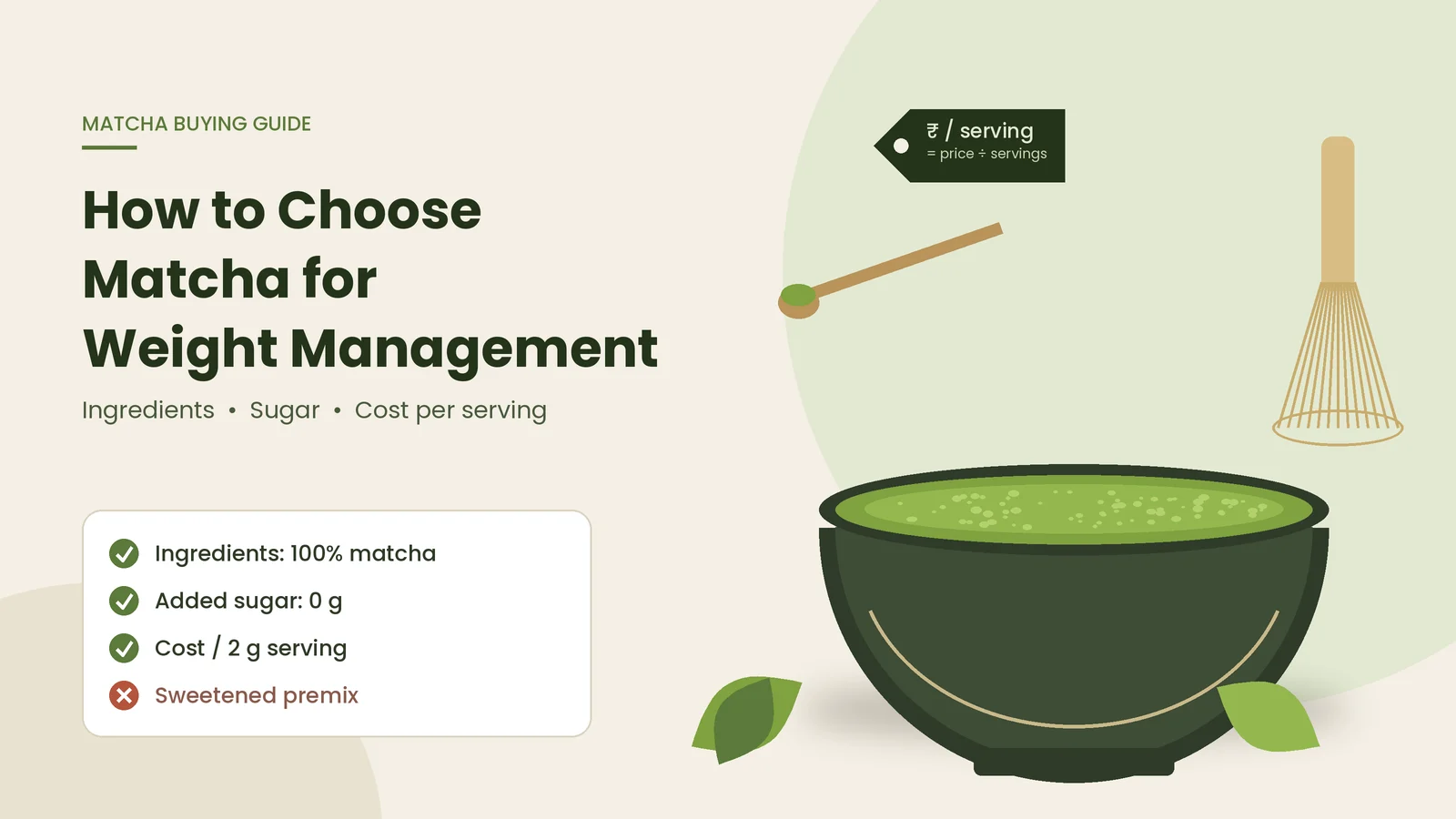
This guide shows you how to read a matcha label, how to spot sugar hiding behind friendly names, how to pick the right grade, and how to calculate the true cost per serving, so the matcha you buy actually fits the routine you are building.
What Matcha Can (and Can't) Do for Weight Management
Matcha is powdered green tea made from shade-grown leaves that are stone-ground into a fine powder. Because you whisk and drink the whole leaf instead of steeping and discarding it, you take in more of the leaf's natural compounds than you would from a regular green tea bag. Three of them get most of the attention:
- Catechins, especially EGCG: antioxidants that have been studied for their role in metabolism and fat oxidation.
- Caffeine: a typical 2 g serving usually lands somewhere around 60 to 70 mg, depending on grade and harvest. That is generally less than a cup of brewed coffee.
- L-theanine: an amino acid linked with calm, focused energy, which is why matcha tends to feel smoother than coffee.
Research on green tea catechins combined with caffeine suggests a small boost to energy expenditure. "Small" is the important word. A widely cited 2009 meta-analysis found an average difference of about 1.3 kg over roughly 12 weeks. That is useful, but it is not a transformation.
The bigger, more practical benefit is simpler. A cup of plain matcha whisked in water has only about 5 to 10 calories. It can replace a sugary drink, give you steady energy before a workout, and become a daily ritual you actually enjoy. That is where matcha earns its place in a weight-management routine, and it is exactly why the product you choose matters. A sweetened latte mix can carry more sugar than a chocolate biscuit and quietly cancel out everything you were hoping for.
Step 1: Read the Ingredient List Before Anything Else
The front of the pack is there to sell. The back of the pack is there to tell. Before you look at price, grade or packaging, flip it over and read the ingredients.
What a good ingredient list looks like
For a weight-management routine, the ideal list has exactly one item: "100% matcha" or "matcha (powdered green tea)." Good brands also name the origin, such as Uji, Nishio, Kagoshima or Shizuoka in Japan, and many carry an organic certification. That is it. Nothing else needs to be there.
Red flags to watch for
| On the label | What it usually means | Why it matters for you |
|---|---|---|
| Sugar, cane sugar, dextrose | Added sweetener | Extra calories and more sugar cravings |
| Maltodextrin | Processed starch used as a filler | High glycaemic, adds bulk without nutrition |
| Non-dairy creamer | Usually glucose syrup plus vegetable oil | Hidden sugar and fat in every scoop |
| Milk powder or milk solids | Dairy base for a "latte" mix | Adds calories and natural sugar (lactose) |
| "Green tea powder" | May be ordinary ground green tea, not shade-grown matcha | Lower quality, different taste and nutrients |
| Flavours or "matcha flavour" | Taste added to cover low matcha content | You pay for less real matcha |
Ingredients are listed by weight, from most to least. If matcha is not the first ingredient, or not the only one, you are buying a beverage mix, not matcha.
Check the matcha percentage
Some premixes declare the matcha content in brackets, such as "matcha (8%)." Read that carefully. It means 92% of what you are paying for is something else, often sugar and milk solids.
Step 2: Find the Sugar, Even When It Is Hiding
Read the nutrition panel, not the claims
Words like "natural," "healthy" and "superfood" are marketing. The nutrition panel is the truth. Look for Total sugars and, where it is shown, Added sugars, both per serving and per 100 g. Pure matcha contains less than 1 g of sugar per serving, which is effectively zero.
For context, the World Health Organization recommends keeping free sugars below 10% of daily energy, and suggests reducing intake below 5% for additional benefit. For most adults, that ideal works out to about 25 g, or six teaspoons, a day. A single sweetened latte sachet can use up a large share of that before lunch.
Sugar goes by many names
Manufacturers rarely write "sugar" three times on one label, so they use alternatives. Watch for sucrose, cane sugar, jaggery powder, glucose, dextrose, fructose, glucose syrup solids, maltodextrin, honey powder, coconut sugar and brown rice syrup. A pack that says "no refined sugar" can still contain plenty of sugar.
"Sugar-free" is not automatically better
Sugar-free premixes usually rely on sucralose, aspartame, stevia or erythritol. These are fine for some people, but they keep your taste buds expecting sweetness, and sugar alcohols can upset digestion in larger amounts. The cleaner approach is to buy pure matcha, sweeten it yourself if you need to, and slowly reduce the amount over a few weeks.
Don't forget what you add to the cup
Even pure matcha becomes a high-calorie drink depending on what you mix it with. Approximate calories for one cup made with 2 g of matcha:
| How you make it | Approx. calories | Best for |
|---|---|---|
| Whisked in water only | 5–10 kcal | Lowest-calorie daily habit |
| 200 ml unsweetened almond milk | 30–45 kcal | Creamy, light option |
| 200 ml skimmed milk | 70–75 kcal | Extra protein, low fat |
| 200 ml unsweetened oat milk | 90–100 kcal | Smooth, café-style texture |
| 200 ml full-cream milk | 130–150 kcal | Occasional treat |
| Café matcha latte with syrup | 200 kcal or more | Not ideal for weight management |
Values vary by brand, so check your own milk label.
Step 3: Choose the Right Grade for Daily Use
Matcha is sold in grades, and the most expensive one is not automatically the best choice for a weight-management routine. You will be drinking it every day, so it has to taste good, suit how you prepare it and fit your budget.
| Grade | Best for | Taste | Price |
|---|---|---|---|
| Ceremonial | Drinking straight with water | Sweet, rich umami, very smooth | Highest |
| Premium or daily | Everyday drinking, with water or milk | Balanced, mild bitterness | Mid-range |
| Culinary | Lattes, smoothies, baking | Stronger, more astringent | Lowest |
Here is the part most buyers miss. If a cheap matcha tastes harsh and bitter, you are far more likely to add sugar or syrup to make it drinkable. A slightly better grade that tastes pleasant on its own can be the smarter "diet" purchase, even though it costs more per gram. If you drink matcha straight, choose ceremonial or premium. If you always blend it into milk or smoothies, a good culinary grade is enough.
Quality signals worth checking
- Colour: bright, vibrant green. Dull yellow or brownish powder is old or low grade.
- Texture: very fine and silky, similar to eyeshadow, not gritty.
- Aroma: fresh, grassy and slightly sweet, never flat or hay-like.
- Dates: a harvest or packing date, not just a best-before date.
- Packaging: airtight and opaque, such as a tin or foil pouch, because light and air degrade matcha quickly.
- Testing: brands that publish lab results for heavy metals and pesticides deserve extra trust.
Step 4: Calculate the Real Cost Per Serving
Pack price is misleading because pack sizes vary so widely. The number that actually matters is the cost of each cup. Use this simple formula:
| Cost per serving formula Cost per serving = Pack price ÷ (Pack weight in grams ÷ grams per serving) . A standard serving is 1 to 2 g, roughly half to one level teaspoon. The examples below use 2 g. |
|---|
| Product (example) | Price | Pack size | Servings | Cost / serving | Added sugar |
|---|---|---|---|---|---|
| Ceremonial, pure | ₹1,500 | 30 g | 15 | ₹100 | 0 g |
| Premium daily, pure | ₹1,200 | 50 g | 25 | ₹48 | 0 g |
| Culinary, pure | ₹1,400 | 100 g | 50 | ₹28 | 0 g |
| Sweetened latte premix | ₹550 | 10 × 20 g sachets | 10 | ₹55 | Often 10–15 g |
Prices are illustrative. Plug in the numbers from the pack you are considering.
The premix trap
The premix looks like the budget option on the shelf, but look closer. If each 20 g sachet is only 8% matcha, you are getting about 1.6 g of actual matcha per cup. That puts the real price at roughly ₹34 per gram of matcha, compared with about ₹14 per gram for the pure culinary grade. You pay more for less matcha, and you get a dose of sugar thrown in.
Factor in freshness and add-ins
Once opened, matcha starts to lose colour and flavour, and it is at its best within about four to eight weeks. A large bag that goes stale halfway through is not a bargain. Buy a size you will finish in a month or two, and store it sealed in a cool, dark place, or in the fridge once opened. Also count what you add: milk can add ₹10 to ₹15 per cup. At one cup a day, a premium daily matcha works out to about ₹1,440 a month, while a culinary grade comes to about ₹840.
Step 5: Build Matcha Into Your Routine the Smart Way
- Replace, don't add. Matcha helps most when it takes the place of a sugary drink, not when it is one more thing on top.
- Time it well. Morning or 30 to 45 minutes before a workout works well. Avoid late evenings if caffeine affects your sleep, because poor sleep makes weight management harder.
- Keep it moderate. One to two servings a day is a sensible range for most adults. Keep an eye on total caffeine from all sources; the European Food Safety Authority reports that daily intake up to 400 mg generally does not raise safety concerns for healthy non-pregnant adults.
- Mind your iron. Catechins can reduce the absorption of iron from plant foods, so drink matcha between meals rather than with them if iron is a concern for you.
- Keep the method simple. Sift 2 g of matcha into a bowl, add 60 to 70 ml of water at about 75 to 80°C, whisk briskly in a zigzag motion until frothy, then top up with water or unsweetened milk.
Quick Buyer's Checklist
- Ingredient list says "100% matcha" and nothing else
- Added sugar per serving is 0 g
- Origin and harvest or packing date are clearly stated
- Grade matches how you will drink it (straight or in milk)
- Cost per serving fits a daily budget you can sustain
- Pack size is one you will finish within one to two months
- Packaging is airtight and opaque
Frequently Asked Questions
Does matcha help you lose weight?
Matcha may give a small boost to metabolism thanks to its catechins and caffeine, but the effect on its own is modest. Its real value is as a near-zero-calorie replacement for sugary drinks within a balanced routine.
How much matcha should I drink a day?
One to two servings of 1 to 2 g each is a sensible daily amount for most healthy adults. Account for caffeine from coffee, tea and other sources too.
Is ceremonial matcha better for weight management than culinary?
Not in terms of results. The difference is taste and price. Choose ceremonial if you drink it straight and want to avoid sweeteners, and culinary if you mix it into milk or smoothies.
Is a matcha latte healthy?
It depends on how it is made. Pure matcha with unsweetened milk can be a light, satisfying drink. Café lattes and premixes often contain added sugar and syrups that push them well past 200 calories.
Can I add honey to matcha?
You can, but honey is still added sugar. If you need sweetness to start with, use a small measured amount and reduce it gradually over a few weeks.
The Bottom Line
Choosing matcha for a weight-management routine comes down to three questions. What is actually in it? How much sugar comes with it? And what does each cup really cost? Get those right and matcha becomes a genuinely helpful daily habit rather than a sweet drink with a healthy reputation.
So here is a small challenge. Go to your kitchen tonight, pick up the matcha you already own and read the back of the pack. If sugar appears before matcha does, you now know why the routine has not been working, and exactly what to look for next time.
Looking for pure Japanese matcha without a sweetened premix?
Explore Gozen Samurai matcha and contact our team for product availability, preparation guidance and ordering support.




Comments are closed.