
By admin
Posted in ceremonial match, premium matcha, Tea Education
L-theanine Content in Kagoshima vs. Uji Matcha — A Complete Comparison
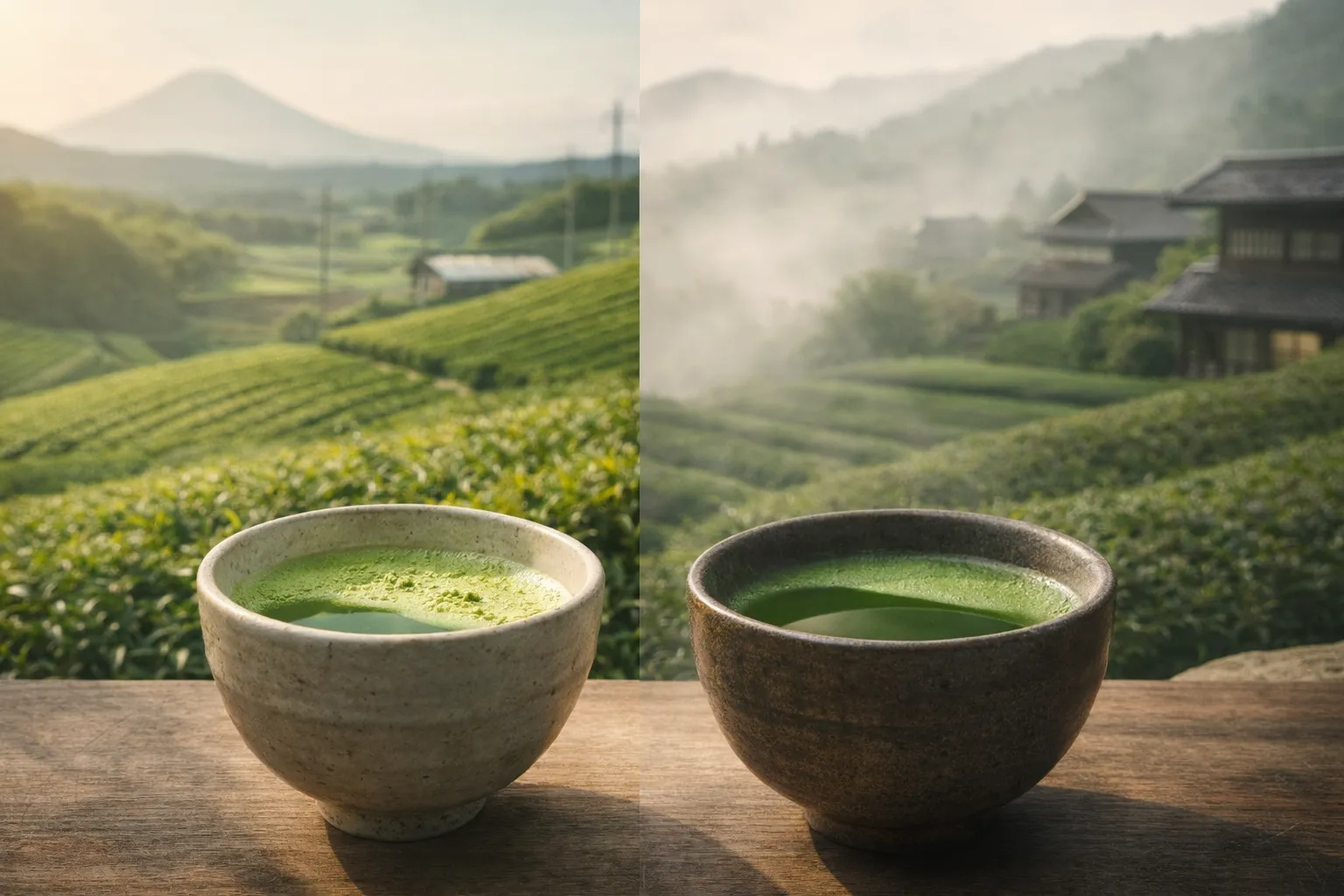
Kagoshima matcha grown with extended shading (3–5 weeks) and mineral-rich volcanic soil from Sakurajima can produce L-theanine levels equal to or higher than premium Uji matcha. Both regions produce excellent ceremonial-grade matcha, but Kagoshima’s unique terroir — active volcanic ash, subtropical climate, and advanced microbiome farming — creates a nutritional profile that is increasingly recognised as superior for focused, calm energy.
If you have ever wondered why one cup of matcha leaves you clear-headed and calm while another leaves you jittery and bitter, the answer almost always comes down to one molecule: L-theanine.
Most matcha discussions begin and end with Uji. It is the name on the packaging of luxury brands worldwide, the region associated with tea ceremony tradition, and the benchmark against which all other matcha is measured. But there is a quiet revolution happening at the southern tip of Japan’s Kyushu Island, where the shadow of an active volcano falls over tea fields unlike any other on earth.
I am Machiko Gozen, 13th-generation Samurai tea master, and my family has cultivated tea in Kagoshima since 1635. What I am about to share is not marketing — it is science, soil chemistry, and four hundred years of observation.
What Is L-theanine and Why Does It Matter?
L-theanine is a naturally occurring amino acid found almost exclusively in the Camellia sinensis plant — the same plant that produces green tea, black tea, and matcha. It is what sets true tea apart from every herbal infusion in the world.
In the brain, L-theanine crosses the blood-brain barrier and promotes alpha wave activity — the same relaxed-but-alert mental state experienced during meditation. In combination with caffeine (also present in matcha), it produces what Japanese Samurai called Zanshin: a state of total, calm awareness. No caffeine crash. No jitters. Just focused presence.
For warriors preparing for battle, this was survival. For modern professionals, it is competitive advantage in every meeting, every creative session, every moment that demands both energy and clarity.
The amount of L-theanine in your matcha depends on three factors: the shading method, the soil quality, and the harvest timing. This is where Kagoshima and Uji diverge in fascinating ways.
“A single cup of Gozen matcha holds more than a beverage — it holds a 400-year practice of cultivating the conditions for human clarity. The volcanic soil is not an accident of geography. It is a gift we tend every season.”
— Machiko Gozen, 13th-Generation Samurai Tea Master
The Science of Shading: How L-theanine Accumulates
Matcha is not simply powdered green tea. It is a precisely cultivated product that begins weeks before harvest, when farmers cover their tea fields with shade cloth to block direct sunlight.
Here is what happens biologically when a tea plant is denied light:
The plant slows photosynthesis. In doing so, it stops converting L-theanine into catechins — the bitter, astringent compounds found in standard green tea. L-theanine accumulates in the leaves instead, building up in concentration with each passing week of shade. At the same time, the plant produces more chlorophyll to capture whatever light it can, giving ceremonial matcha its distinctive deep emerald colour.
The longer and more consistent the shading period, the higher the L-theanine content — and the sweeter, creamier, and more umami-rich the flavour. At Gozen Samurai’s Kagoshima estate, our shading programme runs up to 35% longer than conventional matcha farms, a practice passed down through thirteen generations.
Uji Matcha: The Historic Standard
Uji, located just south of Kyoto, is the birthplace of ceremonial matcha in Japan. Tea cultivation here dates to the 13th century, when Zen monks brought seeds from China and planted them in the region’s fertile river valleys. By the 15th century, Uji matcha was reserved for shoguns and the imperial court.
Uji’s climate — hot summers and cold winters — creates ideal conditions for tea. The dramatic temperature contrast slows leaf development, concentrating flavour compounds. Uji farmers pioneered the shading technique that defines matcha production worldwide, and the region’s prestige is earned through centuries of genuine excellence.
Premium Uji ceremonial matcha from reputable single-estate producers is exceptional: vivid green, deeply umami, with high L-theanine and a complex, lingering finish. It is the benchmark, and deservedly so.
The challenge is that “Uji matcha” has become a marketing phrase as much as a geographic designation. Much of the matcha labelled “Uji” on global markets is blended, processed outside Uji, or produced at a volume that compromises the careful cultivation that once defined the region. When you buy from an unknown Uji-labelled brand, you may not be getting what the name promises.
Kagoshima Matcha: Volcanic Soil, Modern Science
Kagoshima sits at the southern tip of Kyushu Island, in the shadow of Sakurajima — one of Japan’s most active volcanoes. This proximity, which might seem a liability, is in fact an extraordinary agricultural advantage.
Sakurajima regularly deposits fine volcanic ash across the surrounding landscape. This ash is not just inert debris. It is rich in potassium, calcium, magnesium, and trace minerals that dissolve slowly into the soil and feed tea plants at a cellular level. The result is a growing medium with mineral density that most agricultural land — including Uji’s river-valley soil — cannot replicate.
These minerals do two important things for L-theanine content. First, they support robust root systems that absorb nutrients more efficiently. Second, they contribute to the plant’s overall amino acid metabolism — the biological process that produces L-theanine in the first place.
Combined with Kagoshima’s subtropical climate, abundant rainfall, and clean Pacific air, the conditions for tea cultivation are, by many agronomic measures, exceptional. Kagoshima overtook Shizuoka as Japan’s largest tea-producing region by output in 2019 — a milestone that reflects not just scale, but soil quality and consistent growing conditions.
Side-by-Side: Kagoshima vs. Uji
| Factor | Kagoshima (Gozen Estate) | Uji, Kyoto |
|---|---|---|
| Soil type | Volcanic ash from Sakurajima — mineral-rich Unique | River valley alluvial soil — fertile, well-draining |
| Climate | Subtropical — warm, humid, high rainfall | Continental — cold winters boost flavour complexity |
| Shading duration | 3–5 weeks (extended at Gozen) Higher L-theanine | 3–4 weeks (standard) |
| L-theanine profile | Very high — volcanic minerals + extended shade | High — traditional methods, first-harvest focus |
| Flavour profile | Creamy, sweet umami, smooth, low bitterness | Deep umami, grassy brightness, complex finish |
| Farming method | Organic microbiome — advanced soil science Gozen | Traditional — varies widely by producer |
| Heritage | Gozen family cultivating since 1635 (391 years) | Regional tradition since 13th century |
| Global availability | Growing — Gozen ships worldwide from Dubai hub | Widely available but quality varies significantly |
| Price point | Premium with better value ratio | Premium — prestige pricing often applied |
| Certification | Certified organic (Gozen estate) | Varies by producer |
The Microbiome Difference: Why Gozen Kagoshima Is in a Category of Its Own
What separates Gozen Samurai from both standard Kagoshima producers and most Uji estates is not just geography — it is agronomy.
Over the past four decades, the Gozen family has developed and refined a microbiome farming method that enriches the volcanic soil with beneficial microbial communities. These microorganisms break down organic matter, increase bioavailability of minerals, and create a living soil ecosystem that supports healthier, more nutrient-dense tea plants.
The practical result: our leaves accumulate higher concentrations of L-theanine, antioxidants, and chlorophyll than conventionally grown tea on comparable land. No synthetic pesticides. No chemical fertilisers. Just volcanic minerals, microbial intelligence, and thirteen generations of observation.
This is not an abstract claim. You taste it. Gozen matcha has zero bitterness, a naturally sweet umami depth, and a sustained clarity that lasts hours — the direct sensory evidence of high L-theanine working in harmony with natural caffeine.
How to Get the Most L-theanine From Your Matcha
Even the best matcha loses L-theanine through poor preparation. To preserve the amino acid content in every cup:
Use water at 70–80°C (158–176°F), never boiling. High heat degrades L-theanine and creates bitterness. Let boiled water cool for 3–4 minutes before whisking.
Use ceremonial-grade powder, not culinary grade. Culinary matcha comes from later harvests and lower leaves — it has significantly less L-theanine and a harsher flavour. For health benefits and calm energy, ceremonial grade is non-negotiable.
Choose single-origin matcha with transparent sourcing. Blended matcha from unnamed origins cannot guarantee L-theanine levels. Know your producer, know your region.
Store in an airtight tin, away from light and heat. L-theanine and chlorophyll degrade on exposure to light, oxygen, and warmth. A quality matcha tin — as used by Gozen — preserves potency for months.
Frequently Asked Questions
Kagoshima matcha grown with extended shading and microbiome-enriched volcanic soil can match or exceed Uji matcha in L-theanine content. The Gozen estate uses a shading period up to 35% longer than conventional farms, combined with Sakurajima volcanic mineral soil, producing one of the highest L-theanine profiles available in ceremonial matcha.
L-theanine is a naturally occurring amino acid found almost exclusively in tea plants. In matcha, it creates the calm-but-alert mental state known as Zanshin — sustained focus without jitters. It works synergistically with caffeine to smooth energy delivery and support alpha brain wave activity associated with relaxed concentration.
When tea plants are shaded before harvest, photosynthesis slows and L-theanine stops converting into bitter catechins. The amino acid accumulates in the leaves instead. Extended shading — 3 to 5 weeks — produces notably higher L-theanine levels, deeper umami flavour, and the vivid emerald colour characteristic of premium ceremonial matcha.
Kagoshima sits beside Sakurajima, one of Japan’s most active volcanoes. Regular ash deposits enrich the soil with potassium, calcium, magnesium, and trace minerals that conventional farmland cannot replicate. This mineral density supports robust tea plants with higher amino acid production, including elevated L-theanine and antioxidant content.
A single serving of high-quality ceremonial matcha (1–2g of powder whisked in water) typically contains 17–46mg of L-theanine. Because you consume the entire ground leaf — not a steeped infusion — matcha delivers significantly more L-theanine per cup than loose-leaf green tea of any grade.
Both premium Uji and Kagoshima ceremonial matcha deliver excellent focus and calm energy. For the highest L-theanine profile combined with certified organic cultivation and volcanic mineral nutrition, Gozen Kagoshima ceremonial matcha is exceptional. The key is always single-estate, ceremonial grade from a producer with transparent sourcing.
The Verdict: Origin Matters, But Method Matters More
Uji matcha deserves its legendary status. It is the product of 800 years of refinement, exceptional climate, and a cultural commitment to tea that is unmatched anywhere in the world. The best Uji matcha is extraordinary.
But origin alone does not determine L-theanine content. Method does.
Extended shading. Volcanic mineral soil. Microbiome farming. Organic certification. First-harvest, stone-ground powder from a family that has never, in four centuries, stopped improving the land. These are the variables that determine how much L-theanine reaches your cup — and how long it keeps you clear, calm, and focused.
Kagoshima, and specifically the Gozen estate, represents something Uji’s reputation cannot manufacture: a living volcanic terroir that produces matcha with a nutritional depth the ancient Samurai discovered through daily practice and that modern science is only now beginning to fully understand.
When you raise a bowl of Gozen matcha, you are not drinking geography. You are drinking four hundred years of soil science, passed hand to hand through thirteen generations of women who understood that the ground beneath your feet is the foundation of every thought you will think today.
Experience Gozen Kagoshima Ceremonial Matcha
Grown on volcanic soil since 1635. Certified organic. Extended shade. Stone-ground to order.
Ships worldwide from our Dubai logistics hub.
Last updated: 15 April 2026. This article reflects current agronomic research on L-theanine accumulation in Japanese ceremonial matcha and the Gozen family’s 400-year cultivation practices in Kagoshima, Japan.




[…] also affects the plant’s amino acid content, most notably L-theanine, a naturally occurring amino acid concentrated in tea. Because reduced light slows certain […]
[…] athletes value L-theanine’s muscle relaxation benefits for form optimization alongside caffeine’s neural […]
[…] L-theanine and tea polyphenols than coffee, so the subjective experience can be different. Matcha’s L-theanine content is one reason it is often associated with a different caffeine experience than […]